
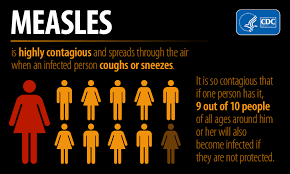
Arizona county health departments are now managing 5 different measles exposure investigations, with a dozen confirmed cases across 4 counties in the last 3 weeks including two new cases identified by Maricopa County on Friday.
Measles outbreaks used to be one-off events usually from international travel. But because of the accelerating anti-vax movement outbreak investigations have become the new normal for public health.
As of last Friday, Mohave County had reported eight cases, all connected to the Colorado City epidemic. Pinal County has two cases. Maricopa has 3 cases & Pima County one. County health staff have found exposures in public settings, triggering several time-sensitive containment efforts.
Behind the scenes, county public health teams are carrying out a host interventions to limit further spread of measles.
What county health departments are doing
When a measles case is confirmed, county health departments immediately shift into outbreak-control mode. Core response activities include:
- Case investigation and verification, including symptom timelines, vaccination status, and infectious periods
- Contact tracing, often involving dozens of potentially exposed individuals
- Exposure notifications for people who may have been exposed in public places, health-care settings, schools, or childcare facilities
- Assessment of immunity status among identified contacts to figure out who is protected and who is susceptible
- Post-exposure prophylaxis, including MMR vaccination or immune globulin when appropriate and timely
- Isolation of confirmed cases to prevent further transmission
- Quarantine or activity restrictions for exposed, susceptible individuals during the incubation period
- Coordination with health-care providers, schools, childcare centers, and neighboring jurisdictions (more on this later).
Schools and childcare: exclusion as a mitigation tool
When measles exposures involve schools or childcare settings, county health departments have more tools at their disposal.
Under Arizona’s communicable disease rules administered by ADHS (see the Communicable Disease Rules on Page 38), each of Arizona’s 15 county health officers has clear legal authority to:
- Isolate confirmed cases
- Quarantine exposed individuals
- Exclude unvaccinated students or children from in-person attendance when necessary to control disease spread
Exclusion of unvaccinated and potentially exposed students from in person school can last more than a month because measles has a long incubation period and public health practice requires exclusion for two full incubation periods to ensure transmission has ended.
If a measles case occurs in a school or daycare, county staff will typically:
- Review immunization records of classmates and peers
- Find students who are unvaccinated or otherwise susceptible
- Decide which students must be temporarily excluded from in-person instruction
- Work with schools and families to clarify timelines, requirements for return, and options for remote learning where available
The New Normal
For the last few decades Arizona has only had sporadic measles cases, largely because vaccination coverage was high enough to prevent transmission. That protection is eroding and in some parts of the state gone.
The anti-vaccine movement is strong and increasingly organized, and public health departments will continue to be operating in an environment where measles outbreaks are routine.
County health departments will continue to respond professionally and aggressively to measles cases. But as vaccination rates continue to fall, these labor-intensive interventions (contact tracing, quarantine, and school exclusion) will become more common.