View the Webinar
AI Webinar Summary
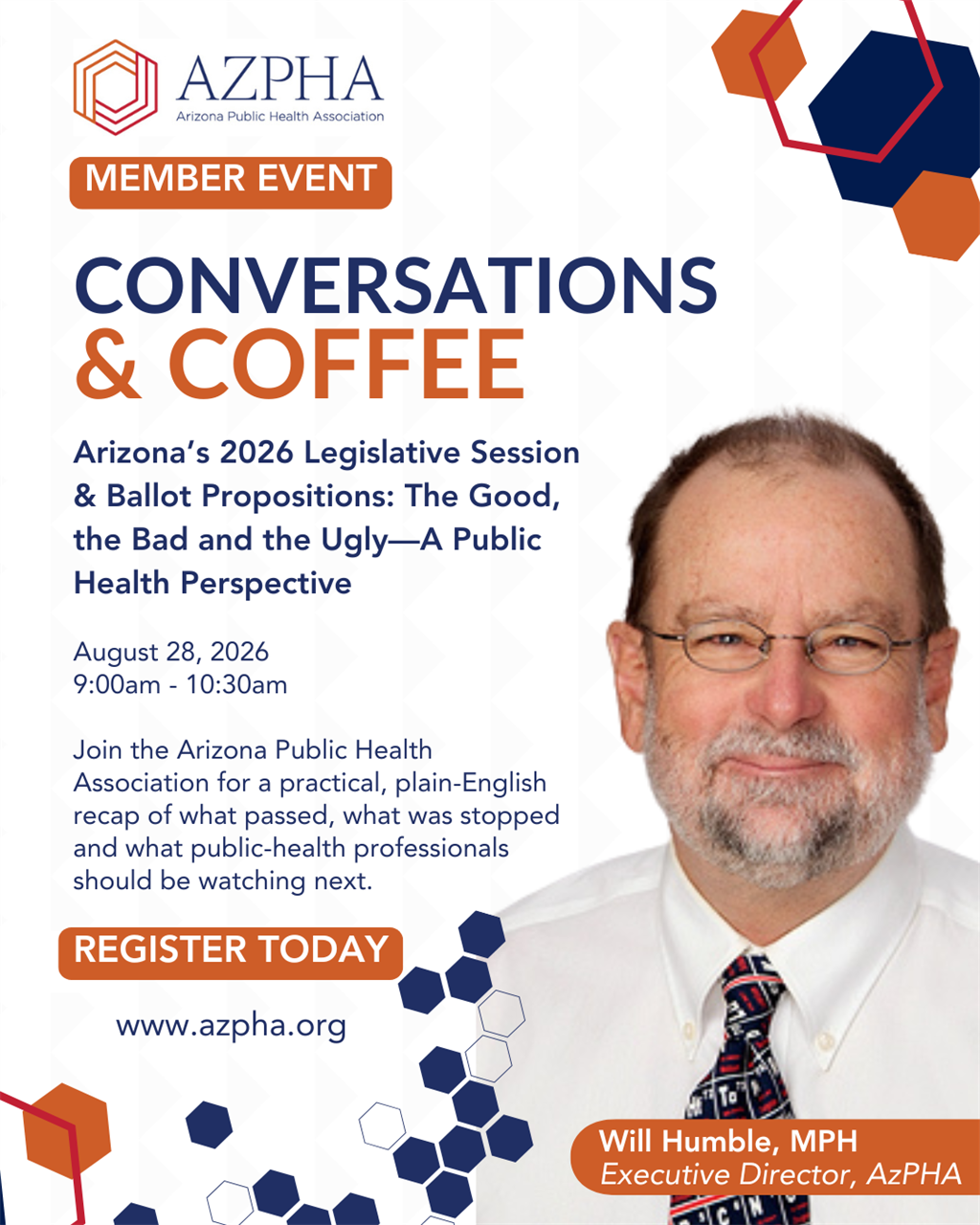
Will led a comprehensive review of the 2026 legislative session from a public health perspective, covering both passed bills and vetoed measures that would have harmed public health.
The session included several significant public health wins, including improved licensing and oversight of skilled nursing and assisted living facilities through bills 2176, 1162, and 2195, as well as new requirements for county jails to screen for mental health needs at intake through bill 2673.
The governor successfully vetoed numerous bills that would have negatively impacted public health, including measures that would have prohibited vaccine incentives for providers, restricted business vaccine requirements, and required hospitals to ask about immigration status.
The budget included important funding wins of $21 million for eligibility staffing at Access and DES to prepare for HR1 implementation, along with $13 million to modernize the Healthy Arizona Plus computer system.
Will also reviewed upcoming ballot propositions, noting that only nine measures would appear on the ballot after several were removed by courts, and discussed AZPHA’s positions against Propositions 144 (securing elections) and 319 (banning photo enforcement cameras).
2026 Legislative Session Public Health
Will presented a summary of the 2026 legislative session from a public health perspective, highlighting both positive developments and areas of concern. Key public health wins included new licensing structures for skilled nursing and assisted living facilities, improved notice requirements and informal dispute resolution processes, better collaboration between AHCCCS and ADHS, and enhanced access to personnel records. Will also discussed a compromise bill allowing cameras in assisted living facilities with resident and family consent, noting that while watered down from previous versions, it represented progress in addressing family concerns about facility oversight.
Long-Term Care Monitoring Requirements
Will explained that a new bill requiring long-term care facilities to disclose whether they allow video monitoring in residents’ rooms will take effect in a few weeks, though he noted this is only a partial step forward and AARP has been pushing for more comprehensive monitoring requirements for years.
The discussion then shifted to a new bill (2673) requiring county jails to screen for mental health needs at intake, though Will expressed concern about the weak enforcement provisions in the bill. The conversation ended with Will mentioning that Maricopa County jail has experienced deaths from drug overdoses and suicide, though the specific numbers were not provided.
Mental Health Court Bills Discussion
Will discussed two bills related to mental health court-ordered treatment and judicial review, explaining that House Bill 2923 aims to streamline the process for families seeking court-ordered treatment while balancing treatment needs with civil liberties. Will noted that current processes are cumbersome and may require additional legal action to address compliance issues in Maricopa County.
Sharon Barnes from Arizona Mad Bombs clarified that Senate Bill 1113 allows for process serving of individuals in hospitals and facilities without involving police, which helps avoid trauma from law enforcement interactions and reduces costs.
Police Presence and Housing Reforms
Sharon and Will discussed the challenges of police presence in facilities serving populations with trauma from past law enforcement interactions. Will agreed to update a slide with more depth on this topic based on Sharon’s input.
Will also explained a small victory in public health housing, highlighting changes to Arizona’s Residential Landlord and Tenant Act that make it easier for tenants to document payment of eviction judgments and potentially seal records, though he noted this is just a step toward needed reforms to balance landlord-tenant rights.
Legislative Updates and Veto Status
Will presented updates on recently passed and vetoed bills, including a new requirement for state agency chief medical officers to maintain active MD or DO licenses, and a victory for breast cancer screening cost-sharing prohibition in commercial health plans.
He emphasized the importance of stakeholders providing feedback to the governor’s office regarding why certain bills should be vetoed, as this helps justify the vetoes of problematic legislation. Will also highlighted that the governor successfully vetoed a bill that would have prohibited health plans from offering financial incentives to providers for high vaccine participation rates.
Budget and Vetoed Bills Update
Will discussed several vetoed bills, including one that would have stopped businesses from requiring masks or vaccinations, which the governor vetoed. He highlighted key budget wins, including $21 million allocated for eligibility staffing at Access and DES to handle new Medicaid requirements from HR1, and $13 million for modernizing the Healthy Arizona Plus computer system.
Will also reviewed upcoming ballot propositions, noting that only nine measures would appear on the ballot after some were removed by courts, and explained that AZPHA opposed Prop 144 (which would restrict mail-in voting) and Prop 319 (which would ban photo enforcement cameras).