
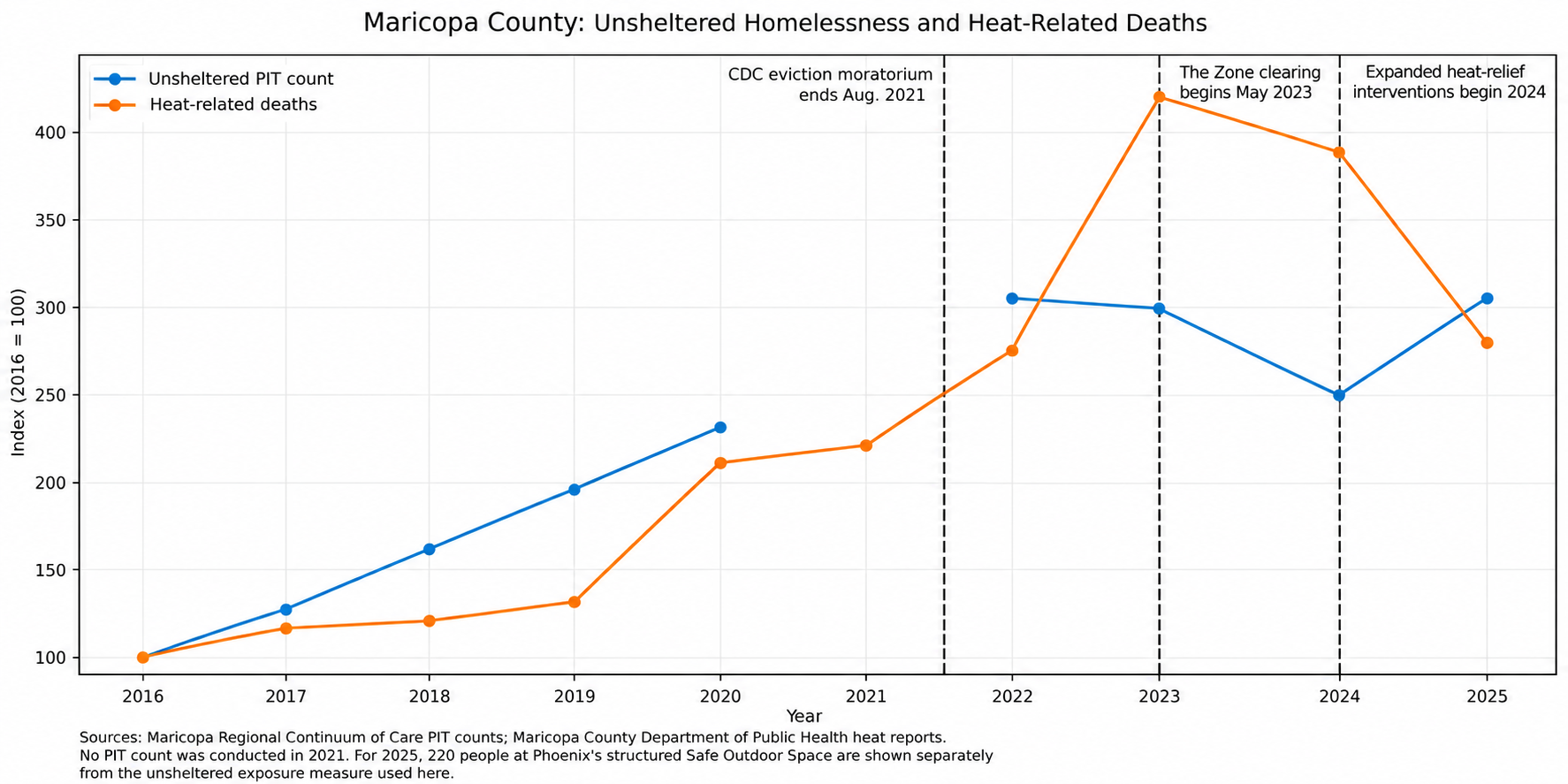
I’ve been noodling on a public health hypothesis about the huge increase in heat-related deaths we’ve seen in Maricopa County over the last decade.
I want to emphasize the rest of this post is my untested hypothesis.
In 2016, Maricopa County’s annual Point-in-Time (PIT) homeless count found 1,646 people living unsheltered. By 2025, that number was about 4,987, after separating out the 220 people staying at Phoenix’s structured Safe Outdoor Space. MAG cautions that the PIT count is a one-night snapshot rather than a count of everyone who experiences homelessness over an entire year.
During that same time period, Maricopa County heat-related deaths went from 154 in 2016 to 430 in 2025, after reaching a staggering 645 deaths in 2023.
That relationship makes public health sense. People living outside during a Maricopa County summer are at extraordinarily high risk from heat. In fact, Maricopa County Public Health data suggests the unhoused have a 500 times higher risk of dying from heat, which equals a 49,900% increase in risk.
How often in public health have you seen a differential that high? Ever?
My basic hypothesis is that our increasingly hot summers aren’t the main reason why we’ve had a cascade in heat deaths. It’s from the increase in homelessness.
The first place to look is simply the growth in homelessness itself. During the pandemic, federal and state protections temporarily interrupted many evictions. But the federal CDC eviction moratorium ended abruptly in August 2021 after the U.S. Supreme Court struck it down.
After that, eviction filings in Maricopa County began climbing steadily. By August 2022 they had already surpassed pre-pandemic levels; there were more than 83,000 filings in 2023 and roughly 87,000 in 2024… the highest number ever recorded in the county.
An eviction filing doesn’t necessarily mean somebody becomes homeless, and rising rents, the shortage of affordable housing and other factors were also at work.
But it isn’t hard to see the potential pathway: more households losing (or being priced out of) their housing means more people at risk of ending up unsheltered.
And that’s exactly what the Point-in-Time counts show over the longer term: a dramatic increase in the number of people living outside in Maricopa County. Put that growing population into our increasingly dangerous summer heat and you have the starting point for my hypothesis.
The large increase in unsheltered homelessness probably helped create the underlying conditions for Maricopa County’s explosion in heat deaths. Put thousands more people outside during an Arizona summer—and especially a population already at 500x risk of death – and deaths are going to increase.
But the number of people experiencing homelessness is only part of the equation.
Where people are living, whether outreach workers can find them, whether water and cooling are nearby, whether cooling centers are open at night, and whether medical teams can reach people before heat illness becomes fatal may be enormously important too.
Dispersing a large encampment beginning in 2024 may have made vulnerable people harder to reach. But Phoenix, Maricopa County, Keys to Change, Circle the City and other partners meanwhile built a much stronger heat-relief infrastructure designed to find people where they are.
One next step would be to look at heat deaths among people experiencing homelessness by ZIP code or census tract before and after The Zone was cleared. Did deaths become more geographically dispersed? Were fatal heat injuries occurring farther from cooling centers and homeless-service infrastructure?
That would tell us a lot more than the countywide totals alone (but I couldn’t find that data).
Of course, the public health approach is to look at the root causes and go upstream to find interventions. Like basically reducing homelessness itself. There isn’t one intervention that will do that. There are several policy approaches Arizona could consider.
Permanent Supported Housing for Persons with a Mental Illness
AHCCCS’ 2024 Serious Mental Illness Report revealed that 7,812 SMI members experienced homelessness that year or about 12% of the SMI population.
AHCCCS data also found that half of the SMI population on the housing waitlist had been waiting for stable housing for more than 6 months. That’s a long time for people who need housing stability to manage their health and daily lives.
Permanent Supported Housing – as was agreed to in the Arnold v Sarn settlement agreement is the intervention here.
Permanent Supportive Housing was one of the four major community services specifically included in the Arnold v. Sarn settlement involving the State and Maricopa County.
Yet, the capacity is woefully insufficient.
Arizona’s Landlord Skewed Landlord and Tenant Act
Another approach is stopping avoidable homelessness before it begins. Arizona law currently allows a landlord to begin the eviction process for nonpayment after a tenant does not pay within five days after receiving written notice.
Arizona should examine changes to the Residential Landlord and Tenant Act that offer more opportunity to cure a temporary financial problem and resolve disputes before somebody loses their home.
Pre-eviction mediation is another tool worth examining. Colorado, for example, requires mediation before an eviction can proceed in certain cases involving tenants receiving SSI, SSDI or Colorado Works cash assistance.
Arizona could consider whether a broader mediation model would resolve more disputes before they turn into eviction judgments and homelessness.
Maricopa County itself has started moving in that direction upstream. Its new Eviction Prevention Pilot provides short-term rental assistance in several high-eviction Phoenix ZIP codes specifically to resolve financial problems before an eviction case reaches court. That’s exactly the kind of intervention that can be evaluated and, if successful, expanded.
Summertime Eviction Moratoriums
Finally, Arizona should examine a seasonal eviction moratorium during the most dangerous part of the summer—perhaps June through September.
That’s a significant policy choice with consequences for both tenants and property owners, so it deserves careful design and debate. But from a public health standpoint, forcing somebody from an air-conditioned apartment into homelessness when afternoon temperatures are routinely well above 110°F creates a very different health risk than an eviction during a milder time of year.
Summary
Cooling centers, bottled water, street medicine and outreach teams save lives—and the recent Maricopa County numbers suggest those investments may be making a difference.
But the most effective heat intervention for a person experiencing homelessness is something even simpler: Housing.