
Addressing Firearm Violence in Arizona: A Public Health Perspective

Guest blog from AZPHA Member RJ Shannon

RJ Shannon of Phoenix, Arizona is this ...

In the last few days including Thursday, November 28th there have been a rash of shootings all over the valley including smaller Arizona towns. We can no longer ignore the effects of this form of violence and the impact on our shared communities.

Since the Republican legislature and Governor Brewer passed and signed legislation that banned law enforcement agencies across the state from destroying firearms in 2013, according to the Johns Hopkins Bloomberg School of Public Health, there has been a 43% increase in firearm injuries and deaths in Arizona.

Every law enforcement agency must resell confiscated firearms back into our communities through a licensed broker, but after that, the trail may end, creating a proliferation of guns that are easily attainable.

The owner does not have to register these firearms nor face liability should an incident take place. Law enforcement agencies across Maricopa County and all other Arizona counties are seeing more risk to their officers along with the dire consequences of firearm threats and in many cases officer involved shootings.

Sadly, many of these shootings happen because of perceived threats when the threat is not visible but assumed. Too many times, the communities most affected by these misconceptions and biases are communities of color – Black, Brown, and Indigenous; folks experiencing mental health episodes and others unlucky enough to be in the wrong place at the wrong time – leaving injuries and deaths in their wake.

Lawsuits do not bring back the dead and may even help with the enormous treatment bills awaiting those who survive, but in the end, we all pay the price.

In a state like ours, it is impossible to know who is legally carrying concealed and who is not, and for the sake of the potential victim or survivor we should always know. To be clear, Arizona is NOT plagued by the irresponsible behaviors of responsible gun owners, but by those newer owners for whom there is no record of ownership or safety training.

Firearm regulation is necessary just as the authors of the US Constitution stated. ALL owners should register through a state-wide/Federal databank; ALL gun owners should purchase insurance and a license to carry concealed firearms.

ALL firearm owners should undergo safety training that offers secured storage recommendations with devices either donated or sold so that the incidents of unintentional/intentional and suicide injuries and deaths are more easily preventable. And ALL gun owners should face the same penalties for neglect leading to intentional or non-intentional injuries or deaths to others.

City councils, County Supervisors, school boards and State leadership along with concerned residents and stakeholders should determine zoning designations for locations where firearms are sold, so that they are not purchased from commercial or individual sellers anywhere close to schools, homes, and other sites where vulnerable persons may be present.

Arizona spent an outstanding sum of taxpayers’ dollars and employee hours determining the safest places to sell medical marijuana to protect the health and welfare of Arizona’s families. We must use the same reasoning regarding how, when and where firearms are sold and used. Arizona’s communities pay too high a price for our firearm associated injuries and deaths to ignore how firearms filter into our communities.

Finally, we invite businesses that rely on the sale and usage of firearms and gun owners to be partners in the prevention of unintentional injuries and increased suicides by guns that we experience among Arizona’s oldest and youngest community members.

It was not that long ago when Arizona law stipulated that any gun owner desiring to carry concealed had to take a safety class offered by the State with minimal payment by the owner. Sadly, the Arizona State Legislature overturned a terrific mandate. Together we must meet collaboratively to find the best way for your businesses to aid in saving lives while offering your expertise and sage advice to new firearm owners on how to use their firearms safely.

I am not naïve and recognize that these relationships between more experienced and less experienced owners have historically forged mentoring relationships, but not in a systemic and state funded way.

If the state wants to continue identifying as a 2nd amendment entity, there is nothing that precludes them from passing gun sense laws supporting the safety of all gun owners, their families, and communities – thereby indirectly adding protections that significantly protects all our lives.

Firearm injuries and deaths are not only a law enforcement issue, but more so, a major public health priority. Firearm injuries are the 2nd leading cause of death for Arizona’s children and teens. Firearm deaths are the number one cause of death for children and teens nationwide and there is no reason to believe that it will not soon be the case for Arizona’s children if things do not change.

According to the Johns Hopkins School of Public Health and the CDC, in 2022, Arizona had the 12th highest gun death rate in the US. In 2021, suspects used firearms in 128 domestic violence homicides. On Thanksgiving night this year (Thanksgiving Day, 2024) a man shot and killed his son in Phoenix during a domestic dispute. Arizona, haven’t you had enough, yet?

These injuries and deaths are almost 100% preventable when owners secure their firearms, ownership is identified & registered, the purchaser is mandated to take safety training, insurance is imposed (you know, like we do with cars???) along with strict age restrictions and provisions for requiring individual and family safety assessments.

When children and others find unsecured weapons and either harm themselves or others as a result, the owners must be held accountable. The responsibility lies with the owner and not the person who finds an unsecured firearm in the home or vehicle.

The Arizona Child Fatality Review Program recently cited that the leading risk factors of Firearm Injury deaths for children and teens are the following: Access to firearms = 100%; Firearm not stored properly = 66%; CPS History with Family = 63%, Substance use = 53%. Criminal Act = 27%, which when identified and assessed for gun ownership and safety measures, were considered almost 100% firearm injury preventable.

According to Channel 12 news, Maricopa County school campuses found more than 100 guns and received numerous threats since 2019. It turns out that it is not a statistic that Arizona tracks and for which the State of Arizona’s Department of Education takes no responsibility believing that it is the community’s responsibilities to pursue these issues.

Parents, if they won’t do something, then we must! If Arizona adopted all or some of the recommendations, responsible gun ownership would increase to support those firearm- owning Arizonans who are already responsible to themselves, their families, and their communities.

These recommendations are only the first steps, but Arizona needs to begin again somewhere. It is past the time to look at who we are but now deciding who we want to be. For some reason, we have determined that it is all right to declare war on ourselves. How about we lead the way towards community peace and reconciliation through a public health and safety lens that supports all of us, our families, and our communities? Just sayin’…

RJ Shannon has advocated for non-violence strategies and firearm safety for 30+ years. You can join her & Moms Demand Action by texting 644-33.

Suicides and Firearms in Arizona:

Call for Presentations: Shape the Future of Public Health at AzPHA’s 2025 Conference

Are you ready to help redefine public health for the future? The Arizona Public Health Association invites you to submit your ideas for presentations at our upcoming annual conference:

Modernizing Public Health Practice:
Building an Innovative & Inclusive Infrastructure for the Public Health of the Future

This exciting event will take place on April 3, 2025, with a call for presentations through February 2, 2025. We’re seeking innovative thinkers, practitioners, and researchers to share insights and strategies that can drive transformative change in public health in the areas of: 1) data, informatics and artificial intelligence; 2) public health workforce; and 3) engaging young professionals.

What We’re Looking for:

The 2025 conference focuses on modernizing public health infrastructure to meet emerging challenges and opportunities. We encourage submissions that explore topics in the following tracks:

  • Using AI to enhance public health practice and patient population outcomes
  • Data infrastructure and informatics
  • Public health workforce
  • Engaging public health professionals
Submit Your Proposal: AzPHA Annual Conference April 3, 2025- Call for Abstracts | Cognito Forms

One of the conference’s key tracks will explore the role of artificial intelligence in public health. As highlighted in Health Affairs, AI is revolutionizing public health by enabling advanced disease surveillance, predictive modeling, and efficient resource allocation. For instance, AI tools are being used to detect outbreaks earlier, allowing for faster interventions.

But the promise of AI comes with challenges. Presentations on this topic could examine issues like algorithmic bias, ethical considerations, data privacy, and the need for equitable implementation. How can public health professionals harness AI’s potential while maintaining public trust? We want to hear your ideas!

Why Submit?

Presenting at AzPHA’s annual conference is a unique opportunity to:

  • Showcase your expertise and innovations to a diverse audience of public health enthusiasts
  • Spark meaningful conversations that shape the future of public health practice
  • Connect with peers, leaders and organizations working toward shared goals

Whether you’re conducting groundbreaking research, implementing impactful programs, or developing innovative tools, your work could inspire and guide others.

How & When to Submit

Our submission deadline is February 2, 2025. If you have any questions, please contact Will Humble (willhumble@azpha.org) or Lauriane Bellot Hanson (laurianehanson@gmail.com). View additional conference details and submit your abstract by February 2, 2025, here: AzPHA Annual Conference April 3, 2025- Call for Abstracts

Let’s collaborate to build a public health infrastructure that’s innovative, inclusive, and ready for the future.

Your voice matters—join us in shaping the conversation!

Submit Your Proposal: 
AzPHA Annual Conference April 3, 2025- Call for Abstracts


Learn How the Arizona State Legislature Works with this Engaging Podcast

The Arizona State Legislature will meet on Monday, January 8, 2024. Many legislators will hit the ground running with bills that they already have in the hopper. See the bills that have been pre-filed so far

That means we need to be ready to fight for good bills, fight against bad bills, and be prepared to advocate for adjustments for bills somewhere in the middle right out of the box.

You can prepare your advocacy chops before the legislative session starts by listening to the Arizona Common Ground podcast, an eight-episode educational podcast series that gives a behind the scenes glimpse of the state legislative system and learn how bills can become laws. The Consumable Podcast Series is Available as:

Krista Romero-Cardenas, MPH, a former senior instructional specialist for the Western Region Public Health Training Center and alumna of the Mel and Enid Zuckerman College of Public Health is the creator and host of the Arizona Common Ground podcast – an eight-episode educational podcast series that will take you through the process of how bills are passed in Arizona.

This is a must-listen to podcast for anybody interested in learning how the Arizona State Legislature makes the sausage!

ARIZONA COMMON GROUND
By AzPHA Member Krista R. Cardenas, MPH 
The podcast series is available as ARIZONA COMMON GROUND on Apple Podcasts
ARIZONA COMMON GROUND | Podcast on Spotify

Arizona Legislative Session Begins Monday, January 13: Here’s Our Advocacy Approach

January 13 marks the beginning of the 2025 legislative session. The kickoff will be the Governor’s address to the legislature where she’ll outline what she sees as priorities.

AzPHA will follow the session closely and express our support or opposition to bills based on a simple core principle…  we support bills that will have a positive impact on public health especially when they are evidence-based or evidence-informed.  We will oppose bills that are likely to have a negative impact on public health. 

Our support or opposition to bills is located on the https://www.azleg.gov/ site under RTS Current Bill Positions. We have a host of Resolutions that also guide our advocacy which are posted on our website.

The fact that we have Resolutions on so many core public health priorities make it easy for us to be swift with our support or opposition. Our Resolutions go all the way back to the 1930s. They are initiated by either the Board or our members and all resolutions have been voted on and approved by our members.

Our Public Health Policy Committee has a discussion board on Basecamp and that’s also where we post information, research and documents related to public health policy.  Let me know if you’d like to sign up for that Basecamp site at willhumble@azpha.org.

Our policy committee also has conference calls Fridays at 2pm starting January 17. Details are in our policy committee basecamp (email me at willhumble@azpha.org to get access to the members policy committee Basecamp).

Transforming Public Health Practice With Generative Artificial Intelligence

Transforming Public Health Practice With Generative Artificial Intelligence | Health Affairs

Abstract: Public health practice appears poised to undergo a transformative shift as a result of the latest advancements in artificial intelligence (AI). These changes will usher in a new era of public health, charged with responding to deficiencies found during the COVID-19 pandemic and managing investments required to meet the health needs of the twenty-first century.

In this Commentary, we explore how AI is being used in public health, and we describe the advanced capabilities of generative AI models capable of producing synthetic content such as images, videos, audio, text, and other digital content.

Viewing the use of AI from the perspective of health departments in the United States, we examine how this new technology can support core public health functions with a focus on near-term opportunities to improve communication, optimize organizational performance, and generate novel insights to drive decision making.

Finally, we review the challenges and risks associated with these technologies, offering suggestions for health officials to harness the new tools to carry out public health goals.

Three Applications for Generative AI Models in Public Health

Public Communication

Organizational Performance

Novel Insights

Public health has the potential to rapidly evolve with the advent of new technologies. But ultimately, AI, including generative AI, is just a tool, similar to a vaccine or genomic surveillance.

Public health practitioners will need to master the new tools and learn to use them as part of a larger public health strategy. This discussion reviews the use of AI and presented three early use cases for generative AI related to communications, organizational performance, and generating novel insights that align with three of the eight core capabilities defined in the Foundational Public Health Services framework.

Transforming Public Health Practice With Generative Artificial Intelligence | Health Affairs

H5N1 Influenza in Valley Wastewater: Does it Matter?

Yesterday brought an unexpected detection of H5N1 ‘avian’ influenza RNA in wastewater from three cities in Maricopa County—Phoenix, Tempe, and Surprise. H5N1 mostly affects wild birds, domestic poultry, and a handful of mammal species (including mild infections among human agricultural workers. But, with no human-to-human transmission and urban Maricopa County not being super agricultural, its presence in wastewater raises intriguing questions about the source. Let’s explore why and the implications.

What is H5N1?

H5N1 (aka avian influenza) is a strain of avian influenza virus that has caused severe outbreaks among wild birds and domestic fowl. Infections in mammals have been rare and mostly mild. Some agricultural workers with close contact with infected birds or cattle have been infected, but with mild symptoms and with no documented human-to-human transmission.

The Wastewater Detections

The ADHS State Laboratory confirmed the presence of H5 RNA in wastewater samples collected from Phoenix, Tempe, and Surprise. The finding was surprising because these cities are not known for large-scale poultry farming (where such a virus might be expected in domestic wastewater).

Also, all three cities say that their stormwater systems (which collect rainwater and runoff) are completely separate from their wastewater systems (which handle sewage). This separation means that the virus’s presence can’t be attributed to wild birds contaminating street drains and then getting into domestic wastewater.

Where’s it Coming From?

So, where is the H5 RNA coming from? After consulting with public health experts, the most plausible explanation points to backyard chicken flocks. Backyard poultry keeping has grown in popularity, and infected chickens could easily introduce the virus into wastewater through improper disposal of chicken tissue via household sinks.

Note: ARS 11-820.04 prohibits counties from adopting laws or regulations prohibiting residents from keeping up to six fowl in their backyards.

While it’s theoretically possible the source of the detections of H5 in wastewater are human infections, it seems like a longshot since no human-to-human transmission of H5N1 has been documented.

What’s Next?

As part of normal annual influenza surveillance, randomly selected specimens from human influenza infections (which is increasing quickly right now) are routinely sequenced – and if some of them are H5 (rather than the ubiquitous H1N1 and H3N2 strains) we should know shortly.

Note: The ADHS State Lab (which confirmed these detections) is finishing its validation protocol for the H5N1 wastewater validation test, with certification by the CDC expected soon. ADHS’ H5N1 assay for human infections IS validated.

Should We Be Concerned?

For now, there’s no need for alarm. Human cases of H5N1 remain rare, mild and there’s is no evidence of human-to-human transmission. However, these detections underscore the importance of vigilance, proper biosecurity measures for backyard flocks, and ongoing surveillance of both human and animal health.

We’ll continue to be on top of local and national developments – but for now there’s nothing to freak about.

Association v. Causation: A Key Distinction when Developing Public Health Policy

One of the key aims of public health is to assess the cause of disease or bad outcomes so we can design interventions.  In order to do that, we need to be able to tell the difference between when something is actually “causing” an outcome and when the exposure or condition is simply “associated” or “correlated” with an outcome. 

Whether something causes or is simply associated with a bad outcome is a key factor when we design interventions.  The following examples may shed some light on the relationship between risk factors, outcomes, and the difference between association and causation.

A study in the American Journal of Pathology “…persons with tattoos appear to die earlier than those without”.   The study found that people in the study group with a tattoo died 14 years earlier than people without a tattoo (p = .0001).

This study doesn’t conclude that having a tattoo actually causes people to die earlier.  Rather, it suggests that having a tattoo may be associated or correlated with other independent factors that might lead to an earlier death (e.g. people with tattoos may be more likely to have risk-taking behaviors).

In order to conclude that an exposure or condition actually causes an outcome, researchers randomly divide study participants into groups by assigning them to the exposure or condition they’re studying (experimental group) while making sure that another group doesn’t have the exposure or condition (control group). 

If the expected outcome is observed within an experimental group and not in the control group, it’s likely that exposure actually caused the outcome.

For example, if researchers were to expose one randomly-selected group of people to poison ivy via direct contact with poison ivy leaves – while not exposing the control group to poison ivy – they would most likely be able to establish that poison ivy actually caused the rash.  It’s this random assignment to conditions that make experiments sophisticated enough to detect actual causation.

Judging the causal significance of an association or causation is both a science and an art.  The gold standard for determining what is an association and what is actual causation is described in a 1964 Surgeon General’s Report on this topic.

Some of the research you read about shows a correlation or association between variables, not causation.  When you’re reading scientific studies, make sure you look for whether the study is talking about an “association or correlation” or whether they are talking about causation.

Editorial Note: Mr. Robert F Kennedy Jr appears to need an in-depth tutelage on the difference between anecdotes and stories and the difference between association & causation. Time and again Mr. Kennedy bases his opinions on spurious reports, anecdotal stories and some articles that draw conclusions about the association between various stimuli and outcomes rather than focusing on causation.

That mind-set is relatively benign when it’s held by a private sector lawyer with a famous name – but it’s potentially dangerous when the person is in charge of nearly 30% of the U.S. federal budget, health care for the majority of the country and comprehensive regulatory authority of drugs, food and medical devices, and the US publicly funded research mission.

RFK Jr. as HHS Secretary: His Shift Away from Evidence Puts Public Health in Peril – AZ Public Health Association

RFK Jr. as HHS Secretary? Why It Could Mean the End of Evidence-Based Public Health Policy – AZ Public Health Association

The Real Danger of State Agency Sunset Reviews: Ineffectiveness During Unified Government

Arizona’s sunset review process is designed to hold state agencies accountable, ensuring they fulfill their missions effectively and efficiently.

However, the current debate over whether these reviews are being ‘weaponized’ in our divided government misses a critical point: the real risk isn’t that sunset reviews are too harsh under divided government, but that they’ve been toothless and ineffective during unified government.

During periods of divided government, as we have now, the legislature tends to actively scrutinize agency performance. Auditor General reports are taken seriously, and legislative committees hold agencies accountable for their shortcomings.

This fosters oversight and ensures state agencies run transparently and efficiently. But, when the same party controls both the executive and legislative branches (as we saw during the Ducey administration) the sunset review process becomes a formality, with little to no meaningful oversight.

The Arizona Auditor General’s Office (an arm of the state legislature) plays a vital role in finding agency deficiencies. Their reports are comprehensive and independent. For example, Auditor General reviews revealed systemic failures in the Arizona Department of Health Services’ nursing home complaint investigations during the Ducey era.

Their 2019 report highlighted unacceptable delays in investigating complaints, putting vulnerable residents at risk. The follow-up review found that the agency had reclassified 98% of high-risk complaints as low risk to give the appearance they had making process and performance corrections.

Despite the severity of these findings, the legislative review process during the Ducey administration largely ignored these issues (although a hearing was held), allowing the problems to persist unchecked (until the next administration took office).

Auditor General’s Office Produces Scathing Review of ADHS’ Nursing Home Complaint Investigations During the Ducey Administration

This lack of accountability during unified government is a systemic issue. The legislative review committees, dominated by the governor’s party, often dismiss Auditor General findings as unimportant or inconvenient. Instead of using these reports to drive meaningful reform, they rubber-stamp agency operations, creating a dangerous lack of oversight.

In contrast, divided government forces a more rigorous review process. Legislators from the opposing party are motivated to scrutinize the executive branch’s performance, often shining a spotlight on agency performance.

For example, recent debates over agencies set to expire in 2025, as reported by the Arizona Capitol Times, show how divided government can lead to shorter leashes for underperforming agencies.

Agencies set to expire in 2025 will likely get ‘shorter leashes’ | Arizona Capitol Times

To strengthen the sunset review process and ensure it works effectively regardless of the political landscape, Arizona needs structural reforms like mandatory legislative hearings on Auditor General findings (regardless of the political composition of the government) independent oversight boards to review agency performance, and increased funding for the Auditor General’s Office.

The real danger of Arizona’s sunset review process isn’t that it’s too harsh under divided government—it’s that it becomes a rubber stamp under unified government.

Without robust oversight, agencies can fail the very people they’re supposed to serve. Ensuring meaningful accountability should be a bipartisan priority, safeguarding the public interest no matter who holds power.

Leading Causes of Death in AZ in 2024 – Heat Deaths up 350% in Last 5 Years; COVID Continues its Drop in 2024

As you recall, our resident AZPHA epidemiologist Allan Williams PhD did a deep dive into the leading causes of death in Arizona during the pandemic and discovered we were the only state where COVID-19 was the leading cause of death during the first couple years of the pandemic.

AzPHA Data Brief: Arizona is the ONLY State in the U.S. In Which COVID-19 Is the Leading Cause of Death During the Pandemic

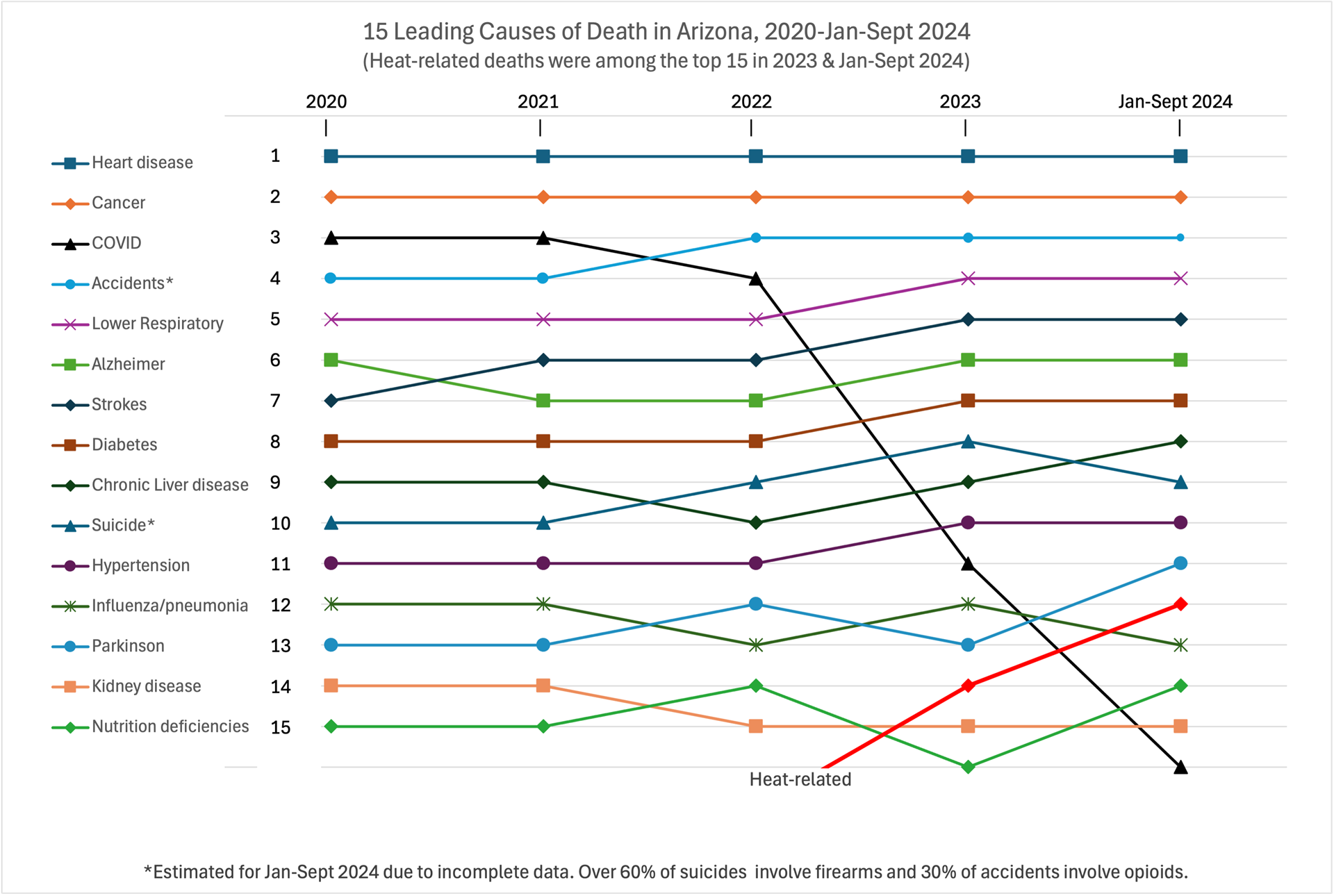
We asked Allan to run the cause-of-death numbers again for 2024 for the period January-Sept. While COVID-19 was still the 4th leading cause of death in Arizona during 2022, it dropped out of the top 15 this year.  

Meanwhile, we continued to have far more heat related deaths than we had just a few years ago – had another dramatic jump in heat-related deaths in 2023 – moving that cause of death up to number 12 (742 deaths in 2024).

An even deeper dive into the heat-related death data found that heat related deaths have increased 350% in the last 5 years (tracking the affordable housing crisis & housing waiting lists for folks with a serious mental illness resulting in homelessness).

The rest of the chart looks pretty stable over the last few years, with heart disease and cancer continuing their dominance as the leading causes of death as it is in the rest of the country.

Main strategies to prevent heart disease and cancer are to stop smoking if you smoke. Make sure to go to your annual checkup where you can learn about things like high blood pressure or early signs of diabetes & take actions to prevent bad a bad outcome.

While you won’t find firearms as a primary cause of death in our charts – they remain a primary mechanism for suicide and homicide deaths and some of the accidents. Over 60% of the suicide deaths included the use of a firearm.

Accidents were the 3rd leading cause of deaths – with accidental poisonings from fentanyl a large component of that category along with car collisions.

Here’s a thumbnail of the leading causes of death in Arizona and some basic individual prevention tips:

1. Heart Disease (11,064)

  • Don’t smoke
  • Exercise regularly
  • Manage blood pressure
  • Manage cholesterol levels
  • Lower salt/alcohol use
  • Better nutrition

2. Cancer (10,021)

  • Don’t smoke
  • Eat well balanced diet
  • Physical activity
  • Get routine screenings
  • Use sunscreen/protect skin
  • Get regular checkups

3. Accidents (4,258)

  • Buckle up
  • Drive a safe car with airbags
  • Don’t drive under the influence
  • Avoid recreational use of pills (fentanyl)
  • In home fall prevention strategies
  • Physical activity/balance

4. Chronic Lower Respiratory Illnesses (2,754)

  • Don’t smoke
  • Worker safety protection
  • Keep up to date with vaccines
  • Exercise

5. Stroke (2,425)

  • Don’t smoke
  • Manage blood pressure
  • Lower alcohol use
  • Better nutrition
  • Seek treatment medication for AFIB (atrial fibrillation)
  • Regular checkups

6. Alzheimer’s (1,950)


7. Diabetes (1,806)

  • Manage the disease
  • Physical activity/nutrition
  • Don’t smoke
  • Manage blood pressure/cholesterol
  • Modest alcohol use

8. Liver Disease (1,154)

  • Getting vaccinated for Hepatitis A and B
  • Practicing good hygiene
  • Drinking alcohol in moderation
  • Use medications as directed
  • Get routine checkups with blood tests
  • Practice harm reduction if you’ve had Hep C

9. Suicide (1,082  >60% from firearms)

  • Depression screening
  • Seek behavioral health help
  • Improve social connectedness
  • Identify persons at risk
  • Evidence based responses
  • Enhance life skills and resilience

10. Hypertension (800)

  • Get regular checkups & take medicine as directed
  • Don’t smoke
  • Lower salt intake
  • Improve physical activity & nutrition
  • Limit alcohol

11.  Parkinsons (745)

12.   Influenza/Pneumonia (725)

  • Stay up to date on all vaccines including influenza, COVID-19, RSV, pneumonia etc.
  • Get routine checkups

13. Heat (742)

  • Strategies to reduce homelessness
  • Increase affordable housing
  • Limit outdoor exposure to extreme heat
  • Stay hydrated

14. Nutritional Deficiency (seniors – usually protein deficiency) 616

  • Eat healthy diet with enough protein
  • Manage diet as you age
  • Sufficient nutrition

15.  Kidney Disease (607)

  • Stay active
  • Manage diabetes
  • Take medication as directed
  • Eat a healthy diet
  • Reduce salt intake
  • Don’t smoke
  • Check and control your blood sugar and blood pressure as part of your regular checkups
  • Get your kidney function checked if you have one or more of the ‘high risk’ factors: diabetes, hypertension, obesity, a family history.

Preventing Child Fatalities in Arizona: The Case for Firearm Safety Reform – AZ Public Health Association