2022 Was Tumultuous for Access to Abortion in Arizona: New Report Provides Surveillance Detail

2022 was a tumultuous year for access to abortion care in Arizona. The chaos began when the US Supreme Court overturned the 1972 Roe v Wade ruling that had guaranteed the legal right to abortion care up to viability on June 24. Shortly after the Roe ruling, then AZ Attorney General Mark Brnovich filed a motion in Pima County Superior Court to make abortion illegal in AZ.

Nearly immediately, most abortion providers in Arizona stopped providing the procedure in late June and July. An abortion surveillance report published earlier this month shows the immediate impact of the Roe decision, with abortions going from about 1,200 in June to only 216 in July, as clinics and providers waited to find out exactly what was legal.

Arizona Supreme Court to Decide the Fate of Abortion Care in AZ: Oral Arguments December 12, 2023

Prior to Roe being overturned, the AZ Legislature passed and then Governor Ducey signed a law banning abortions after 15 weeks of gestation “absent a medical emergency” with no exceptions for rape or incest. While that law passed before Roe was overturned, it didn’t take effect until September 23, 2022, so between June 24 and September 23, the main law on the books, from Arizona’s territorial era, stated that all abortions are illegal to perform “unless it is necessary to save her life”.

Originally called ARS 13-211, 13-212, and 13-213, those 1901 anti-abortion laws were later renumbered 13-3603, 13-3604, and 13-3605. Statute 13-211 made it illegal for anyone to provide an abortion. Statute 13-212 made it illegal for any pregnant woman to solicit or receive any procedure that caused an abortion. Statute 13-213 made it illegal to advertise contraception or abortion services.

Almost immediately after the 15-week law took effect Pima County Superior Court Judge Kellie Johnson sided with Brnovich and reinstated the 19th-century law. The state appellate court quickly put the law on hold pending the outcome of Planned Parenthood Arizona’s appeal of Johnson’s decision.

Abortion care somewhat resumed by August. For the rest of 2022 abortion services were still limited as reflected in the new surveillance report, An average of 640 abortions were performed per month between August & December 2022 vs. an average of 1,300/month before Roe was overturned.

While abortions were down 18% in 2022 vs. 2021, the number of births was mostly unchanged between 2020, 2021 and 2022 (76,781, 77,857 & 78,355 respectively). This suggests many Arizona residents sought abortion care in neighboring states like CA, NV, CO, or NM

Abortion Report in Arizona – 2022
Report snapshots:
  • The vast majority of abortions were performed prior to 15 weeks’ gestation (96%)
  • Half of all abortions were medication and half used surgical procedures
  • There are several graphs in the report with data for marital and educational status, age distributions, race and ethnicity, pregnancy history, geography, maternal medical conditions cited for obtaining an abortion, and doctor’s field of specialty
View the Full Report

If you’d like to sign the petition to guarantee access to abortion care, visit the Arizona for Abortion Access website.  Follow the link under the volunteer section to “Mobilize” and look for opportunities to sign the petition or volunteer to collect signatures (which requires training).

ASTHO Update: Strengthening the Role of Public Health Agency Officials in the Health Safety Net System

ASTHO and the Center for Health Care Strategies interviewed or surveyed staff from public health and Medicaid agencies in Arkansas, Massachusetts, North Carolina, and Oregon to understand the ways in which the two agencies collaborate to deliver clinical services and shape and implement policies in the healthcare safety net system. You can view how those states included public health principles into their contracts with Medicaid managed care providers to improve health outcomes in their states.

Massachusetts opts to use CHIP administrative funding to help support its Health Services Initiatives (HSIs). To implement the HSIs, the Centers for Medicare & Medicaid Services (CMS) allows states to use up to 10% of their total CHIP spending for activities designed to protect public health, including public health programs and certain preventive services, including clinical and supportive services, for children in CHIP and other low-income children otherwise ineligible for CHIP.

Leveraging Partnerships Between Public Health and Medicaid to Strengthen the Healthcare Safety Net

Learn How the Arizona State Legislature Works by Listening to this Consumable Podcast

The Arizona State Legislature will convene on Monday, January 8, 2024. Many legislators will hit the ground running with bills that they already have in the hopper. See the bills that have been pre-filed so far

That means we need to be ready to fight for good bills, fight against bad bills, and be prepared to advocate for adjustments for bills somewhere in the middle right out of the box.

You can prepare your advocacy chops before the legislative session starts by listening to the Arizona Common Ground podcast, an eight-episode educational podcast series that gives a behind the scenes glimpse of the state legislative system and learn how bills can become laws. The Consumable Podcast Series is Available as:

ARIZONA COMMON GROUND on Apple Podcasts

ARIZONA COMMON GROUND | Podcast on Spotify

Krista Romero-Cardenas, MPH, a former senior instructional specialist for the Western Region Public Health Training Center and alumna of the Mel and Enid Zuckerman College of Public Health is the creator and host of the Arizona Common Ground podcast – an eight-episode educational podcast series that will take you through the process of how bills are passed in Arizona.

This is a must-listen to podcast for anybody interested in learning how the Arizona State Legislature makes the sausage!

ARIZONA COMMON GROUND

By AzPHA Member Krista R. Cardenas, MPH & former AZPHA Intern

The podcast series is available as ARIZONA COMMON GROUND on Apple Podcasts

ARIZONA COMMON GROUND | Podcast on Spotify

Let Legislators Know What You Think: Here’s How

The Arizona State Legislature uses the ‘Request to Speak’ (RTS) system facilitate tracking of bills proposed and allowing the public to register an opinion on bills and to request to speak on a bill in a committee.

It replaces the old slips of paper used back in the day and lets committee chairperson know you want to speak to the committee. Under the old paper system, you could only sign in to speak or register an opinion if you were physically at the capitol.

Tutorial: Using the Request to Speak Program

After the initial setup at a kiosk located in the House or Senate, the RTS program allows you to participate from your home or office. When the committee is in session, the committee members and the public will see a list of names of people who have registered an opinion.

It also shows whether you want to speak or not, who you represent. You can also leave more detailed comments or links to resources in comment boxes. This information is also available if a person searches past committee agendas. Legislators, journalists and the public will see your bill position throughout the process.

A catch is that you’re required to come to the capitol the first time you use the RTS system. When you come to the Capitol, you create an account and sign in on one of the Kiosks in either the House or Senate.

If you create an account at home, you’ll only be able to use the Bill Status Inquiry application to track activity on a bill, not register an opinion or create a request to speak until you come to the capitol and sign in on one of the Kiosks here.

Here’s a tutorial summarizing how to get set up and use Arizona’s RTS system: Using the Request to Speak Program

Using RTS has a bit of a learning curve, but if I can become proficient at using it- anybody can!

Arizona Legislative Session Begins Monday, January 8: Here’s Our Advocacy Approach

January 8 This week marks the beginning of the 2024 legislative session. The kickoff will be the Governor’s address to the legislature where she’ll outline what she sees as priorities.

Our Advocacy Approach

AzPHA will follow the session closely and express our support or opposition to bills based on a simple core principle…  we support bills that will have a positive impact on public health especially when they are evidence-based or evidence-informed.  We will oppose bills that are likely to have a negative impact on public health. 

Our support or opposition to bills is located on the https://www.azleg.gov/ site under RTS Current Bill Positions. We have a host of Resolutions that also guide our advocacy which are posted on our website.

The fact that we have Resolutions on so many core public health priorities make it easy for us to be swift with our support or opposition. Our Resolutions go all the way back to the 1930s. They are initiated by either the Board or our members and all resolutions have been voted on and approved by our members.

Our Public Health Policy Committee has a discussion board on Basecamp and that’s also where we post information, research and documents related to public health policy.  Let me know if you’d like to sign up for that Basecamp site at willhumble@azpha.org.

Our policy committee also has conference calls every other Friday at 2pm starting in mid January. Details are in our policy committee basecamp (email me at willhumble@azpha.org to get access to the members policy committee Basecamp).

Straw Purchase of Firearms in Arizona is a Huge Problem, and the Interventions Are Low-hanging Fruit

  • Guest blog by Mike Humphrey, Pima County Board of Health

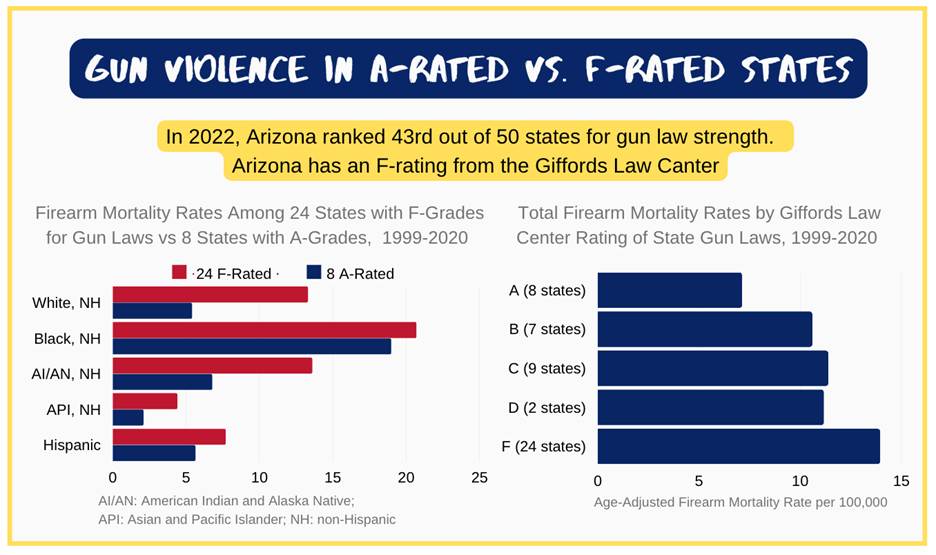
Firearm-related violence is a public health and safety threat to all Pima County residents.  According to the Pima County Health Department, in 2022, 226 persons died as a result of firearm violence in Pima County. Thus far in 2023, 146 have perished.

AzPHA Report: Firearm Violence in Arizona: Data to Support Prevention Policies

Firearm-related violence represents a staggering human and economic cost locally. In 2022, there were 533 hospital and emergency visits costing $33,107,484. 70% of these costs were covered by public funds. 

In 2010, the Centers for Disease Control estimated that medical and work loss costs for firearm-related violence in Arizona averaged over $1 million per victim.  Other significant firearm-related violence costs that are not accounted for in this estimate include:  emergency response, law enforcement, criminal justice, incarceration, and quality of life. 

Straw purchasers – those persons who illegally sell or transfer a firearm – are a major source of firearms to prohibited possessors – those individuals who cannot legally own a firearm. Prohibited possessors commit a significant percentage of firearm-related crimes in Pima County, according to the Pima County Attorney’s Office.

The criminal use of firearms contributes to high numbers of deaths and/or injuries, constituting a public health crisis on both sides of the international border. 

Arizona Revised Statutes 13-3102 A (5) specifically prohibits the selling or transfer of a firearm to a prohibited possessor – also known as a straw purchase or gift. This state statute gives local law enforcement not only the authority, but the responsibility to enforce this law.

While the Bureau of Alcohol, Tobacco, Firearms and Explosives (ATF&E) is responsible for enforcing federal straw purchase laws, this agency has been without a permanent director until recently and has been grossly underfunded for many years. The agency’s staffing for southern Arizona has been reduced from 6 to 3 agents.

The most current data available provided by the U.S. Government Accountability Office reports that only 12 persons were prosecuted nationally for straw purchases by the ATF&E in 2017. 

In Pima County, it has been estimated that a straw purchase is attempted daily at local Federal Firearm License (FFL) dealers. This estimate does not include firearms obtained from private sellers. Clearly, the problem is growing and of such magnitude that local law enforcement agencies, working in conjunction with State and Federal authorities, must take a more active role in the apprehension and prosecution of these offenders. 

Policy Recommendation

A joint task force should be created, comprised of federal, state and local law enforcement agencies to identify and charge persons engaged in transferring or selling firearms to prohibited possessors, using all applicable state and federal laws.

Prior to this enhanced enforcement of straw purchase laws, it is recommended that an Arizona- specific public information campaign be implemented aimed at warning potential straw purchasers of the legal and financial ramifications of their activities. 

Unlike most Second Amendment related issues here in Arizona, this does not require the passage of new legislation.  Also noteworthy is that people from all sides of the Second Amendment issue want to see firearms taken out of the arms of criminals. which is what enhanced enforcement of straw purchase laws would accomplish. 

These steps, if implemented would help reduce the incidence of straw purchase of firearms and thereby reduce the ability of prohibited possessors to obtain these weapons.  These actions would have a positive impact on reducing firearm-related violence in our community.

– Mike Humphrey, Pima County Board of Health

Leading Causes of Death in Arizona, 2023 (thru 11/26) & Thumbnail Interventions

1. Heart Disease (10,887)

  • Don’t smoke
  • Exercise regularly
  • Manage blood pressure
  • Manage cholesterol levels
  • Lower salt/alcohol use
  • Better nutrition

2. Cancer (9,644)

  • Don’t smoke
  • Eat well balanced diet
  • Physical activity
  • Get routine screenings
  • Use sunscreen/protect skin
  • Get regular checkups

3. Chronic Lower Respiratory Illnesses (2,611)

  • Don’t smoke
  • Worker safety protection
  • Keep up to date with vaccines
  • Exercise

4. Stroke (2,362)

  • Don’t smoke
  • Manage blood pressure
  • Lower alcohol use
  • Better nutrition
  • Seek treatment medication for AFIB (atrial fibrillation)
  • Regular checkups

5. Accidents (2,324)

  • Buckle up
  • Drive a safe car with airbags
  • Don’t drive under the influence
  • Avoid recreational use of pills (fentanyl)
  • In home fall prevention strategies
  • Physical activity/balance

6. Alzheimer’s (1,977)


7. Diabetes (1,750)

  • Manage the disease
  • Physical activity/nutrition
  • Don’t smoke
  • Manage blood pressure/cholesterol
  • Modest alcohol use

8. Liver Disease (1,071)

  • Getting vaccinated for Hepatitis A and B
  • Practicing good hygiene
  • Drinking alcohol in moderation
  • Use medications as directed
  • Get routine checkups with blood tests
  • Practice harm reduction if you’ve had Hep C

9. Hypertension (809)

  • Get regular checkups & take medicine as directed
  • Don’t smoke
  • Lower salt intake
  • Improve physical activity & nutrition
  • Limit alcohol

10. Heat (775)

  • Strategies to reduce homelessness
  • Increase affordable housing
  • Limit outdoor exposure to extreme heat
  • Stay hydrated

11.   Influenza/Pneumonia (686)

  • Stay up to date on all vaccines including influenza, COVID-19, pneumonia etc.
  • Get routine checkups

12.  Parkinsons (689)


13.  COVID-19 (674)

  • Get most up to date booster vaccines for COVID-19

14.  Kidney Disease (623)

  • Stay active
  • Manage diabetes
  • Take medication as directed
  • Eat a healthy diet
  • Reduce salt intake
  • Don’t smoke
  • Check and control your blood sugar and blood pressure as part of your regular checkups
  • Get your kidney function checked if you have one or more of the ‘high risk’ factors: diabetes, hypertension, obesity, a family history.

15. Suicide (599)

  • Depression screening
  • Seek behavioral health help
  • Improve social connectedness
  • Identify persons at risk
  • Evidence based responses
  • Enhance life skills and resilience

16. Nutritional Deficiency (seniors – usually protein deficiency) 563

  • Eat healthy diet with enough protein
  • Manage diet as you age
  • Sufficient nutrition

Trends in Leading Causes of Death in Arizona (2022-2023)

Heat Deaths up 350% in Last 4 Years; COVID Drops Substantially in 2023

As you probably recall, our resident AZPHA epidemiologist Allan Willaims PhD did a deep dive into the leading causes of death in Arizona during the pandemic and discovered we were the only state where COVID-19 was the leading cause of death during the first couple years of the pandemic.

AzPHA Data Brief: Arizona is the ONLY State in the U.S. In Which COVID-19 Is the Leading Cause of Death During the Pandemic

We asked Allan to run the cause-of-death numbers again for 2023 and 2022. While COVID-19 was still the 4th leading cause of death in Arizona during 2022, it dropped way down to number 13 this year. Meanwhile, we had another dramatic jump in heat-related deaths in 2023 – moving that cause of death up to number 10 (it wasn’t even in the top 15 last year).

See: Arizona COVID-19 deaths were way down, heat-related deaths spiked in 2023 | KJZZ

An even deeper dive into the heat-related death data found that heat related deaths have increased 350% in the last 4 years (tracking the affordable housing crisis).


You might also notice that the Accident’s category appears to be decrease in 2023, going from #3 to #5. That shift downward is more of an artifact of timeline by which medical examiners can establish a cause of death for opioid and other poisonings (opioid and other drug overdoses are mostly classified in the Accidents category (accidental poisonings). Blood toxicology reports have a relatively long lag time, slowing the cause of death data for accidents.


Here are some excerpts from an interview I did this week on KJZZ’ The Show: Arizona COVID-19 deaths were way down, heat-related deaths spiked in 2023 | KJZZ

Gilger: Were you surprised by any of these trends?

WILL HUMBLE: Well, I don’t know that the increase in heat-related deaths really surprised me that much. I mean, it kind of makes sense when you look at the numbers for homelessness in Arizona and the problems with affordable housing that’s putting people out into the street. Combine that with the July that we had.

We had a just a continuing big increase in heat-related deaths. And if you look at 2022, heat-related deaths wasn’t even in the top 20. This year, it’s No. 10. So, a big increase. Part of that’s homelessness. It’s a combination really of homelessness and the extreme temperatures that we had that were unusually high, especially the low temperatures at night.

Gilger: The other biggest shift when you look at these breakdowns is the big drop we saw in deaths related to COVID-19, which makes sense as well.

HUMBLE: Yeah. Right. So if you look, if you go back to 2020, 2021 Arizona was the only state where to COVID-19 was the No. 1 leading cause of death — even more than heart disease and cancer in 2020. That dropped a little bit in 2022. So that it was the fourth-leading cause of death. This year, 2023, so far it’s way down the list at No. 13. So big drop in the death from COVID-19, but a big increase in the death from heat-related illnesses.

Gilger: So much of what we talk about when we talk about deaths in the news is related to the opioid epidemic, the fentanyl crisis. How big of a chunk of the picture are those right now?

HUMBLE: It’s a big chunk. So the top two are, will always probably be — unless we have another pandemic — heart disease and cancer. But the third category is what’s called accidents. And initially you think, well, accidents mean car crashes.

Well, it’s accidental poisonings is what dominates that category, and it’s the third-leading cause of death in 2022. Right now, it’s classified as like fifth in 2023. But that’s going to go up because the toxicology reports, it takes so long to finish, they can’t establish the cause of death until that blood work comes back.

Gilger: We hear a lot about suicides in the news and about the rise in suicides, particularly among certain populations. This was lower down the list this year. How does this compare to recent years?

HUMBLE: It’s about the same as recent years in terms of the causes of death. If you look inside that data, demographically, it really is dominated by men over 70 that use a firearm as the method to end their life. So that’s demographics. If you look at where are the numbers of in suicides, it’s men over 70. Of course, there’s suicides across the board of all the age groups and genders. But that’s the, that’s the biggest chunk. It’s about the same as last year.

Gilger: Let’s talk for a few more minutes about heat-related deaths. We know that it was hotter. But we also know that there’s a housing crisis and more people are on the street and living on the street. Do we know, though, though much comorbidities play into this — things like drug use, mental illness, disability. How are those categorized?

HUMBLE: So, when you look at a death certificate, it’ll say heat-related death, there might be two to three different causes. So in other words, when you’re making the final determination … it’s about like what’s the No. 1 leading cause of death.

So, for a heat death, most likely there’s something else going on as well. Drugs is a big part, and Maricopa County did a a survey that found methamphetamine especially, but also fentanyl, are big co-factors for people who die from heat-related illnesses. But there’s the dominant reason of course is that they’re outside in the summer.

Ok…  then what can we learn from these data? Public health and policy-makers can use this info to set intervention priorities etc. But individuals can learn about things they can do to improve their chances of staving off these causes of mortality.

The big factors are of course stop smoking if you smoke. Make sure to go to your annual checkup where you can learn about things like high blood pressure or early signs of diabetes & take actions to prevent bad a bad outcome. Make sure to get your routine recommended cancer screenings and stay up to date with your vaccinations.

Western Region Public Health Training Center’s Public Health & Primary Care Leadership Institute!


January 26 – April 26, 2024

Are you interested in exploring a range of critical topics to enhance your leadership and communication skills, help better cross-sector collaboration, and develop more fair and effective approaches to improving population health? If so, you’re in luck, as the Western Region Public Health Training Center has just the training for you (free).

Program Overview:

  • Friday, January 26, 2024, 1pm – 6pm MST: Leading through Turbulence: New Leadership Styles for Today
  • Friday, February 9, 2024, 1pm – 3pm MST: Leading Organizational Change
  • Friday, March 1, 2024, 1pm – 3pm MST: Leading Organizational Change (cont.)
  • Friday, March 15, 2024, 1pm – 5pm MST: Collaboration: Innovative Techniques
  • Friday, April 5, 2024, 1pm-5pm MST: Strategic Communication and Collaboration
  • Friday, April 26, 2024, 1pm-3pm MST: Building Resilience

Who Should Apply?
Early- to mid-career professionals in public health and community-based primary care, especially those in rural areas or serving medically underserved populations.

Application criteria:  Along with your contact information, role, and agency, we require a letter of support from your supervisor to ensure the support and facilitation of your attendance at all virtual learning sessions.

Questions? Submit any questions to wrphtc@arizona.edu.

Application deadline: Applications are due by January 5, 2024

Western Region Leadership Institute | Western Region Public Health Training Center

New Process for Requesting Data from ADHS

ADHS launched a process for requesting data from the Department. Details and request portals are on a new webpage that lists public data assets and the form to request data.

ADHS says “…  this form does not guarantee the fulfillment of the request, but it will connect the requester with the right program within ADHS to respond to the request”. Once the request goes to the right ADHS program they say there may be added programmatic processes where more information or forms are requested.

They say that from now on people should submit all new data requests through the new ADHS Data Request Submission Form. For questions, please contact the Enterprise Data Management Office at edmo@azdhs.gov

_