Thursday Oct 5, 2023 7:30 – 8:30 AM AZ Time
Two convenient ways to participate:
In-person Event at Alexi’s Grill (3350 North Central Avenue #120, Phoenix AZ)
OR
Live stream the YouTube presentation from the comfort of your home or office.
Vitalyst has two core types of grants available. Their two-tiered Systems Change and Spark Grants are designed to catalyze collaborative work that transforms systems through changes to policies and practices that improve the health for our communities.
Systems Change Grants invest in efforts that positively address complex community health challenges and reduce structural and/or systemic gaps in health outcomes or opportunities.
Award Amount
Grant Process
Drafting Your LOI
Online Application Process – How to Guide: http://vitalysthealth.
AHCCCS recently launched AHCCCS Connect which sends personalized program reminders and updates to Medicaid members (and applicants) to help from initial application through annual renewal.
AHCCCS Connect sends SMS texts, automated voice calls, and/or emails to members who provide valid phone numbers and/or email addresses.
To receive these communications, AHCCCS members need to provide a phone number capable of receiving text messages, and/or an email address in their Health-e-Arizona Plus (HEAplus) account at www.healthearizonaplus.gov.
New applicants will be automatically added to AHCCCS Connect when they provide an email address and/or cell phone number. SMS texts and voice calls come from 888.831.7578.
Last week the Biden Administration launched the American Climate Corps, a workforce training and service initiative that will ensure more young people have access to the skills-based training necessary for good-paying careers in the clean energy and climate resilience economy.
American Climate Corps Website
The American Climate Corps will offer paying jobs to 20,000 young people putting them to work conserving and restoring our lands and waters, bolstering community resilience, deploying clean energy, implementing energy efficient technologies, and advancing environmental justice.
One of the goals is to provide career paythwas and skills in the clean energy and climate sectors after they complete their paid training program.
Sign up to learn about how you can join the American Climate Corp here: American Climate Corps | The White House
By this time next week there’s a good chance that large portions of the federal government will be shut down. Funding for the federal government expires next Friday (September 30). If Congress doesn’t approve a continuing resolution or a short-term appropriation a government shutdown will begin on October 1.
Most public health folks in the know at the national level think the likelihood of a government shutdown is high.
Last week HHS released its contingency plan for a potential shutdown, including operational plans for each of their major agencies. For example, here is CDC’s contingency staffing plan.
CMS says they have sufficient funding for Medicaid to fund the first quarter of FY24 (thru December 31, 2023). Likewise, Indian Health Service received advance appropriations for the coming fiscal year so the majority of IHS-funded programs will remain funded and operational.
Some CDC staff are considered ‘essential workers’ and won’t be furloughed – but 59% of their workforce would be furloughed.
Note: When I was at ADHS we had 2 or maybe 3 federal government shutdowns. We always did an in-depth analysis of the consequences for the CDC funds we received – and there were always enough carry-forward funds to get us through the mess. WIC was always our biggest concern, but the shutdowns on our watch were never long enough to jeopardize WIC, but this one could be.
Publication Date: Friday, August 18, 2023
Authors: Bryna Koch, Michelle Moore, Brianna Rooney, Mona Arora, Jennifer Peters, Daniel Derksen
About The Report
This important report reviews the public health response to the COVID-19, explores health disparities, identifies unmet health needs, makes recommendations, and suggests interventions to improve health outcomes and reduce health disparities. It also provides a good overview of Arizona’s public health system.
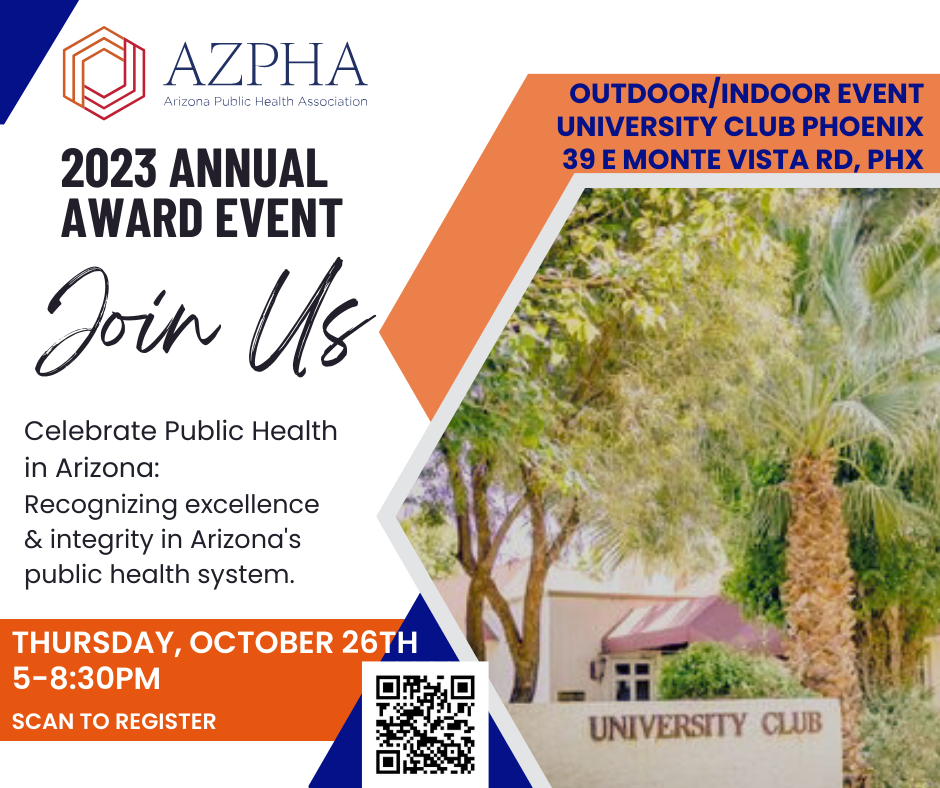
This is the final call to nominate folks for our 2023 Annual Awards. Nomination deadline has been extended to September 22, 2023
Note the Venue Change: Event will Be Held at the
University Club of Phoenix
39 E Monte Vista Rd, Phoenix, AZ 85004
Tickets are only $60 and includes food and drink tickets
_________________________
To bring additional attention to this important public health issue, this month we will highlight at risk populations in Arizona and simple steps we can all take to decrease suicides.
American Indians have a disproportionately high rate of suicide among all Arizonans. According to the University of Arizona’s Center for Rural Health, suicide death rates in 2021 were highest among American Indian and Alaska Native (AIAN) people, males, and people who live in rural areas.
The Arizona Department of Education’s Office of Indian Education is encouraging individuals to check on others and know how to reach out for help.
It can be scary to discuss suicide. It is a tough conversation, and one where both parties must be vulnerable. But it is also a courageous conversation and one we encourage you to have if you have any concerns.
For more information, consider calling 9-88, or chat online with someone for advice: www.crisistextline.org
The majority of suicide deaths in Arizona and nationally are by firearm. Arizona has an especially difficult history with firearm deaths, as detailed in AzPHA’s recent white paper. What can we do?
See the Report: Firearm Violence in Arizona: Data to Support Prevention Policies
Gun locks are one protective factor that can help slow down someone who is suicidal. Having to find the lock for the gun, and the ammunition ideally stored elsewhere, may be enough time to stop the person from dying by suicide.
AzPHA will have more than 100 gun locks available for distribution at our February 2024 conference. We encourage you to take one and have a discussion with your family or someone else you know how owns firearms. We can all do a better job of keeping firearms safe and out of the hands of those who may be considering suicide.
It can be scary to discuss suicide. It is a tough conversation, and one where both parties must be vulnerable. But it is also a courageous conversation and one we encourage you to have if you have any concerns.
For more information, consider calling 9-88, or chat online with someone for advice: www.crisistextline.org
Report: The Arizona State Hospital lacking staff, treatment options (azcentral.com)
New COVID vaccines greenlit as cases surge: What to know (azcentral.com)
New COVID vaccine is here in Arizona (and it’s not called a booster) (azcentral.com)
FDA signs off on covid vaccine. New shots to be available soon (usatoday.com)
Food and Drug Administration approves COVID boosters for upcoming season (azmirror.com)
The state is still in the first quarter of the new fiscal year, but it’s already time to start the budgeting process for next year. On September 1, most state agencies submitted their wish lists for the year ahead – proposals that the Governor will consider as she puts together the state budget she will release in January.
The Governor’s office hasn’t published all the agency requests, but some of the outlined priorities include: