Career Note from the Field: Kelli Donley Williams Reflects on Public Health’s Big Picture

In 2003, I was just a public health baby intern at the state health department in the office of HIV/AIDS. Cathy Eden was the director. I would linger in the halls to try catch glimpses of her or Susan Gerard. Will Humble was working at ADHS, but we wouldn’t become friend until years later.

I was assigned to an HIV epidemiology project about an issue in Pima County. Basically — I was told to spend the summer hunched over a spreadsheet or occasionally to sit through heated community meetings in Tucson libraries. It was a weird time, but one I wouldn’t forget. I was working and going to school full-time and living off school loans and Lean Cuisines. There was little glamour, lots of late nights, and plenty of sweat and tears.

I also vividly remember this period of working in public health because much like today, it was strange politically. George W. Bush was President, and the health department was given a list of words that were no longer acceptable in Federal grants. (Sound familiar?) The rollercoaster of public health funding headed downward, and those on the ride buckled up.

I had no idea we’d all be thrown for another loop more than 20 years later.

If you’re new to public health or mid-career, you may have only known the joyful, happy, times ––­­or as I like to call them: the Promotional Products Days (PPD).

If you own a notebook, pen, or water bottle emblazoned with your employer’s name, you’ve lived through good days. While considered cheap giveaways elsewhere, in our industry they’re a sign that we’re living as my mama would say, high on the hog.

In the days of DOGE, the PPD have vamoosed.

It makes sense if you’re feeling scared about what’s next, or whether you should be looking for a different career path all together. We see colleagues on the national stage being pushed out of their long, respected careers and others resigning in protest. We have long-standing programs losing funding and coworkers suddenly out of work. The once firm ground of science is beginning to shake.

Before you leave public health, please consider this: you’ve never been more needed. Public health needs workers in all phases of career. Public health needs those willing to do the very hard work to show science works. Public health needs our collective voices to continue to advocate for our field. Public health has never been more punk.

We are in this together, and we need you.

Croatia: Public Health and Health Care

For the next couple of weeks, I’m traveling in Europe with my family. Since I’m unwilling to keep up with AZ & US public health policy stuff, I thought I’d share some insights from the public health and health care systems in the countries I’m visiting. First up: Croatia.

Croatia’s Universal Health Care System

Croatia provides universal health care coverage via the Croatian Health Insurance Fund. The system is primarily funded through payroll contributions. Patients choose a primary care doctor who acts as a gatekeeper for specialty care.

Hospitals are public and private, but reimbursement comes mainly through the Croatian Health Insurance Fund. Many Croatians buy supplemental insurance to cover co-pays or get faster access to certain services, but no one is uninsured. 

A Hybrid National – Regional Approach

The Croatia Ministry of Health sets the country’s public health policy. The Croatian Institute of Public Health runs national-level programs like vaccination, disease surveillance, and chronic disease monitoring. Each county also has its own public health institute, which oversees day-to-day work like restaurant inspections, environmental health, and school health. 

Infectious disease outbreaks are tracked nationally by the national Institute of Public Health, which works with county institutes to implement testing, tracing, and vaccination campaigns.

Hospitals, Nursing Homes, & Child Care

Hospitals are licensed and regulated nationally through the Ministry of Health. Inspectors check for compliance with staffing requirements, infection control, and patient safety standards.

Nursing homes are regulated jointly by health and social welfare authorities, blending medical oversight with social service support. Childcare centers must meet standards set by the Ministries of Health and Education, with public health inspectors ensuring safe sanitation, food, and building conditions.

Food Safety and Restaurant Inspections

Croatia’s counties do restaurant inspections under national rules that are in sync with EU food safety standards (Croatia is in the EU). This includes monitoring kitchens, storage, and preparation areas. Restaurants must also follow the EU’s “farm to fork” policy, which requires traceability of ingredients from producers to plates.

Compared with the U.S., there’s less variation between regions since EU rules apply equally across member states.

Emergency Medical Services

Emergency medical services are run by counties but coordinated nationally. Ambulance networks extend to rural and island areas, which is important in a country with a long coastline. 

EMS centers in Zagreb, Rijeka, Split, Osijek provide 24 h service as does more decentralized service at their 54 county health districts – with at least one to two EMS teams. In areas with 30,000 inhabitants, ambulance services are staffed by “on call” or “on duty” family physicians.

Physical Activity & Urban Planning

One striking difference between Croatia and the U.S. is the role of daily physical activity built into life. Croatian cities are far more walkable, with compact town centers, car-free pedestrian zones, and extensive bike paths.

Public policies at both the national and city level support walkability and cycling, from investing in sidewalks to expanding protected bike lanes. In smaller towns, the layout still reflects centuries-old planning—markets and schools are often within walking distance.

This urban design naturally builds in more purposeful physical activity. Where in the US driving is the default, in Croatia walking or biking is often the easiest way to get around. That has a measurable effect on obesity rates, which are much lower than in the U.S. Of course, the better food standards in the EU when compared to the US also plays a role.

Mental Health & Substance Use

Care for serious mental illness and behavioral health is integrated into the health system, though resources are more limited than in much of the EU.

Specialized psychiatric hospitals exist, and outpatient mental health services are covered. Substance use treatment, including programs for alcohol and opioids, is available through both hospitals and community clinics, with public health institutes playing a role in prevention.

Still, stigma is still a big barrier I’m told. Croatia is investing in community-based mental health care to reduce reliance on institutional treatment, following EU recommendations.

Alcohol consumption in Croatia is higher than in the U.S. Wine and beer are part of daily culture, and per capita alcohol intake is above the EU average. Public health campaigns have targeted youth drinking and binge drinking, but alcohol is still a significant health challenge.

Firearm Violence

When it comes to firearm violence, the gap between Croatia and the United States is striking. In the U.S., gun deaths remain a leading cause of premature mortality, with firearm homicide rates hovering around 5 to 6 per 100,000 people in recent years. Croatia, by contrast, reports only about 0.1 to 0.3 firearm homicides per 100,000 — an order of magnitude lower.

The reasons are fairly straightforward: America has far more guns (roughly one per person) while Croatia has far fewer (around 14 per 100 people). Add in tighter licensing and storage rules across the EU & you have a recipe for far fewer violent incidents involving firearms. In Croatia, homicides and suicides are far less likely to involve a gun at all, while in the U.S. firearms are central to both.

Incarceration Rates

The same kind of disparity shows up in incarceration. The US imprisons 541 people per 100,000 residents (one of the highest rates in the world) while Croatia incarcerates around 115 per 100,000.

The US locks up about five times as many people per capita as Croatia does. These differences reflect not just policy choices around criminal justice but also the underlying social drivers of violence. Inequality, community disinvestment, and easy access to firearms amplify violent crime in the U.S.

Health Outcomes Compared to the U.S.

  • Obesity: About 25% of adults, compared to more than 40% in the U.S.
  • Smoking: Around 25% of adults, much higher than in the U.S.
  • Alcohol: Higher per capita intake than both France and the U.S.
  • Life Expectancy: About 78 years, lower than Western Europe and slightly below the U.S.

The Role of the European Union

EU membership has had a good influence on Croatia’s public health. Food safety, chemical safety, and consumer protections are governed by EU-wide rules.

Additives and preservatives that are common in the U.S. are banned or restricted. The EU also sets reporting standards for infectious disease, requiring Croatia to share surveillance data with European networks.

Next week I’ll cover France’s health care and public health environment.

ACA Premiums Set to Increase in 2026 as Enhanced Marketplace Premium Tax Credits Expire

Arizona residents who purchase health insurance through the ACA marketplace are facing significant premium increases in 2026 unless congress acts to extend enhanced premium tax credits by September 30.

The enhanced tax credits expanded eligibility and increased subsidies for individuals and families purchasing insurance through the ACA marketplace. These enhancements were extended through 2025 but expire at the end of this year. Without these credits, many enrollees will see their premiums rise substantially.

Az’s healthcare premiums set to soar on 2026 online marketplace

If Congress doesn’t extend the expanded tax credits Marketplace insurance rate increases will range from 2.5% to over 55%. The increase isn’t all due to the end of the enhanced tax credit – but most of it is.

For example, a 60-year-old couple earning $80,000 annually (approximately 405% of the federal poverty level) currently pays $567 per month for their health insurance. If the enhanced credits expire, their monthly premium could more than triple to $2,026, an annual increase of $17,500. Approximately 300,000 Arizonans rely on the ACA marketplace for their health insurance coverage.

Summary of the History of Marketplace Tax Credits

2010–2013: From Law to Implementation

  • March 23, 2010: When the Affordable Care Act (ACA) was signed into law, it established the framework for advanceable, refundable premium tax credits for individuals and families purchasing insurance through the Marketplace.
  • 2013: The Federally Facilitated Marketplace opened to enroll individuals in Marketplace plans eligible for APTC.
  • 2014: APTCs became available. IRS made them advanceable and refundable, meaning enrollees received payments throughout the year.
  • March 2015: Enrollment rose to 10.2 million, with 85% receiving APTC. Cost-sharing subsidies also aided affordability. Among HealthCare.gov users, over 8 in 10 new or renewed enrollees received an average APTC of $268/month, reducing premiums by roughly 72%. Many had net premiums under $100.

2021–2022: American Rescue Plan Act Expansion

  • March 11, 2021: President Biden signed the American Rescue Plan Act:
    • Eliminated the 400% FPL “subsidy cliff”, making higher-income households eligible for APTC.
    • Capped contributions so that no household paid more than 8.5% of income toward premiums.

2023–2025: Extended Subsidy Enhancements (IRA)

  • The Inflation Reduction Act (2022) extended the ARPA enhancements through December 31, 2025.
  • These enhancements enabled:
    • A dramatic increase in marketplace enrollment from 11.2 million in 2021 to 20.8 million in 2024.
    • Sustained population eligibility across income levels thanks to the phased-out subsidies rather than an abrupt cutoff.

Summary

Starting in 2026, the rules will revert to the pre-pandemic structure that was in place in 2020 unless Congress acts to extend the IRA and ARPA enhancements :

  • Eligibility capped at 400% of the federal poverty level (FPL) If your income is just above that threshold, youll no longer qualify for any premium help.
  • Smaller subsidies within the 100–400% FPL band Credits wont be as generous, so even people who still qualify will see higher premiums.
  • “Subsidy cliff” returns A family just over 400% of FPL will lose thousands of dollars in annual subsidies, even if their premiums are a large share of income.
  • Higher net premiums for lower-income enrollees Because the ARPA/IRA boosted subsidies most strongly for people below 250% of FPL, their share of income required for coverage will jump back up.
  • The 8.5% of Income Premium Cap ends
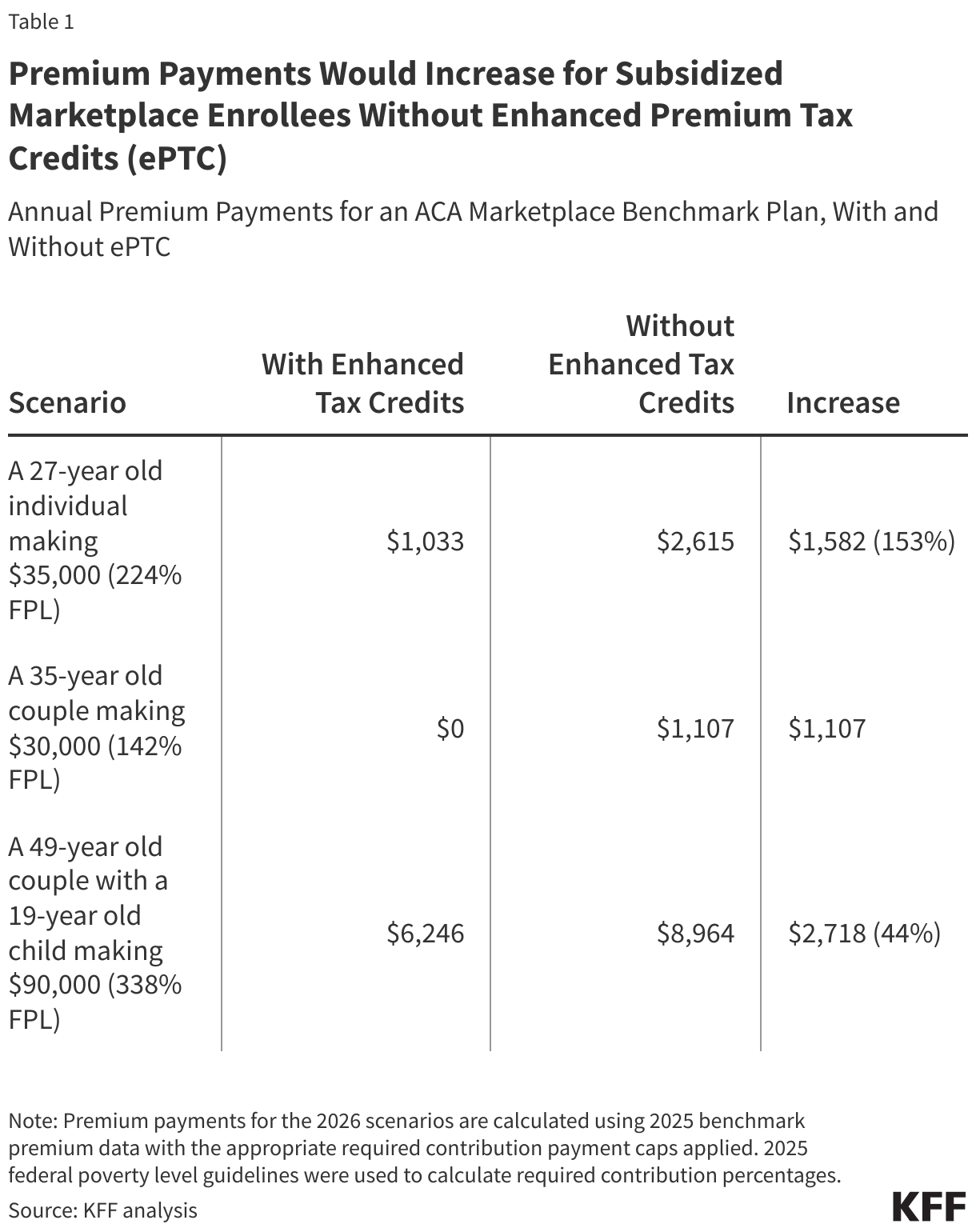
Premium Payments Would Increase for Subsidized Marketplace Enrollees Without Enhanced Premium Tax Credits

Annual Premium Payments for an ACA Marketplace Benchmark Plan, With and Without ePTC

Table with 4 columns and 3 rows. (column headers with buttons are sortable)
A 27-year old individual making $35,000 (224% FPL) $1,033 $2,615 $1,582 (153%)
A 35-year old couple making $30,000 (142% FPL) $0 $1,107 $1,107
A 49-year old couple with a 19-year old child making $90,000 (338% FPL) $6,246 $8,964 $2,718 (44%)
Premium Payments if Enhanced Premium Tax Credits Expire | KFF

Without renewal, the system resets to the original ACA design, which was still helpful for many, but left a lot more people facing unaffordable premiums, especially middle-income households just over the 400% FPL threshold who will stand to pay more than 8.5% of income for premiums.

Scenario Note: With the enhanced tax credits in place, Marketplace enrollees making between 100%-150% of the federal poverty level are eligible for a fully subsidized benchmark plan. Prior to the availability of the ePTCs, enrollees making just above the poverty level were expected to contribute about 2% of their household income towards a benchmark plan. If the enhanced tax credits expire, low-income enrollees (currently paying $0 for a benchmark plan) will have to start paying for coverage again. For example, a 35-year-old couple earning $30,000 can expect to start paying $1,107 annually for a Marketplace benchmark plan.

Register Today: 2025 AzPHA Public Health Awards

Thursday, October 23, 2025

5:30 – 8:30pm

435 Collective

435 S 3rd Ave, Phoenix, AZ 85003

Each year AzPHA recognizes public health professionals, health professionals and community members across Arizona who are performing extraordinary services to our community at our annual awards event. Many of our awards go back decades.

Policymaker of the Year Award

Kris Mayes, Arizona Attorney General

Senator Andy Nichols Honor Award

Karen Woodhouse

Pete Wertheim Public Health Leadership Award 

Barbara Lang & Jeanne Nizigiymana 

Public Health Research Award

Megan Jehn & Kristen Pogreba Brown

Alida Montiel Indigenous Health & Advocacy Award

Francis Villescaz 

Rising Public Health Champion

Jeffrey Hanna 

Special Event Guest


Nandi Marshall, DrPH, MPH, CHES

APHA President Elect

Register Today: Only $45

Includes complimentary beer, wine and soft drinks & taco bar!

ACIP Pulls Their Punch

The CDC’s Advisory Committee on Immunization Practices met Thursday and Friday to revise the nation’s child and adult vaccine schedules. Normally these meetings are careful, evidence-based discussions among experts.

This time, the tone was different with performative statements, repeated mistakes, and ideological posturing in contrast with the usually academic atmosphere. CDC staff presentations remained clear and grounded, laying out the risks, benefits, and data with precision. Despite the wacky language the panelists used at the meeting, their decisions were surprisingly modest. Let’s start with what they did on the COVID booster.

COVID Vaccine

ACIP thankfully voted down a motion to require prescriptions for all adults (the chair broke the 6-6 tie). However, they dropped the earlier broad, universal recommendations. The COVID booster now falls on what’s called “shared clinical decision-making” for everybody 6 months old and up.

From CDC:

Shared clinical decision-making recommendations are intended to be flexible. The decision to vaccinate may be based on the individual’s characteristics, values, and preferences; the provider’s clinical discretion; and the characteristics of the vaccine. There is no default assumption that the vaccine should be administered to all persons in a particular age group or risk group.”

Here are the exact motions that the committee voted on for COVID. Pay particular attention to votes 2 and 4:

Vote 1. It is the sense of the committee that the CDC engages in an effort to promote more consistent and comprehensive informed consent processes, and as part of that considers adding language accessible to patients and medical providers to describe at least the six risks and uncertainties included in the Work Group Chair presentation. Passed (Yes 11, NO 1)

Vote 2. It is the sense of the committee that state and jurisdictions should require a prescription for the administration of COVID-19 vaccination.  Failed to Pass (Yes – 6, No – 6) – the chair broke the tie by voting NO.

Vote 3. It is the sense of the committee that in conversations with patients before COVID-19 vaccination, authorized healthcare providers discuss the risks and benefits of the vaccination for the individual patient.  The discussion should consider known risk factors for severe outcomes from COVID-19, such as age, prior infections, immunosuppression, and certain comorbidities identified by the CDC, and include a discussion of the potential benefits and risks of vaccination and related uncertainties especially those outlined in the vaccine information statement, as part of informed consent. Passed  (Yes – 12, NO – 0)

Vote 4. The pediatric and adult immunization schedules for administration of FDA-approved COVID-19 vaccines should be updated as follows:

  • Adults 65 and older: Vaccination based on individual-based decision making – also known as shared clinical decision making.
  • Individuals 6 months to 64 years: Vaccination based on individual-based decision-making – with an emphasis that the benefit of vaccination is most favorable for individuals who are at an increased risk, according to the CDC list of COVID-19 risk factors.  Passed (Yes -12, No – 0)

I think this means that people 65 and over should be able to get the vaccine in pharmacies relatively easy. They won’t need a prescription. The ‘shared clinical decision-making’ criteria doesn’t mean there needs to be a doctor actually advising the patient – although some pharmacies may choose to require that – but it’s not something that’s required to meet the recommendation standard.

I think this also means people under 65 are still eligible, but the emphasis is on weighing individual risk factors with a healthcare provider. However, there’s no prescription needed, and there’s nothing in the language of shared clinical decision-making standard to suggest the person needs a doctor’s note or assessment. The ACIP was silent regarding pregnancy, but I think pregnant women can get it as a regular adult with ‘shared clinical decision-making’.

As for coverage by health plans – I think today’s decision means health plans should generally cover the vaccine and there is no prescription needed.

Now, that doesn’t mean that pharmacies and health plans won’t take a restrictive view of the ACIP recommendations and voluntarily limit who they vaccinate. With ACIP no longer urging universal use, insurers may be less likely to cover shots for healthy younger adults, and some pharmacies might hesitate to offer them without clear state guidance.

Also, last week Governor Hobbs issued an Executive Order to clear up the confusion and smooth the vaccination road. A key element of that EO was the directive for the ADHS to issue a Standing Order authorizing the vaccine – essentially a blanket prescription, allowing pharmacies to vaccinate anyone who wants the shot.

That Standing Order, which has been issued by former US Surgeon General Richard Carmona, should go a long way toward giving pharmacies comfort about administering the vaccine. Here’s a link to Dr Carmona’s Standing Order

MMRV Vaccine

ACIP voted to withdraw its recommendation for use of the combined MMRV vaccine in children under 4. Research has shown that this shot slightly increases the risk of febrile seizures compared with giving the measles-mumps-rubella (MMR) and varicella (chickenpox) vaccines separately. While the combined shot is still a choice if parents prefer, ACIP now recommends separate administration.

This decision will also affect reimbursement. Some health insurers, like Blue Cross Blue Shield of Arizona, had been pushing pediatricians to use the combined MMRV to avoid paying separately for two shots. With the new guidance, insurers will likely need to cover the MMR and varicella vaccines individually. Families who previously opted for the convenience of the MMRV may see reduced or ended coverage for that choice – but families should still be able to get their kids vaccinated with no co-pay or deductible.

Hepatitis B Vaccine Recommendation

The committee ultimately decided not to delay the Hep B vaccine birth dose until one month of age if the mother tests negative for the virus. The committee discussed the post market surveillance that showed that the vaccine has a very low (about one severe allergic reaction per 2–3 million doses),

Had they made the change, the decision would have put infants at risk, especially if a mother’s Hep B status is unknown or if she is positive. The stakes are high: nine in ten babies who contract Hep B develop lifelong chronic infection, compared with only one in ten adults. It also may have caused health systems to interpret it as permission to drop the Hep B birth dose from standard newborn care meaning babies of unscreened or even positive moms might not get the vaccine at birth.

The birth dose of Hep B will be on a future agenda – as many members were ‘concerned’ about the Hep B vaccine’s safety based on anecdotal evidence of higher rates of irritability and fussiness in babies, despite CDC studies showing no increased risk of neurological issues.

Hobbs Moves to Protect Households from the Increasing Costs of Electricity

Arizona Governor Hobbs’ Executive Order (2025-13) with a goal of shortening bureaucratic delays related to infrastructure generation and transmission, promote energy infrastructure development, and by doing so, mitigate energy costs for residential ratepayers.

It sets up the Arizona Energy Promise Taskforce, directs state agencies to study affordability, and sets clear expectations that energy growth must not lead to rising costs for families.

For many Arizona families, electricity is already the second-biggest household expense—only rent exceeds it. Food often ends up taking a back seat. Rising electricity costs are not just an issue of comfort or budget; they impose real health risks.

As Arizona plans for more capacity to meet a projected ~40% increase in peak electricity demand over the next 15 years, there is intense interest in new generation sources, including those fueled by methane (natural gas) or similar fossil fuels.

Beyond making climate change worse focusing on methane burning rather than renewables, methane-based generation infrastructure requires large capital investment. When these costs are built into utility rates, residential customers, especially those least able to pay, end up footing the bill.

Public policy must prevent this kind of cost shift. When governments or utilities subsidize capital costs for fossil fuel infrastructure to pay for generation for data centers through ratepayer bills, it makes everyday households subsidize large data center users – the very entities that are making the new generation facilities necessary.

We already know that the Arizona Corporation Commission doesn’t care about ordinary residential ratepayers, which is why it was important for the Governor to step in to the extent that she can.

  • The Order calls for energy affordability studies to find opportunities to reduce costs for consumers.
  • The Taskforce must plan to enable energy infrastructure growth without pushing up energy costs.
  • Streamlining siting and development on state land could lower the non-fuel costs of projects—those are often shareable savings that can help avoid rate increases.  
Executive Order Core Principles
  1. No hidden subsidies: Capital, maintenance, and fuel costs of new generation should not be shifted to households unless there’s a clear benefit and fair allocation.
  2. Favor clean or renewable sources: Where possible, invest in renewables whose fuel cost is zero and whose environmental cost is lower—both for health and future rate stability.
  3. Transparency and accountability: Let families see what they’re being charged for—and whether rate increases are driven by necessary costs or by poor planning.

Governor Hobbs’ action is a promising step. But ensuring that ratepayers, especially low-income families, don’t end up subsidizing costly, polluting methane plants for data centers is essential for an energy future that is both affordable and fair.

RIP Arizona Energy Efficiency Standards

In 2010, the Arizona Corporation Commission adopted Energy Efficiency Standards that required they utilities that the ACC regulates (e.g. APS, TEP) to steadily reduce energy waste. The rules called for the utilities to achieve annual energy savings equivalent to 22% of their previous year’s retail energy sales by 2020.

They were directed to meet these goals through programs like weatherization, high-efficiency lighting and appliances, load management, and demand-response tools to reduce peak demand.

It was working. For every $1 people invested in energy efficiency, Arizonans saw nearly $4 in benefits, a return on investment that is difficult to match in any other energy resource.

Over time, these standards saved families hundreds of millions of dollars, reduced stress on the grid during sweltering summer months, and cut down on the need for building more methane burning power plants.

Despite the Rules’ success, the ACC voted unanimously Wednesday to repeal the Electric Energy Efficiency Rules.

The Commissioners justified their repeal by arguing that the rules “force ratepayers who don’t use energy efficiency programs to foot the bill for those who do.” This ignores the fact that energy efficiency saves money for all customers by reducing the need for new, expensive power plants and transmission infrastructure.

We opposed the Commission’s action, urging the ACC to modernize them, cut unnecessary administrative costs while keeping the benefits.

The repeal won’t take effect immediately but once finished in a few months utilities will stop incentivizing ratepayers to save energy. Instead, they’ll continue to focus on more and more methane burning power plants to generate the electricity that efficiency practices spurred on by the efficiency standards had been saving. 

But – voters put these commissioners in place, so the majority of Arizonans must not care about energy efficiency or the constant increase in their electricity bills.

The Endangerment Finding: What It Is & Why Its Repeal is a Disaster

The Trump administration has announced its intention to revoke the U.S. Environmental Protection Agency’s (EPA) Endangerment Finding, a cornerstone of modern public health and environmental protection. Here’s what Arizonans need to know about what the Endangerment Finding is, and why revoking it would endanger our health, safety, and future.

What Is the Endangerment Finding?

In 2007, the U.S. Supreme Court ruled in Massachusetts v. EPA that greenhouse gases like carbon dioxide and methane qualify as “air pollutants” under the Clean Air Act. The Court required EPA to determine whether those pollutants endanger public health or welfare.

Two years later, in 2009, the EPA issued its Endangerment Finding, concluding that six major greenhouse gases – including carbon dioxide, methane, and nitrous oxide – pose a direct threat to human health and well-being. That finding, which the courts have again and again – legally obligates the EPA to create and enforce various standards to cut climate pollution from power plants, vehicles, and other sources. These standards have worked: Over the last 15 years, air pollution has decreased dramatically, and much of this decrease can be attributed to EPA standards that rest on the foundation of the Endangerment Finding.

Why does the Endangerment Finding Matter in Arizona?

Arizona is already on the frontlines of the climate crisis. Over the past few years, we’ve seen record-breaking heat waves, prolonged droughts, and devastating wildfires. Phoenix recently endured more than 140 consecutive days above 100 degrees, straining hospitals and driving up rates of heat-related illness and death.

The Endangerment Finding underpins standards that:

  • Reduce air pollution from cars, trucks, and power plants.
  • Prevent thousands of asthma attacks and premature deaths each year.
  • Protect vulnerable communities, including children, older adults, and those with pre-existing conditions, from extreme heat and poor air quality.

Without it, Arizona communities would be left more exposed to dirty air, dangerous heat, and escalating health risks.

What Happens If It Is Revoked?

If the Trump administration rescinds the Endangerment Finding, the EPA would no longer be required to protect Americans from climate pollution, even though the science proves that pollution is making our air dirtier, our weather more extreme, and our families less health

Without the EPA’s anti-pollution standards, we can expect climate change to worse. That means:

  • More extreme weather, including longer droughts, more severe wildfires, and intense flash floods.
  • Greater spread of diseases – such as the West Nile virus, Zika, and Valley Fever – as warmer conditions expand the reach of disease-carrying insects.
  • Threats to drinking water, as droughts and floods alternately compromise water supplies.
  • Rising health care costs, as pollution-related illnesses, such as asthma, heart disease, and other respiratory conditions, become more widespread.
  • Economic harm to Arizona’s farmers, ranchers, and families as heat and water stress undermine crops and livelihoods.

In short, revoking the Endangerment Finding would give fossil fuel companies a green light to pollute with impunity. Meanwhile, Arizonans would be forced to pay the price with our wallets, our health, and even our lives.

What Can You Do About It?

You can take action by telling the EPA that your health deserves to be protected. The EPA is accepting public comments on this proposal until September 22. This weekend is our last chance to make our voices heard.

 CLICK HERE to submit a comment to the EPA urging them to keep the Endangerment Finding in place and continuing protecting our health from dangerous climate pollution. In comment be sure to remind the EPA that protecting public health is the very core of its missions. Also, be sure to share your personal story about how climate change and air pollution have affected you, your family, and your community.

Study: Daily steps and health outcomes in adults: a systematic review and dose-response meta-analysis

Walking is one of the easiest ways to improve your health. You don’t need a gym membership or special equipment—just a pair of shoes and a little time each day.

A new study published in The Lancet Public Health looked at data from more than 160,000 people. Researchers found that walking around 7,000 steps a day can lower the risk of many serious health problems. Even walking about 4,000 steps showed clear benefits.

People who hit this mark had a much lower chance of dying early, getting heart disease, type 2 diabetes, cancer, dementia, or even depression compared to people who only walked about 2,000 steps a day.

Daily steps and health outcomes in adults: a systematic review and dose-response meta-analysis – The Lancet Public Health

Walking also helps with mood, sleep, stronger bones, and keeping a healthy weight. For Arizona communities, encouraging people to walk more—through safe sidewalks, parks, and community programs—can make a big difference.

One simple way to stay on track is to use a Fitbit, Apple Watch, or another smartwatch.

These devices count your steps, remind you to get moving, and let you see your progress over time. Setting daily goals and seeing the numbers add up can be motivating and keep you accountable.

If you’re looking for a healthy habit that’s free, simple, and proven to work, start by walking more. Aim for 7,000 steps a day—and step into better health.

Arizona Losing SNAP‑Education in 2 Weeks

HR1 made big (bad) changes to federal nutrition programs, including SNAP (the Supplemental Nutrition Assistance Program). While many of the cuts like stricter SNAP eligibility rules and ending health insurance subsidies won’t happen until after the 2026 elections, one change is immediate: SNAP‑Ed, the nutrition education program, will mostly end at the end of this month.

SNAP‑Ed (administered by ADHS) has helped Arizonans for decades. It teaches families how to eat healthy on a budget, provides lessons in schools, supports community gardens, farmers markets, and runs public campaigns on nutrition. 

Research shows SNAP‑Ed improves food security, helps prevent diet-related diseases, and supports healthy habits that last a lifetime.

Cutting SNAP‑Ed means we’ll lose these important services. Families will have fewer opportunities to learn about nutrition and healthy cooking. Schools and community programs that rely on SNAP‑Ed funding will struggle to keep offering lessons and workshops.

Rural communities and low-income families are likely to feel the effects first, as they rely on SNAP‑Ed for guidance, education, and support.

Ending SNAP-Ed removes a proven program that has improved the health and food security of Arizonans for years. Without SNAP‑Ed, families will face more challenges accessing healthy food.

HR1-SNAP-Changes-Presentation-Hunger-Summit