Arizona AG Mayes Defending the Rule of Law (and Public Health) with Legal Challenges

Since taking office, Arizona Attorney General Kris Mayes has initiated or joined at least 18 lawsuits against the Trump administration, focusing on defending constitutional principles and protecting the rights of Arizonans.

These legal actions (filed jointly with several other state Attorney Generals) span various sectors, including public health, education, labor, and environmental policy.

In the public health arena, Mayes is challenging administration’s decisions to cut or delay funding for critical public health and healthcare programs. For example, she joined lawsuits opposing the termination of nearly $12 billion in public health grants, which support services like telehealth, mobile vaccine clinics, and opioid treatment programs. They’ve also contested the administration’s attempts to disrupt National Institutes of Health grant processes.

Beyond health care, Mayes et.al. have gotten preliminary injunctions against the mass firing of federal probationary employees and a court order restoring over $1 billion in federal funds aimed at assisting low-income and unhoused students.

These legal efforts underscore the pivotal role of the judicial branch will be over the next 3.5 years in upholding the rule of law when executive and agency actions overstep constitutional boundaries or are in conflict with existing federal laws.

As we press through the next 3.5 years it’s crucial that the judicial branch exercise their legitimate constitutional checks and balances power to ensure that the administration adheres to the constitution and existing federal laws.

Right now, the judicial branch is the only branch of government that’s willing to act as a check on the administration’s illegal and unconstitutional actions.

For a comprehensive overview of Attorney General Mayes’ legal actions, visit the Arizona Attorney General’s Federal Action Lawsuits page: Arizona Attorney General’s Federal Action Lawsuits | Arizona Attorney General

AZPHA Breakfast & Learn Public Health Under Siege: How the American Public Health Association is Fighting Back 

Friday, June 20, 2025   9-10am

Public health is under siege. From destructive policy changes to the indiscriminate firing of experienced experts at the CDC, FDA, and other HHS agencies – decisions by Secretary Kennedy are putting the nation’s health—and the future of biomedical research—at serious risk. 

Fortunately the American Public Health Association has come to the rescue – filing lawsuits, motions and briefs in several lawsuits challenging Kennedy’s harmful decisions.

Join Rebecca Boulos, Don Hoppert and Rebecca Nevedale from APHA on Friday June 20 at 9am for our member webinar outlining how APHA is pushing back, including legal actions and advocacy efforts to limit the damage.

Hosted in partnership with the AZPHA, this session will detail what’s at stake and how public health advocates can take a stand. Don’t miss this chance to stay informed, get engaged, and help defend the future of public health.

Our Speakers:

 Rebecca Boulos

Rebecca Boulos: Chair, APHA Action Board

Don Hoppert - Washington, District of ...

Don Hoppert: APHA Director of Government Relations

Rebecca Nevedale

Rebecca Nevedale, AzPHA & APHA Council of Affiliates Chair

Register Today

Free for AZPHA Members

Investigative Journalism & Independent Auditing Spark Improvements in Assisted Living, Skilled Nursing & Dementia Care

Over the past several years AZ’s system for ensuring people who live in assisted living and skilled nursing facilities are treated properly has faced intense scrutiny—for good reason.

An (award-winning) investigative series by The Arizona Republic, titled The Bitter End, by Caitlin McGlade and Sahana Jayaraman – uncovered unacceptable conditions in care homes in Arizona.

Their reporting exposed a pattern of resident harm, neglect, and systemic regulatory failures during the Ducey/Christ/Herrington era   – when the ADHS had mostly abdicated its duty to enforce basic standards of safety and care at assisted living and skilled nursing facilities.

McGlade’s stories along with a series of damning reports by the AZ Auditor General’s Office exposed agency conduct that was failing Arizona’s seniors.

AZ failed to investigate nursing home complaints, report finds
Republic series are IRE investigative journalism award winner, finalist
Auditor General’s Office Produces Scathing Review of ADHS’ Nursing Home Complaint Investigations During the Ducey Era

The revelations eventually prompted long-overdue reforms under the Hobbs Administration including leadership changes at ADHS and a growing political will at the legislature to address the crisis—including residents living with dementia.

Now under new leadership, ADHS has been working hard to rebuild trust and strengthen oversight of assisted living and skilled nursing facilities and other healthcare institutions.

The agency has been changing policies, priorities, program leadership, improving training and rebooting the licensing division’s culture. They’ve even proposed licensing fee increases to provide the revenue needed to step up their oversight. 

Another step forward came last week when ADHS got final approval for a new set of dementia care regulations. The new rules, approved by the Governor’s Regulatory Review Council, require enhanced training for staff, better care planning, improved documentation, and more accountability mechanisms.

Arizona dementia-care rules for assisted living clear final hurdle

AZPHA commends the new ADHS leadership team for standing firm against industry pressure to water down the dementia care protections. Their willingness to prioritize patient care is a sharp contrast from the unchecked ambivalence & neglect that occurred during the Ducey/Christ/Herrington era.

The reform of ADHS’ licensing work and the new dementia care rules are reminders that investigative journalism and independent watchdog oversight (the AZ Auditor General) are critical to creating meaningful changes when agency and executive branch leadership allows a system to fail.

This kind of investigative journalism – which was key to getting the kinds of reform we’re now seeing – is only possible with reader support… so please subscribe to local journalism!

While there’s still a lot more work to do like hiring, training and mentoring the surveyors that do this work – the adoption of the new dementia care rules shows ADHS is doing what they can to protect seniors again.

Note: In another encouraging action, ADHS is adjusting their licensing fees for healthcare institutions – an important step that’ll l provide badly needed money to hire, train, and keep more and better inspectors.

The fees that pay for ADHS’ licensing work were set by me way back in 2009 and haven’t been adjusted since. Meanwhile, inflation has eroded the value of the licensing revenue by 48% since those fees were set. See the new (draft) licensing fee rules 9 A.A.C. 10 HCIs EIS Draft – Fees

ADHS – Rulemakings in Progress – Health Care Institution Fees

Will Kennedy’s Elimination of CDC’s Smoking & Health Program Make America Healthy? No.

In yet another damaging move, Kennedy eliminated CDC’s Office on Smoking and Health last week — threatening decades of progress in tobacco prevention and control even as tobacco smoking remains the number one preventable cause of death in the US.

The Office of Smoking and Health provides vital funding & technical assistance to every state in the country, supporting  quitlines, public education campaigns, data collection, and policy development.

These efforts will go up in smoke now that Kennedy has thrown the program in the trash heap. 

Lifesaving Programs to Prevent and Reduce Tobacco Use Go Up in Smoke

Tobacco remains the leading cause of preventable death in the United States, killing more than 480,000 people annually.

So much for Making America Healthy Again.

Arizona Still Has Work to Do On Tobacco Control

This week, the American Lung Association released its latest “Up in Smoke” report, a national look at how states are doing when it comes to reducing tobacco use and protecting people from secondhand smoke.

Arizona’s grades are mixed. While we’ve made progress in some areas, we still have serious gaps to address. 

The report grades states in five areas: funding for tobacco prevention, smokefree air laws, access to cessation services, tobacco taxes, and flavored tobacco product restrictions.

Arizona earned a C in smokefree air laws and a B in cessation services, but we scored a failing grade—an F—for tobacco taxes and flavored tobacco product regulations. That’s deeply concerning.

You can read the full report here.

Public Health Law Center | A Free Resource for Local Public Health

Public Health Law Center | A Free Resource for Local Public Health

The Public Health Law Center provides free legal technical assistance to public health managers within state, local, Tribal and territorial health departments. They also provide support related to working with your Attorney General’s office.

They also answer questions related to the litigation process and provide case analysis. They have several assistant AGs and former litigators on staff.

Reach out to Tom Pryor or Manel Kappagoda with questions or Contact the  Public Health Law Center online.

_________________________ 

CDC Reports Decline in Drug Overdose Deaths in the US & AZ

Guest piece via AzPHA member Allan Williams, Ph.D.

The March 16 AZPHA Policy Update (“A Turning Point in the Opioid Crisis”) reviewed a February 25 CDC report indicating a 24% decline in US drug overdose deaths over the 12-month period ending in September 2024 compared to the previous 12-month period.  That finding has now been updated in a May 14 CDC report with data available through December 2024.

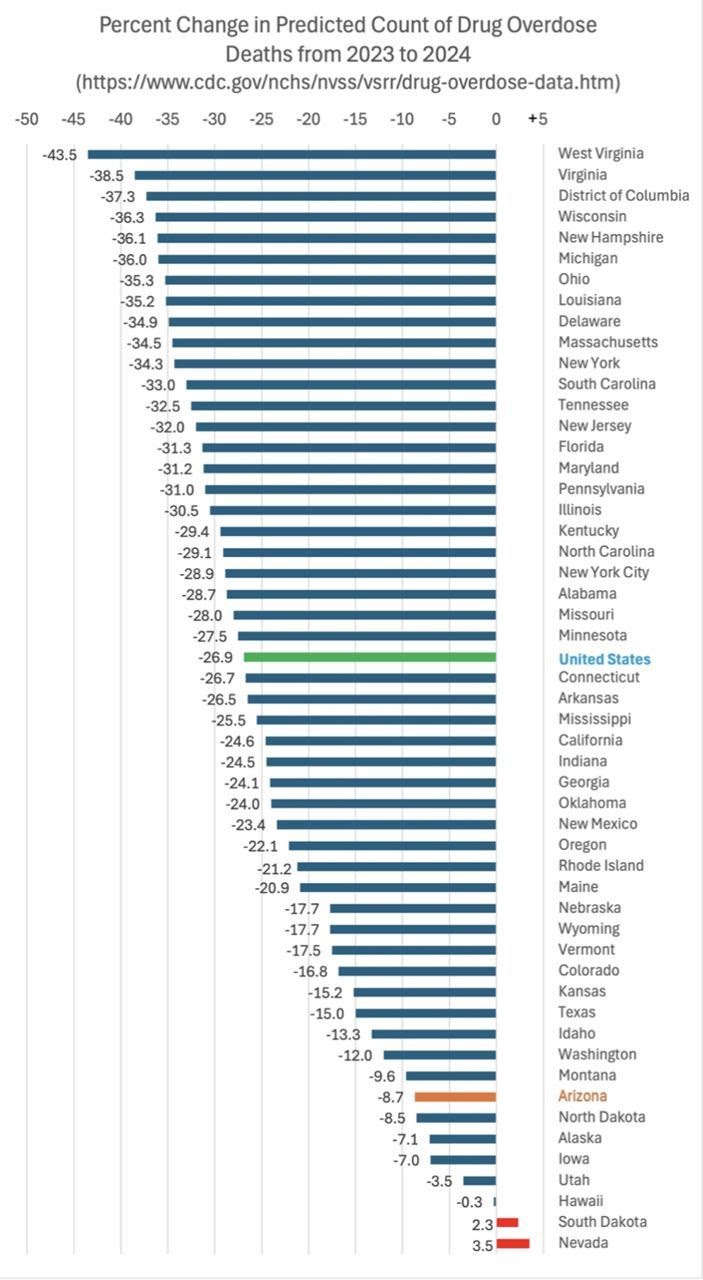
The CDC’s Provisional Drug Overdose Death Counts reported that there were 29,646 fewer drug overdose deaths in the US in 2024, dropping from 110,037 in 2023 to 80,391 in 2024, an unprecedented 26.9% decline. This was the lowest number of overdose deaths since 2019.

All but two states experienced declines, and the declines varied by over 100-fold (see chart below). The largest percent decline in overdose deaths was in West Virgina (43.5%) and the smallest decline was in Hawaii (0.3%). Small increases were found in Nevada (3.5%) and South Dakota (2.3%).

Drug overdose deaths in Arizona declined from 2,780 in 2023 to 2,539 in 2024, an 8.7% decrease, one of the smaller decreases in the US.  Regression analysis indicated a small (R2=0.22) but significant association between rates of drug overdose deaths in 2023 and the percent decline in deaths in 2024.

The drug overdose deaths included in the CDC analysis included opioid deaths as well as other drugs such as cocaine and methamphetamine.  Multiple drugs may be involved in drug deaths and these deaths are counted in each of the identified drug categories.

There were 28,397 fewer opioid deaths in the US, a decline of 34.2%—from 83,140 in 2023 to 54,743 deaths in 2024—which were largely responsible for the overall decline. Deaths from synthetic opioids excluding methadone (primarily fentanyl and its analogs) declined by 36.5% (76,282 to 48,422 deaths). There were 8,659 fewer US deaths involving cocaine in 2024, a  28.1% decline, and 7,640 fewer US deaths involving psychostimulants with abuse potential such as methamphetamine, a 20.6% decline.

In Arizona, deaths involving opioids declined by 321 deaths (2,053 to 1,732, a 15.6% decrease). Deaths involving synthetic opioids other than methadone (primarily fentanyl) declined by 346 deaths (18.5%). Deaths involving cocaine remained constant, while deaths involving psychostimulants increased by 69 deaths (4.5%).

Ten-year Trends in Drug Overdose Deaths

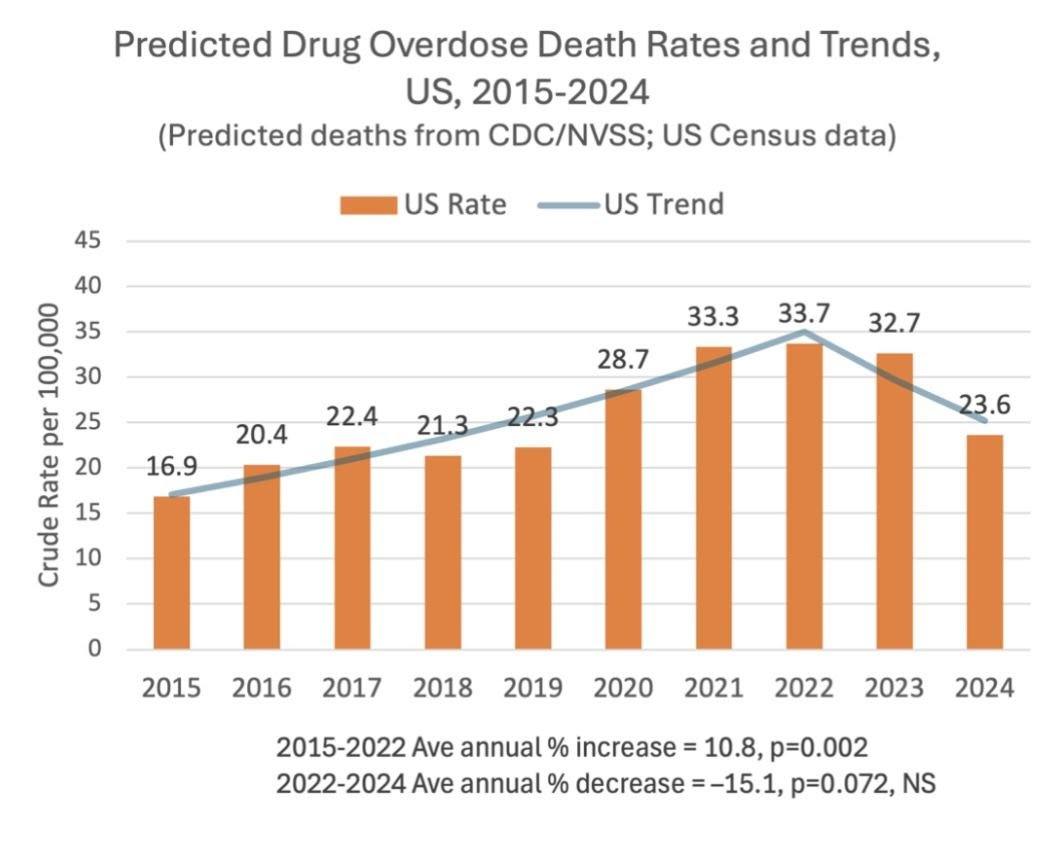
The CDC report included the reported and predicted numbers of drug overdose deaths in the US and in the states from 2015 to 2024. Using the “predicted” death counts for consistency with other findings and US census data for denominators, crude rates of drug overdose deaths per 100,000  from 2015 to 2024 were calculated and a Joinpoint trend analysis conducted for both the US and Arizona.

Predicted US drug overdose death rates increased significantly by 10.8% per year from 2015 to 2022. From 2022 to 2024, the rate decreased by 15.1% per year, although the trend did not reach statistical significance. However, the rate in 2024 was significantly lower than the 2023 rate.

The drug overdose death rate in Arizona also increased significantly by 14.0% per year from 2015 to 2021, then declined by a non-significant 4.6% per year. As with the US data, the rate in 2024 was significantly lower than the rate in 2023.

No Single Explanation for the Decline

This unprecedented decline in 2024 was widely reported by the media (CNNWash PostNYTimesPBS Horizon, among other sources) with numerous quoted experts and health officials agreeing that there is no single cause for the decline, but that multiple factors are likely to have contributed. As described previously in the March 16 Policy Update, these factors include increased access to and use of naloxone, better access to treatment, and possible changes in the drug supply.

Increased availability and use of naloxone:

Seven out of ten drug overdose deaths involve opioids. Naloxone is a drug that rapidly reverses an opioid overdose and is a critical tool in preventing opioid deaths. Since 12/31/21, virtually every state allowed licensed pharmacists to provide naloxone to patients without a prior prescriber visit through standing or protocol orders or other means.  Retail pharmacy-dispensed naloxone prescriptions increased 122% from Q! 2019 to Q4 2023 (Rikard, 2024). 

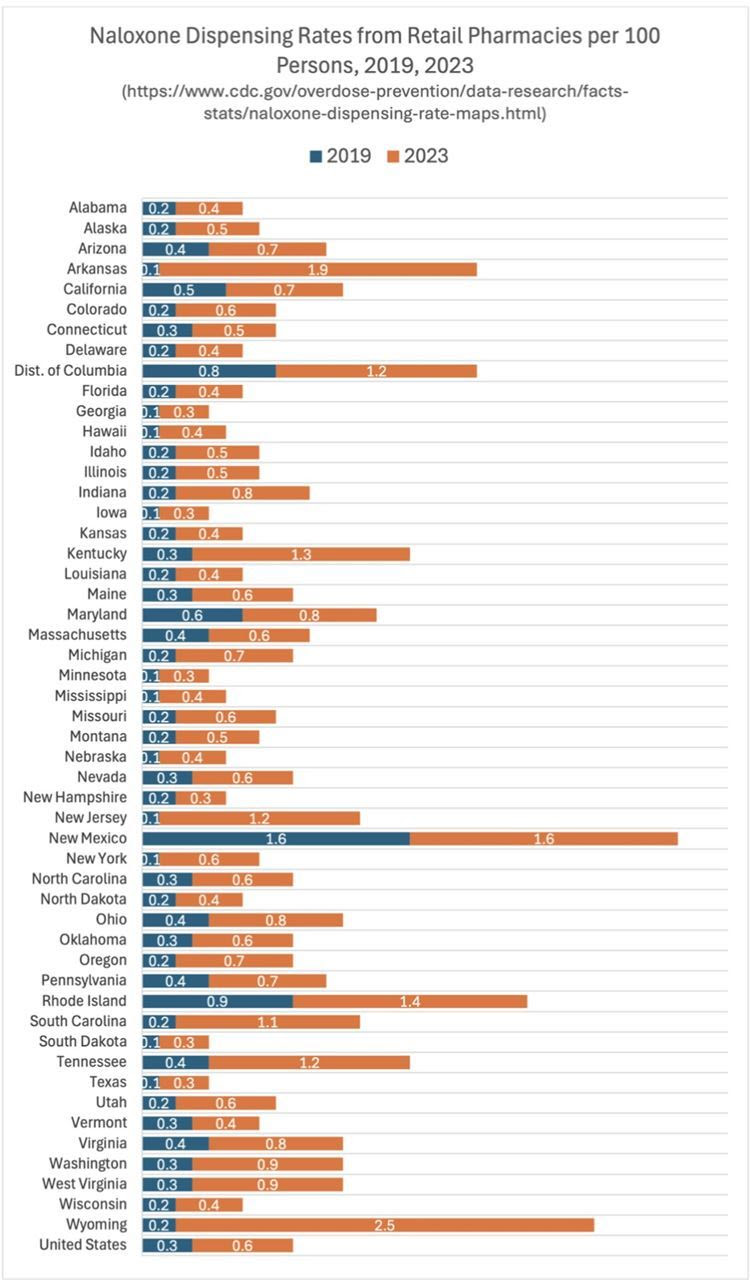
This study did not include naloxone sold over the counter – approved by the FDA in March 2023 – or naloxone distributed outside of pharmacies by community and public health programs, first responders, hospitals, some librariesvending machines, by mail, or other sources. According to the CDC, the overall rate of naloxone dispensed from retail pharmacies in the US increased from 0.3 to 0.6 per 100 persons from 2019 to 2023 and more than 2.1 million naloxone prescriptions were dispensed from retail pharmacies in 2023 (see chart below).

Fentanyl Test Strips

The rapid rise in opioid deaths – as well as the recent decline – was driven mainly by fentanyl. Fentanyl is often added to other illicit drugs by the suppliers, creating a greatly increased risk of an overdose.

Fentanyl test strips (FTS) can identify the presence of fentanyl in drugs. Arizona legalized FTS in May of 2021. As of Dec. 2023, 45 states and the Dist. of Columbia had permitted the use of FTS and several studies have reported changes in drug behavior and safety awareness following positive FTS findings.

Better Access to Treatment

The Biden administration expanded access to addiction treatment medications such as methadone and buprenorphine which reduce opioid withdrawal symptoms (as well as expanding access to naloxone).

In addition to federally funded drug treatment programs (which may or may not be continued by HHS), state and local governments in the US received more than $6 billion in opioid settlement funds in 2022 and 2023 (Arizona received over $97 million and is expected to receive over $1billion over 18 years).

review of reported spending of opioid funds by KFF, Johns Hopkins, and Shatterproof, indicated that states allocated an average of 18% of their funds for addiction and mental health treatment; 14% for housing, transportation, legal aid; 11% for harm reduction efforts such as naloxone; and 9% to programs to prevent substance abuse disorders.

Overall, the top priority from early opioid spending was treatment, with $416 million targeted to residential rehab, outpatient counseling, medications of opioid use disorder, and more. The review did not include spending in 2024.

Changes in Drug Use or Supply

While the Biden administration took steps to limit the export from China of the precursor chemicals used to manufacture fentanyl, the impact remains uncertain. The US Customs and Border Protection reported a 19% decline in fentanyl seizures in fiscal 2024 compared to FY 2023. However, this followed an 83% increase in 2023.

Cocaine seizures showed a 16% decline in 2024, following a 15% increase in 2023. Methamphetamine seizures, on the other hand, increased 24% increase in 2024, following a 20% decline in 2023. Given the up-and-down swings in annual and monthly drug seizures, these changes may reflect enforcement priorities and resources as much as changes in drug trafficking.

Some experts theorize that the drug supply in some regions may include less fentanyl when combined with other drugs such as xylazine, while others suggest that fewer people are using drugs alone.

Finally, with respect to a safer drug supply, it might be noted that a recent Canadian studyfound that two interventions—providing pharmaceutical-grade opioids to people who use toxic street drugs and decriminalization of drug possession—significantly increased opioid-related hospitalizations by 58% with no clear evidence of a change in opioid deaths.

Reduced Number of Susceptible People

It has also been suggested that there are fewer people at risk given the high death toll among regular users of fentanyl year after year. Grim, but maybe a factor.

Will the Decline Continue?

Despite the availability of opioid settlement funds, possible cuts to federally-funded programs to address drug abuse (including Medicaid) could undermine prevention efforts. In addition, a recent study found that 11% of adults surveyed in June 2024 reporting using illicit opioids during the past 12 months, a higher prevalence than has been previously reported.

Use was higher among men, Black respondents, and younger age groups (drug overdose deaths are still the leading cause of death among 18-44 year olds, according to the CDC).

Technical Notes:

Drug overdose deaths were identified by underlying cause of death ICD-10 drug overdose codes X40-44 (unintentional), X60-64 (suicide), X85 (homicide), and Y10-Y14 (undetermined).

Drug overdose death counts obtained from “final” CDC Wonder differ slightly from the counts tabulated by the NVSS since the NVSS internal database continues to update death data after annual data is declared “final” in CDC Wonder and is no longer updated with newly reported data. For example, CDC Wonder final data for 2023 indicated 105,007 drug overdose deaths in the US, while NVSS indicated106,881 deaths.

Since drug overdose deaths require lengthy investigations and toxicology testing, there is a longer delay in reporting those deaths compared to other causes of death. To adjust for underreporting in 2024, “predicted” counts were estimated for each state and the US based on the reported provisional (incomplete) counts which were then adjusted using the degree of completeness based on previous final vs provisional data.

Save Money & Energy Via Arizona’s New Efficiency Program

Arizonans under 150% of area median income are now eligible to take part in a program to improve the energy efficiency and save money on utility bills!

The initiative is called EFFICIENCY ARIZONA and it’s offered by the Arizona Governor’s Office of Resiliency through the DEO Home Energy Rebates programs.

Efficiency Arizona | Save Money. Save Energy.

Arizona was allocated $153M from the Inflation Reduction Act to assist over 20,000 households in upgrading energy-efficient appliances. Eligibility is limited to households under 150% of the area median income.

Even though Trump signed an executive order directing the Department of Energy to end disbursement of funds under the Inflation Reduction Act, court actions have ordered the Department to release the funds.

In addition to A/C replacements, the program includes upgrades like dryers, insulation, ventilation, ovens, stoves, and water heaters. People who already have a heat pump aren’t eligible for the A/C part of the program.

Here’s the Program Toolkit with key messaging, resources, social media sample posts, press release and LTE templates, and Spanish-language messaging.

Arizona Grants Compiled by Vitalyst Health Foundation

Due May 16th: Trans Justice Funding Project

Due May 28th: Access to Housing and Economic Assistance for Development (AHEAD) Grants

Due May 30th: ACF of Cochise

Due May 31st: Arizona Justice Reinvestment Grants

Due May 31st: Fast Pitch Competition (Women Founders Network)

Due June 2nd: Basic Field Grant Applications

Due June 2nd: Innovative Grants

Due June 2nd: AWS Imagine Grant Program U.S.

Due June 4th: Systems for Action: Community-Led Systems Research to Address Systemic Racism

Due June 18th: Native American Partnership Fund

NEW Due June 20th: Tribal Wildlife Grant Program (Federal)

Due June 26th: Safe Streets and Roads for All (SS4A) Grant Program (Federal Funding)

NEW Due June 30th: Verizon Business Digital Ready Grant (for-profit)

NEW Due June 30th: T-Mobile Hometown Grant

Due June 30th: NFL Foundation Grassroots Program

Due June 30th: Arizona’s Digital Equity Program

Due June 30th: Stable Housing and Empowering Communities

Due July 1st: New Earth Foundation

NEW Due July 3rd: Broadband Equity, Access & Deployment (BEAD) Program

NEW Due July 14th: The Community Arts Grant Program (Scottsdale)

Due July 25th: Software Initiatives

NEW Due August 4th: Food Access and Retail Expansion Fund (predevelopment, planning, and implementation)

Due August 4th: Innovative Grant (Southeast Arizona)

NEW Due August 15th: Tribal Housing and Urban Development-Veterans Affairs Supportive Housing (Federal)

Due August 15th: Navajo Nation Chapter / Community Contributions Grant

NEW Due September 30th: Indian Community Development Block Grant (Federal)

Due October 31st: Native American Community Activities and Contributions Grant

Due December 15th (Opens October 1st): Shade Structure Grant

Ongoing: Community Heart & Soul Seed Grant Program

Ongoing (until October 31st): Community Action Fund (Indigenous-led)

Ongoing: Arizona Housing Fund 

Ongoing: Arizona Together for Impact Fund