AHCCCS 101, Part 3: Contract Management & Accountability

In Part 1, we walked through why Arizona built AHCCCS using managed care from the beginning. In Part 2, we covered how the state gets permission from the federal government to design and update the program using waivers and State Plan Amendments.

AHCCCS 101 (Part 1 of 4): AHCCCS’ Origin Story – Why Arizona Built Medicaid Different – AZ Public Health Association

AHCCCS 101 (Part 2 of 4): Waivers, State Plan Amendments and Who Decides – AZ Public Health Association

Now we get to what AHCCCS actually does every day.

At its core, AHCCCS’ main job is contract management.

Before we get into that, it’s worth stepping back and remembering how many people depend on this system. AHCCCS provides health insurance to well over 2 million Arizonans in a typical year.

That includes kids, people with disabilities, seniors needing long-term care, and adults (and some kids) with serious mental illness.

So how does AHCCCS make sure those people actually get care?

It goes back to the model we talked about in Part 1. AHCCCS doesn’t pay most providers directly. Instead, it contracts with health plans called AHCCCS Complete Care contractors and pays them a fixed amount per member per month.

Those contractors are responsible for building provider networks, paying claims, and making sure members get the services they’re entitled to.

That means AHCCCS is paying these plans with taxpayer dollars and trusting them to deliver care. So the agency’s job is to make sure the plans do what they said they would do in the contracts they signed.

Note: The American Indian Health Program is an administrative exception to the AHCCCS as contract manager rule -as the agency directly runs that fee-for-service program. In my opinion the horrible multi-billion-dollar fraud and human trafficking that occurred during the Ducey Administration probably wouldn’t have happened if a contractor were running AIHP & AHCCCS was regulating the contract.

One of the main tools AHCCCS uses is something called ACOMs, which stands for AHCCCS Medical Policy Manuals. These are detailed policy documents that spell out what services must be covered, how decisions should be made, and what standards plans are expected to meet.

In simple terms, ACOMs are the contractual rulebook that health plans have to follow.

But writing rules for required services isn’t enough. AHCCCS also needs to check whether plans are actually following them. Contract management. Compliance and enforcement.

AHCCCS conducts regular audits of its contracted health plans. These reviews look at things like whether claims are being paid correctly, whether services are being approved appropriately, and whether plans are meeting their contractual obligations.

Another key area is network adequacy. This is about whether a plan has enough doctors, specialists, and providers so members can actually get care when they need it. A benefit on paper doesn’t mean much if there’s no provider available to deliver it or if people have to wait forever for an appointment or drive a super long way for care.

Quality is another focus. AHCCCS uses national performance measures like HEDIS (Healthcare Effectiveness Data and Information Set) to track how well plans are doing. These measures look at things like preventive care, chronic disease management, and follow-up after hospital visits.

If plans don’t meet expectations, AHCCCS can require corrective action and in some cases impose financial penalties.

Members themselves are also part of the accountability system. If someone is denied a service or has trouble getting care, they can file a grievance or an appeal. Those complaints are tracked and reviewed, and they can highlight patterns of problems within a health plan.

All of this ties back to the core idea from Part 1.

AHCCCS pays health plans a fixed amount per member per month. A plan can save money by postponing care, denying services, or offering a poor network.  That creates a real risk. That’s what AHCCCS is supposed to prevent.

That’s why contract management is so important.

AHCCCS has to make sure that the care it’s paying for is actually being delivered. Not just on paper via the contract but in real life.

In Part 4, we’ll take a closer look at the real-life part of AHCCCS…  how people enroll, who qualifies, – basically what real live people experience in the real world.

Two-Minute Warning at the Capitol (but both sides have unlimited time outs)

If you read our late-March update—Committee Deadlines Hit, Floor Action Accelerates, and Budget Negotiations Start—we said we were in the “late third quarter” of the legislative session. Fast forward a few weeks, and now we’re at the two-minute warning.

Arizona’s “100-day session” is more of a suggestion than a rule, especially with divided government. Legislature leaders can keep things going, and they often do, but less so on election years like this.

Almost all committees are done (except for Rules). What’s left is Committee of the Whole amendments, and third read (final floor) votes.

Just like we predicted, budget negotiations have taken center stage, and they’ve hit the phase where informal talks break down followed by pressure tactics to force real negotiations.

The Governor, like most of those before her, told the legislature she’ll veto everything that comes to her until a budget deal is done. This isn’t a new strategy… it’s standard operating procedure. Governors from Fife Symington forward have used the same play. It’s a way to force leadership to stop messing around and finish the budget.

Until there’s a budget agreement, the rest of the legislative agenda is effectively frozen. Bills that made it through committees and are sitting on deck for third read in suspended animation.

Once the budget deal comes together (it will) you’ll see a rapid series of floor votes as lawmakers clear the backlog and send a wave of bills to the Governor.

One added wrinkle this year is whether the state aligns with federal tax changes under HR1, which could complicate and slow negotiations even more.

Whether any agency directors will get confirmation is unclear. Hoffman’s Director Nomination Committee has hardly met at all this session – although Ruvjit “Ruby” Dhillon-Williams is up in that committee for the Department of Housing job next week (4/20).

Will Debbie Johnston at ADHS or Roberta Harrison at AHCCCS get hearings? We don’t know.

AG Mayes Compels APS to Stop Cutting Off People’s Power When Temps are Over 95°F

This week Attorney General Kris Mayes compelled Arizona Public Service to stop cutting off people’s power when temperatures are above 95°F.

Attorney General Mayes Secures $7 Million Settlement with APS Following Investigation into Disconnection Practices During Extreme Heat | Attorney General’s Office

APS would never have done this on their own. This was only done in response to a $7M settlement with APS pressed by Mayes – resolving allegations that APS violated the Arizona Consumer Fraud Act because of their previous disconnection policies.

There were several concessions APS made in the agreement – but the public health win is a new APS policy to stop cutting off people for nonpayment when the forecast high is 95°F or higher.

APS was earlier compelled to pause disconnections between June 1 and October 15, so this new agreement extends beyond fixed calendar dates and tying it directly to actual heat risk.

The settlement reflects a basic public health principle: align policy with risk. A temperature-based standard is better than a rigid seasonal window.

Kudos to Attorney General Mayes for pursuing this evidence based public health intervention.

You can bet your bottom dollar that the current Arizona Corporation Commission (or former AG Candidate Hamadeh) would never have gotten this out of APS.

Some Welcome News for Public Health (maybe_

This week brought a surprise and some relief (maybe). The president nominated Erica Schwartz, MD, JD to lead the CDC.

She’s a board-certified preventive medicine doctor, a former deputy surgeon general, a retired Coast Guard officer, and has a law degree. More importantly, she actually believes in using evidence to guide public health policy decisions.

I gotta say, this pick looks like the president is stomping on Kennedy’s toes pretty hard. Kennedy built his brand on spraying false information about vaccines and doing whatever he can to undermine evidence-based public health.

Schwartz is the opposite. She has a long history of believing in the scientific method and using evidence and data to inform and drive policy decisions.

Dr. Georges Benjamin, head of the APHA and keynote speaker at our May 1 AZPHA conference, said this week:

I think the administration has identified someone who is highly qualified and has a demonstrated track record of competence in being both a good physician and a decent manager. Things she’s said have clearly been based on good science.”

If confirmed, Dr. Schwartz would be a check on Kennedy’s whimsical vibe-based policy making. Let’s hope she uses her authority to push back on Kennedy. A bit of brinksmanship would be refreshing.

Register Today: From Crisis to Care: Improving Outcomes in Arizona’s Behavioral Health System

We’ve just about finalized our agenda for the Arizona Public Health Association’s 98th Annual Conference, and this year’s program focuses on one of the most important public health challenges facing Arizona: strengthening our behavioral health system.

View Our Agenda and Conference Brochure

Join us Friday, May 1 at the Desert Willow Conference Center in Phoenix for From Crisis to Care: Improving Outcomes in Arizona’s Behavioral Health System.

The day will explore practical strategies to improve outcomes across Arizona—from crisis response systems and Medicaid policy to maternal mental health, housing supports, integrated care, and new analytic tools.

We’re honored to open the conference with Georges Benjamin, MD, Executive Director, American Public Health Association, one of the nation’s most influential physician leaders and a steadfast advocate for evidence-based public health policy.

Register Here

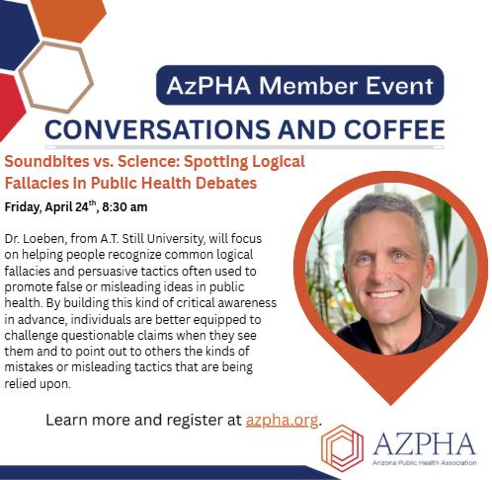
AZPHA Member Breakfast & Learn Soundbites vs. Science: Spotting Logical Fallacies in Public Health Debates


In an era where misleading and inaccurate information spreads rapidly online, public health professionals face the challenge of deciding how best to respond.

One common instinct is to search out evidence that directly disproves the false claim. 

While such an approach is important it can also be time-consuming and can delay one’s response.  It can also fail to address a common problem or tactic with public health rhetoric. 

In this talk I focus on helping people recognize common logical fallacies and persuasive tactics often used to promote false or misleading ideas in public health.

By building this kind of critical awareness in advance, individuals are better equipped to challenge questionable claims when they see them and to point out to others the kinds of mistakes or misleading tactics that are being relied upon.

Register Here

Greg Loeben, Ph.D., MPH, is currently an Associate Professor and the Practicum Director in the Public Health Department at A.T. Still University.  Dr. Loeben’s research interests focus broadly on public health ethics and clinical ethics, particularly in end-of-life decision making. 

Previously, he held faculty positions in Bioethics at Midwestern University in Glendale, Arizona, and the Center for Bioethics at the University of Pennsylvania. He has also taught courses at Arizona State University and the University of Arizona.  He has a long history of consulting and doing clinical medical ethics for hospital systems, hospices, and other healthcare organizations.

Public Comment Open on Phoenix Plan to Limit (forbid) Humanitarian Aid in City Parks

Last week I wrote about the City of Phoenix’s proposal to clamp down on humanitarian aid in public parks — things like wound care, vaccinations, and basic services that many unhoused folks need. Super basic safety net stuff.

The parks department is in a full court press to get their proposal signed off on by the Council.

Phoenix Parks Department Doubles Down on Red Tape to Stop Humanitarian Aid in Parks – AZ Public Health Association

The city is asking for public comment before the ordinance comes back to the Phoenix City Council in early May.

The current draft would place new limits and permit requirements on food distribution and medical services in parks including caps on how often organizations can provide care (only twice a month and then only if the city actually gives them permits – which are subject to subjective review.

If you believe parks should remain places where people can access basic humanitarian support — not just recreation — now is the time to speak up.

The City has set up a short survey to collect feedback. It only takes a few minutes, and it will directly inform what comes back to Council:

Weigh in here to express disapproval of the parks department ploy to stop humanitarian aid in city parks

They’re also hosting a handful of community meetings (in-person and virtual) over the next few days if you want to engage more deeply.

Bottom line: this proposal isn’t set in stone yet. Public input matters — but only if people actually weigh in.

Medical Treatment and Food Distribution in Parks | City of Phoenix

AHCCCS 101 Part 2: Waivers, State Plan Amendments and Who Decides

In Part 1, we walked through why Arizona built AHCCCS differently, using managed care from the start instead of fee-for-service.

AHCCCS 101 (Part 1 of 4): AHCCCS’ Origin Story – Why Arizona Built Medicaid Different

That raises the next logical question: how did and does Arizona get permission to design its Medicaid program this way? Remember – Arizona can’t just do what it wants because the federal government pays more than ½ of the cost for Medicaid – so the authorizing statute built some structure around how states can and can’t experiment with how they run their programs.

The federal government allows flexibility from the mainline approach to Medicaid, but only through specific tools. The two most important are Section 1115 waivers and State Plan Amendments, often called SPAs.

A Section 1115 waiver is a permission slip from CMS to try something new. It allows a state to waive certain rules in federal Medicaid law. Normally, states must follow detailed requirements about who is eligible, what services are covered, and how care is delivered and paid for.

A waver gives the state some room to step outside those rules and test a different approach. That’s what Arizona did back in 1982 when it asked for a waiver to use managed care instead of fee for service reimbursement for most populations (Native Americans being the exception)

But waiver flexibilities come with conditions. A waiver must still support Medicaid’s core purpose to provide coverage and care for required populations. Waivers are also supposed to be a real experiment (not just a policy preference) and when the state applies for a waiver they have to measure their results and report back.

Arizona’s recent H2O (Housing and Health Opportunities) waiver is a good example. It allows AHCCCS to cover certain housing-related services for members with high needs. The idea is that stable housing can improve health and reduce costly medical care. But Arizona has to track outcomes and show whether the approach actually works.

AHCCCS Tackling Housing Instability with Their New ‘H2O’ Program

A State Plan Amendment is different. Every state has a Medicaid state plan, which acts as the rulebook for the program. A SPA is simply a change to that rulebook. These changes still have to follow federal law, so they don’t require an experiment or formal evaluation like waivers do so SPAs are usually more routine and quicker to approve.

A simple way to think about it is this: a SPA updates the program within existing rules, while a waiver allows the state to test something outside those rules.

The process is fairly structured for both waivers and SPAs. AHCCCS develops a proposal and sends it to CMS. CMS reviews the request and can approve it, deny it, or ask the state to revise parts of it.

For waivers, there’s also a public comment period at both the state and federal level. In practice, many approvals involve back-and-forth negotiation before CMS signs off.

One concept that often causes confusion is “budget neutrality.” For 1115 waivers, the state has to show that the proposal will not cost the federal government more than what Medicaid would have cost without the waiver.

That doesn’t mean spending can’t change. But it does mean the aggregate cost to the feds won’t be higher. For example, with the H2O waiver they can spend more on housing support if they can show that it reduces other costs (e.g. hospitalizations).

Timing also differs between the two tools. SPAs are often approved in a few months. Waivers usually take a lot longer because of the added complexity, negotiations, and federal review (and the financial assessment).

If CMS doesn’t agree with a proposal, it rarely ends with a flat rejection. More often, CMS partially approves the request or requires changes before moving forward. States then revise and resubmit. Arizona uses both tools regularly.

Arizona Section 1115 Demonstration Waivers

Arizona Medicaid State Plan Amendments

Waivers are used for broader system changes like housing supports or delivery system reforms. SPAs are used for more routine updates, like adjusting payment methods or adding services that already fit within federal rules.

The key takeaway is simple. SPAs are for changes within the rules. Waivers are for testing new ideas outside the rules.

In Part 3, we’ll move from policy to practice and walk through how AHCCCS works day to day… how people enroll, how they get assigned to a health plan etc.

Kennedy’s 2027 Budget Guts Public Health

Secretary Kennedy and the president released their proposed federal budget for FFY 2027 (starting October 1, 2026) last week. As expected, it calls for deep cuts across core public health programs including some that Kennedy has publicly supported, like physical activity and nutrition.

Bottom line: depending on how you define “core public health,” the proposal cuts funding in the range of roughly 20–30% across major prevention and public health program lines. Some individual programs are reduced far more—or eliminated entirely.

A reminder: this is just a proposal. Congress decides what actually gets funded. But the current Congress has shown a pattern of rubber stamping the administration and budget bills only require a simple majority in the Senate.

At the same time, Congress often falls back on continuing resolutions instead of passing full budgets. So the real question is whether this year breaks that pattern and whether these cuts move from paper to practice.

NACCHO Analysis: FY27 Kennedy’s Budget Request

Legislative ASTHO Analysis: FY 27 Kennedy Budget Request

The proposal significantly reduces overall discretionary funding for public health and restructures how funds are delivered. In several cases, it combines or drops categorical programs and replaces them with broader block-style approaches.

State and Local Public Health

Kennedy wants to dramatically cut funds that flow to state and local health departments.

  • Big cuts to core infrastructure funding that supports epidemiology, lab capacity, and workforce
  • Reductions or elimination of programs that fund day-to-day public health operations
  • Less support for data modernization and surveillance systems

Chronic Disease and Prevention

Programs aimed at preventing long-term conditions see widespread reductions:

  • Heart disease, diabetes, and cancer prevention programs scaled back
  • Tobacco control funding reduced
  • Injury and violence prevention programs cut

Maternal and Child Health: Constrained Investments

The proposal trims or restructures funding for maternal and child health programs:

  • Reductions in programs that support maternal health outcomes
  • Cuts to early childhood and family health initiatives
  • Less investment in addressing disparities in birth outcomes

Infectious Disease and Preparedness: Mixed Signals

Some high-profile preparedness functions are kept, but the broader system is weakened:

  • Select funding for pandemic preparedness stays
  • But cuts to the public health workforce and infrastructure undermine readiness
  • Reductions in immunization program support at the state/local level

Nutrition and Physical Activity

Despite Kennedy’s bloviations about prevention and lifestyle:

  • Nutrition programs face cuts or restructuring
  • Physical activity initiatives are reduced
  • Community-based prevention efforts are scaled back

What Happens Next?

Congress now takes over. There are a few realistic paths:

  1. Full adoption (unlikely but possible): Congress passes a budget close to the proposal
  2. Partial restoration: Lawmakers push back on the most visible cuts
  3. Continuing resolution: Funding stays flat, delaying major changes

Historically, CRs are common, but the political environment this year makes outcomes less predictable. For now this is all in suspended animation.