Arizona’s 2026 Legislative Session & Ballot Propositions:  The Good, the Bad & the Ugly—A Public Health Perspective

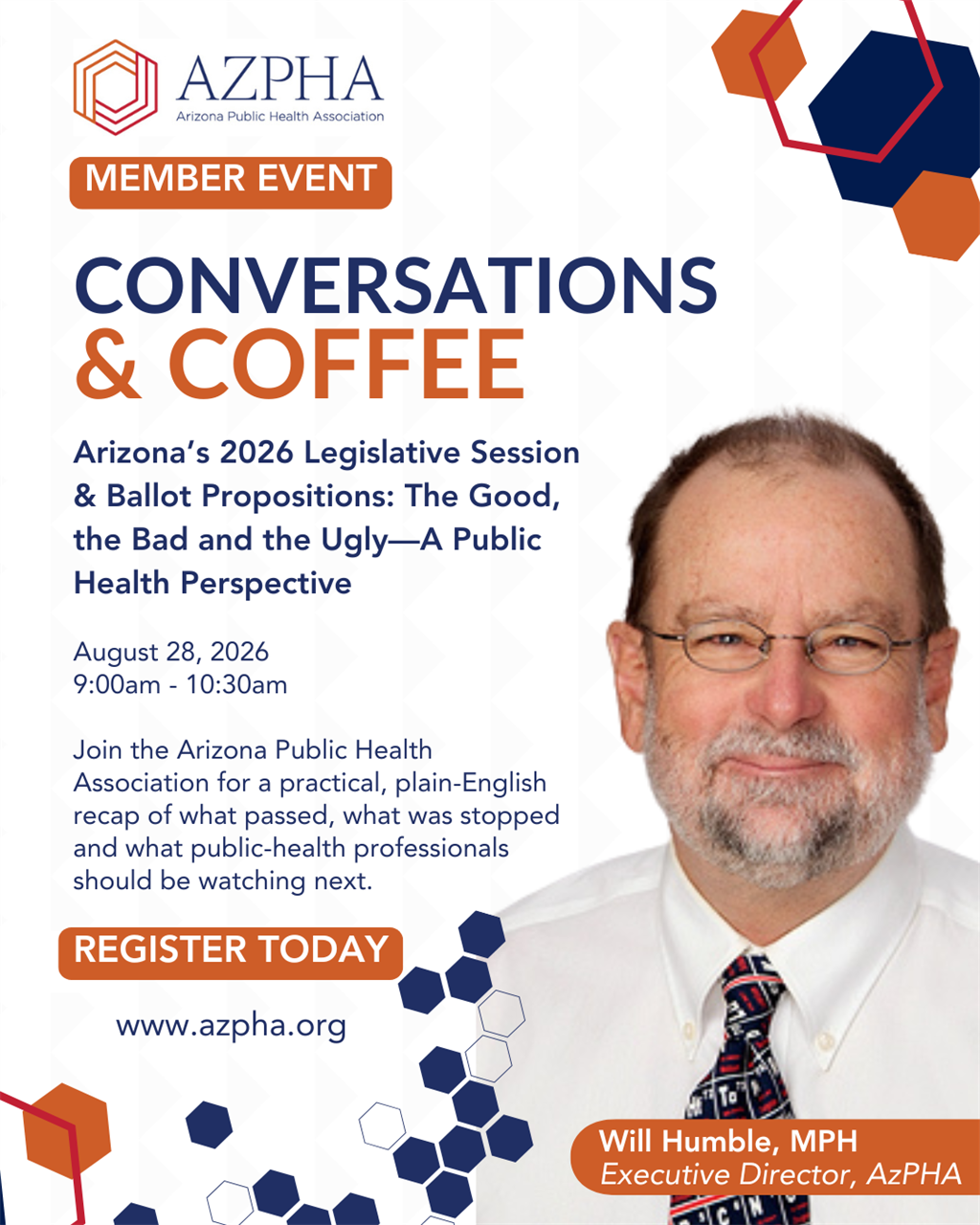
AZPHA Coffee & Conversations

Arizona’s 2026 Legislative Session & Ballot Propositions: 

The Good, the Bad & the Ugly—A Public Health Perspective

Arizona’s 2026 legislative session produced some meaningful public-health wins, several important gubernatorial vetoes and a state budget that will directly affect Medicaid and food-assistance programs.

Now, voters will face 11 statewide ballot propositions this fall—including measures affecting mail voting, school vouchers, public-employee unions, traffic-safety cameras and school funding.

Join the Arizona Public Health Association on August 28 at 9am for a practical, plain-English recap of what passed, what was stopped and what public-health professionals should be watching next.


Will Humble, MPH, Executive Director of the Arizona Public Health Association, will review the most consequential health and human-services legislation, examine whether the state budget provides enough capacity to implement new AHCCCS eligibility requirements and walk through the 2026 ballot propositions from a public-health perspective.

Whether you followed every committee hearing or tuned out the Legislature months ago, this webinar will get you caught up—and ready for November.

Register today and bring your questions

View the ppt in advance

A Political Irony: How Ducey & Brewer Locked In Napolitano’s Agency Regulations

There’s an Arizona twist to state agency rulemaking that I’ve never quite understood.

Both the Brewer & Ducey administrations put handcuffs on agency directors when it comes to rulemaking. Each issued Executive Orders saying that agencies even start on a new rule unless they went through a cumbersome review process and got approval from the governor’s office. A nearly impossible feat.

Brewer’s moratorium had an odd but predictable effect: it largely locked in the agency rules adopted during the Napolitano administration. Napolitano’s agencies had been prolific rulemakers, and their rules remained in effect throughout the Brewer Administration.

Then Ducey continued the same approach for another 8 years.

So, in an effort to stop agencies from adopting new regulations, two Republican administrations effectively preserved a whole bunch of Napolitano-era rules at agencies like the ADEQ, ADHS, ADES, ADWR etc.

As a result, Napolitano’s rules governing air, water and waste, health, resource management are largely still intact even though she abandoned her post almost 20 years ago. 

Ducey’s hostility toward agency rulemaking turned out to be good for public health and the environment. If he had pursued rules, his agency directors would have undoubtedly weakened protections across the board.

I’ve never understood Brewer and Ducey’s strategy.

If I was governor, I’d take a lesson from Napolitano. I’d tell my agency directors to hire good policy people, find outdated regulations, and use my existing statutory authority to use agency rulemakings to lock in my priorities for the long haul.

When I was ADHS director, we were able to get several major rulemakings completed, but most were specifically required by statute. Medical marijuana was the obvious example. We also overhauled the regulations governing assisted living centers, skilled nursing facilities and behavioral health facilities.

To get that overhaul done, we worked with stakeholders to pass a bill directing ADHS to rewrite the rules. Governor Brewer signed it. In other words, we needed a statute requiring the agency to regulate before the agency could get through the barriers to rulemaking.

Rules have way more staying power and when subsequent governors are hostile to changing their predecessors agency rules they do themselves a disservice… but that turned out OK for state public health – at least in Arizona.

Public Health Policies Have a Shelf Life: Laws, Regulations, & Executive Orders

Kennedy, the president & Congress have made plenty of decisions that are damaging to public health over the last 1.6 years. Some reduce access to healthcare. Others weaken environmental protections, end important research or replace evidence-based decisions with political ideology.

But not all bad policies are equally durable. One way to assess the long-term risk (or benefits) of the actions that they’ve taken is to look at which approach they took.

Did they actually change law? Did they not change law, but alter official agency regulations? Or, did they just issue an executive order?

Federal policy changes fall into 3 main categories: 1) laws passed by Congress; 2) regulations adopted by federal agencies; and 3) executive orders issued by the president.

This Week’s Exhibit: Low Durability Executive Orders

This week the White House released a new government-wide policy implementing an executive order the president signed in May 2025. The policy changes how federal agencies review and fund certain life-sciences research proposals.

It deals largely with what they call “dangerous gain-of-function,” or DGOF, research. That basically means research that might make a biological agent more dangerous… for example, by increasing its ability to spread, resist treatment, evade a vaccine or infect a new species.

Under the new policy (again – just an executive order), the HHS agencies aren’t supposed to fund research that meets its (nebulous) DGOF definition. Research that might potentially cross that line must undergo additional risk-benefit reviews by the researcher, the research institution, the federal funding agency and a new government-wide review body.

USG-Policy-for-Stopping-High-Risk-Life-Sciences-Research_July-2026

I’m not going to pass judgment on the EO from last week in this blog (much will depend on how it’s implemented)… mostly I’m using it as an example of a non-durable policy change.

It isn’t a law passed by Congress. It isn’t a regulation placed in the Code of Federal Regulations. It’s an executive-branch policy established through an executive order.

That makes it the least durable policy change – because a new president can come in and rescind the EO and it goes away at once (although federal agencies would of course need time to change their internal policies).

The Middle: Federal Regulations

So executive orders are the least durable policy changes. The next rung is formal agency rulemaking.

Congress often passes broad laws and directs agencies like HHS, CMS or EPA to fill in the details. Agencies do that through regulations, usually by publishing a proposed rule, accepting public comments and eventually issuing a final rule that becomes part of the Code of Federal Regulations—the CFR.

That process can take months or even years and is subject to federal government wide administrative policy laws.

The administration is using this process aggressively. OMB, for example, has proposed rewriting federal grant regulations to give political appointees more power over which grants are awarded or canceled.

AzPHA submitted comments opposing that proposal. EPA also has several rulemakings underway that would weaken environmental and public health protections.

Action Alert: Federal Government Planning to Implement Political Litmus Tests for Federal Grants Across All Health Agencies

A future administration can reverse those rules but changing them takes months or years. The agency has to conduct another rulemaking, accept comments, build an administrative record and defend its decision in court.

Most Durable: Laws Passed by Congress

The hardest policies to reverse are statutes.

When Congress passes a bill and the president signs it, the requirements become federal law. A future president can’t simply sign an executive order and make that law disappear. Congress needs to pass another bill changing or repealing it.

The new federal Medicaid work requirement is an example. Because Congress placed it in federal law, a future president couldn’t end the requirement alone. An administration might have some flexibility over implementation but repealing it would require Congress to act.

That’s why harmful statutory changes present the greatest long-term public health risk. They can continue causing damage long after the president, cabinet secretaries and political appointees who promoted them are gone.

Summary

Executive orders can cause immediate disruption, but they’re relatively easy to reverse. Rule changes can be pretty durable – but they take months or years to complete and reversing them also will take a lot of time. Statutory changes are super durable – because it takes an act of congress (and the president’s signature) to reverse the law.

When we evaluate this administration’s harmful public health actions keep in mind that some are long-lasting (Medicaid eligibility changes), some are changeable with some elbow grease and time (e.g. EPA changes to loosen air quality standards), and some can be gone like a flash when there’s a new president (Executive Orders).

How Birds, Mosquitoes & Monsoons Drive West Nile

Maricopa County is having an active West Nile virus season. As of last week, we had 47 human cases and five deaths. 183 mosquito trap samples have tested positive, already more than during all of 2025… and we have a few months to go.

Birds Are the Reservoir

People get West Nile virus from the bite of an infected mosquito. But mosquitoes don’t get the virus from people. They get it by feeding on infected birds.

West Nile Virus | CDC

Here’s how it works. A mosquito bites an infected bird and picks up the virus. It then spreads the virus by biting more birds. The main blood meal for the female mosquitoes are birds, but some of the mosquitoes end up biting people (birds are an easily accessible outdoor target – and there are lots of birds around).

Birds have immune systems too. Most birds survive West Nile infection and develop immunity after that, making them less likely to become infected again and pass the virus to another mosquito… which explains why West Nile tends to run in cycles.

A wet and wild monsoon can produce lots of mosquitoes. But mosquitoes alone don’t cause a large outbreak. The virus also needs susceptible birds to keep the bird-mosquito-bird cycle going.

After a few summers with low West Nile activity, more young birds enter the population without immunity. If a wet summer, then produces lots of mosquitoes, the virus can take off because there are lots of easily accessible birds around.

Lots of mosquitoes plus lots of susceptible birds equals more virus in the mosquito population and more chances for people to get infected.

Clinical Signs and Symptoms of West Nile Virus Disease | West Nile Virus | CDC

Finding the Hot Spots

Our county health departments all have vector control programs that depending on what part of the state they’re in do varying levels of mosquito abatement work. Maricopa County sets hundreds of mosquito traps across the Valley.

Many use dry ice, which releases carbon dioxide to attract the mosquitoes to the trap. Mosquitoes are attracted to carbon dioxide because it is one of the signals they use to find animals and people.

County staff collect the mosquitoes and test groups of them for West Nile virus. The results help find neighborhoods where infected mosquitoes are concentrated.

That gives mosquito-abatement staff clues about where to look for standing water and breeding sites.

Most homeowners know to check buckets, flowerpots, wheelbarrows, old tires and clogged gutters after it rains.

But we have lots of other breeding sites too. For example, we have thousands of neglected swimming pools in Arizona. Some have broken pumps or bad water chemistry. Some are completely drained but collect enough rainwater to breed mosquitoes.

Storm drains can be another weird source. Leaves, trash and other debris can block drainage under the street level and leave pockets of water underground.

Once a breeding site is found, mosquito-control staff can remove the water or use larvicide to prevent mosquito larvae from becoming adults. When infected adult mosquitoes hot spots are found via the mosquito traps, the county may also use targeted spraying to kill the adult mosquitoes.

What Can You Do?

Start with your own property. Dump or treat standing water. Check pool covers, toys, plant saucers, irrigation equipment and containers hidden along the side of the house.

Pay attention to the neighborhood too. Report green pools, clogged drains and other likely breeding places.

Use mosquito repellent when mosquitoes are active. Wear loose-fitting long sleeves and pants when practical, especially around dusk and dawn.

Small indoor mosquito traps may catch a few mosquitoes that get inside, but don’t let a gadget substitute for screens, repellent and getting rid of standing water.

Could 2004 Happen Again?

Arizona’s 2004 outbreak was unusual because West Nile had only recently arrived. Almost none of the bird population had immunity so the virus spread rapidly in the urban bird population. Maricopa County recorded 355 cases that year.

But we shouldn’t assume an outbreak that large can never happen again. In 2021, Maricopa County had 1,487 cases and 101 deaths the largest West Nile outbreak ever recorded in a single U.S. county.

Note: 2021 was an active monsoon in the Phoenix area. The airport reported 4.20 inches that summer. The Phoenix Rainfall Index, which averages gauges across the Valley, measured 5.82 inches—the second-highest total since that index began in 1990.

West Nile prevention is just one of the many ways county health departments quietly work every day to keep us healthy and safe. Their teams trap and test mosquitoes, investigate human cases, track neighborhood hot spots, find breeding sites and stop breeding to prevent things from getting worse. Most of that work happens behind the scenes.

We all have a role at the micro level: dumping standing water, maintaining our pools, reporting green pools and clogged drains, using repellent and paying attention to what’s happening around our own homes.

County health departments manage the big picture. The rest of us need to manage our part of it.

Research Surveillance Note:

Crystal M. Hepp, Ph.D., an Associate Professor at the NAU School of Informatics, Computing, and Cyber Systems has made some interesting discoveries about WNV in Arizona.

    • Genomic efforts have revealed that West Nile virus is endemic in Maricopa County, and has been since 2013. This means that rather than being imported from somewhere else, the same variant of the virus that was circulating in the prior year is able to overwinter in the county due to mild winters, and then reemerge the following year.
    • Genomic efforts have additionally revealed that the latest variant that is causing the majority of WNV transmission in the county entered the county in 2023, starting in the southeast valley. Over the next three years, this variant moved west across the valley, with 2025 showing the greatest amount of westward dispersal. This movement was supported by the warmest winter on record, resulting in near-continuous WNV circulation.
    • Research has further identified a few distinct source locations that are being or have been targeted for additional mitigation efforts to further drive down the virus population and reduce risk.
West Nile cases rise in Arizona – Arizona PBS