Cleaning Up the Books, Undoing Prior Damage & Moving Public Health Forward
Buckle up. This is going to be the longest blog post I’ve written. But I think it has to be. I really don’t want to break it up into smaller blogs – but maybe I’ll do that later.
For pretty much my whole 30 plus public health advocacy career I’ve spent a lot (most) of my time on defense – trying to stop bills that are bad for public health. For the next two years we can shift from our heels to our toes.
Note: As I write this it looks like the Democrats will have a 20-10 majority in the Senate and a 38–22 majority in the House. This hasn’t happened since I was in 1st grade.
I’ve been reviewing our earlier legislative reports & blog posts and thinking about what a more prevention-oriented legislative agenda could look like.
In this post I’ll cover a menu of public health policy opportunities for the incoming legislative majority to consider… not a list of demands or even a proposed legislative agenda for the first session. The purpose is to get the inventory of possibilities out there.
There will need to be discipline from the new majority in deciding what to take on first. Some ideas are relatively straightforward, while others require substantial appropriations or detailed stakeholder input. Some will need careful legal work. Some might be right for 2027, while others may need to wait until 2028.
I’ve organized the opportunities into three categories: 1) easy cleaning up of obsolete laws; 2) repealing harmful laws passed during the Brewer & Ducey administrations; and 3) advancing evidence-based public health policies that haven’t received serious legislative consideration yet.
_______________
Part I: Cleaning Up the Books
Reproductive Health: Aligning Arizona Statutes w/ Prop 139
Arizona voters approved Proposition 139 in 2024, setting up constitutional protections for abortion care. But that didn’t remove legacy abortion restrictions from Arizona’s statutes.
For example, Governor Ducey signed Arizona’s 15-week abortion restriction in 2022. That provision has been found unconstitutional but is still on the books. Last February a state court judge struck down several restrictions, like mandatory waiting periods, ultrasound requirements, telemedicine restrictions and prohibitions relating to fetal genetic abnormalities. But – that ruling is still subject to appeal.
Let’s relieve the judicial docket by simply repealing them.
There’s already a legislative starting point. HB2653 from 2026 from last session proposed a broad repeal of abortion-related restrictions. Other proposals, including SB1219 and SB1220, addressed fetal provisions and abortion consent requirements. They never even got assigned to a committee.
Contraceptive access also deserves consideration. SB1396 from 2026, the proposed Arizona Right to Contraception Act, would have set up explicit statutory protections for obtaining and providing contraception. Something important to codify given the makeup of the Arizona and US Supreme Courts. Again, the Republican’s wouldn’t even consider those this year.
The Attorney General’s reproductive rights litigation page provides a useful summary of the legal landscape. Totally simple place to start and an easy lift.
__________________
Part II: Undoing Public Health Policy Damage
Restoring Public Health Authority
1. Back in 2022 Governor Ducey pushed a bill that limits Arizona governors to only establish public health emergency in 30 day increments (ARS § 26-303). It passed. The maximum time for a public health emergency is now 120 days unless the governor gets the legislature to approve 30 day extensions (Ugenti-Rita bill).
One of our top priorities should be to completely repeal those limits and revert to the public health emergency authority as it existed before Ducey and the Legislature watered it down: 36-787 – Public health authority during state of emergency or state of war emergency; notices; appeals.
An alternative would be to allow the governor to declare the PH emergency for one year with additional 6 month extensions with the consent of the legislature.
Note: The legislature tried to make this measure voter protected by putting it on the ballot (as Proposition 135). Voters rejected that proposition 56% No to 44% Yes.
2. Additionally, during the COVID-19 pandemic, the legislature and Ducey enacted restrictions on what public health officials, local governments and other institutions can’t do to control communicable diseases. Ducey signed HB2770 which said businesses never have to enforce any government recommended mask mandates on their patrons. 44-7951 – Businesses exempt from mask mandate. We should repeal that too.
Concealed Firearm Carry
Governor Brewer signed SB1108 in 2010, ending the requirement that most eligible adults obtain a permit before carrying a concealed firearm. That change is reflected in A.R.S. §13-3102.
The Legislature should strike that law and restore concealed-carry permitting and training requirements, along with restrictions on local governments’ ability to adopt their own firearm-safety policies.
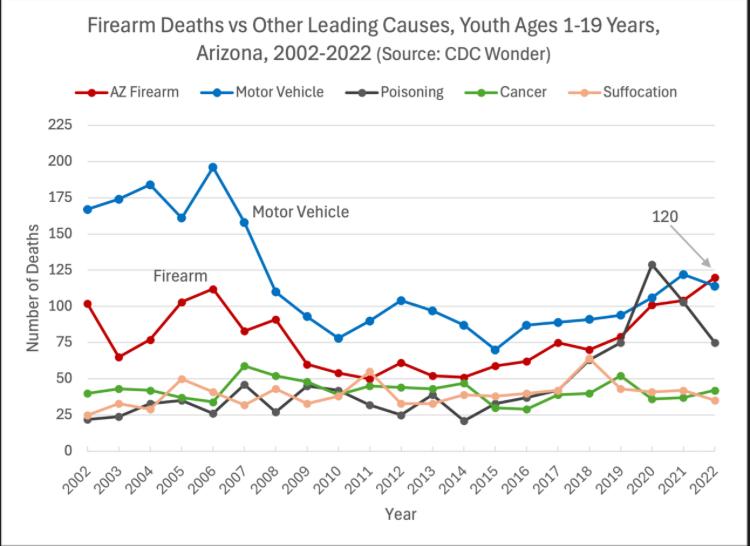
Our 2023 Firearm Violence Prevention Report outlines several evidence-based approaches to reducing firearm injuries and deaths.
Overhauling the ESA Voucher Expansion
Governor Ducey signed HB2853 in 2022, expanding Arizona’s Empowerment Scholarship Account program to essentially all schoolchildren, regardless of family income and without hardly any guardrails for spending or accountability.
The universal expansion appears in A.R.S. §15-2401.01, while A.R.S. §15-2402 governs ESA expenditures.
The expansion has generated substantial added state spending, concerns about how public funds are used (wasted), and how student outcomes are (not) measured. The money that’s flying out of state coffers prevents those funds from being used in ways that could improve public health.
One good idea is a $125,000 annual household income cap for universal ESA eligibility, with carefully designed exceptions for students with disabilities and other established needs.
The Legislature should also make private schools and religious microschools receiving ESA funds to meet academic accountability standards, including standardized assessments, reporting of student outcomes and reasonable health and safety requirements.
Spending rules for homeschool families needs to be dramatically tightened, with MUCH better limits on eligible educational purchases, improved documentation, stronger auditing (accountability) and recovery of improper expenditures.
These aren’t new ideas. SB1306 from last year proposed income and expenditure restrictions, although its income threshold was $200,000 and it contained another eligibility pathway. HB2577 addressed academic assessments, while HB2580 proposed added religious microschool safeguards.
Education is one of the most important social determinants of health. State education spending also competes with other investments in healthcare, housing, nutrition and public services.
___________________
Part III: Moving Public Health Policy Forward
A. Preventing Disease and Injury
Making Personal-Belief Exemptions Meaningfully Informed
Arizona’s school immunization exemption statute, A.R.S. §15-873, allows parents to exempt their children based on personal beliefs by signing a statement acknowledging receipt of vaccine information and understanding the risks and benefits.
But the statute doesn’t require parents to complete an educational program or receive counseling before claiming an exemption.
The Legislature could require a standardized, evidence-based educational module or documented counseling before granting a personal-belief exemption. It could also establish periodic renewal requirements and stronger verification procedures.
The aim would be to preserve parental decision-making while ensuring that decisions affecting both children and their classmates are meaningfully informed.
Arizona could also improve public access to school-level vaccination and exemption data. It should also include explicit statutory authority for local health officers to exclude students with personal exemptions from school (public, private, or religious ESA microschool) during outbreaks (this authority right now is just in ADHS administrative code).
Tobacco Prevention: Licensing Retailers
Arizona aligned its minimum tobacco purchase age with federal law in 2025. But meaningful enforcement is still a concern.
A statewide tobacco retailer licensing program could set up regular compliance checks, escalating penalties for repeated sales to minors and suspension or revocation of licenses for serious violations.
The Legislature could also review restrictions on local tobacco prevention ordinances and strengthen oversight of nicotine products marketed to young people. Tobacco retailer licensing has appeared repeatedly in our earlier legislative updates as an unfinished public health opportunity.
Firearm Safety: Child Access Prevention
Arizona could finally establish a comprehensive Child Access Prevention law requiring adults to take reasonable precautions to prevent children from accessing unsecured firearms.
The 2026 Legislature had a model. SB1600, sponsored by Senator Lela Alston and colleagues, proposed penalties under specified circumstances when a person negligently allowed a minor to access a readily dischargeable firearm. HB2578 offered another approach.
The proposals could be revisited, including how the law defines minors, reasonable firearm storage practices and exceptions for lawful supervised activities. Other options include extreme-risk protection orders and expanded background-check requirements.
A compendium of other evidence-based firearm safety model legislation can be found in our major landmark report from 2023: Firearm Violence in Arizona: Data to Support Prevention Policies
Injury Prevention: Bicycle Helmets and E-Bike Safety
Arizona could establish a statewide bicycle helmet requirement for children and teenagers and much clearer standards for the increasingly powerful electric bicycles being used by young riders.
Proposals could address helmet use, age restrictions for faster e-bikes, safety education and distinctions between electric bicycles and more powerful motorized vehicles.
Local governments have already adopted varying requirements. Statewide standards could improve consistency and reduce preventable head injuries.
B. Housing Stability and Behavioral Health
Housing Stability: Preventing Evictions & Homelessness
Housing stability is a fundamental social determinant of health. In Arizona, losing housing during the summer can expose people to life-threatening heat.
I’ve written about this in Preventing an Eviction Is Public Health and Homelessness, Heat Deaths & The Zone.
There are several legislative opportunities.
Summer eviction protections: Arizona could suspend physical evictions during dangerous summer months in counties where average summertime high temperatures exceed 100°F, with clearly defined exceptions for immediate safety threats.
Senator Lauren Kuby’s SB1608 from 2026 provides a starting point. It proposed restricting evictions during weeks with temperatures reaching at least 90°F on two or more days, along with indoor temperature standards for rental housing.
Crime-free lease addendums: Arizona could amend its Residential Landlord and Tenant Act to prevent landlords from relying solely on unsubstantiated allegations of criminal conduct as grounds for eviction. We’ve covered the consequences in How Crime-Free Lease Addendums Fuel Homelessness & Heat Deaths and a 2026 follow-up on legislative advocacy.
Pre-eviction mediation: Colorado’s HB23-1120provides a model for requiring mediation before certain evictions involving tenants receiving SSI or SSDI. Arizona could consider similar protections, together with longer notice periods, opportunities to cure lease violations and access to eviction prevention assistance.
Earlier Arizona bills also provide models. HB2710 from 2026 addressed evictions for cause, while HB2565 proposed improved information about tenant aid.
The goal is to prevent avoidable homelessness while keeping lawful remedies for landlords dealing with serious lease violations.
Permanent Supported Housing for Folks w/ a Serious Mental Illness
One of the most consequential budget opportunities would be a substantial increase in ongoing AHCCCS funding for permanent supported housing for Arizonans with serious mental illness.
This is closely connected to Arizona’s obligations under the 2014 Arnold v. Sarn settlement agreement, which incorporated evidence-based service models for supported housing, supported employment, Assertive Community Treatment and peer support.
The settlement set up standards and accountability measures, but access to permanent supported housing continues to be an important issue.
As I described in Homelessness, Heat Deaths & The Zone, AHCCCS data showed lengthy waits for housing aid among people with serious mental illness.
A major recurring appropriation could expand rental aid, access to permanent affordable housing and the services that help members keep stable housing.
The funding proposal should distinguish rental subsidies from Medicaid-reimbursable supportive services and include clear measures of increased capacity, waiting times and housing stability.
Housing is often essential to successful behavioral health treatment. Without it, maintaining medication, accessing services, finding employment and avoiding hospitalization or incarceration become much harder.
This is an important opportunity to invest in prevention and community-based treatment rather than relying on expensive crisis services.
C. Heat, Energy and Environmental Health
Protecting Electricity Access During Extreme Heat
Several Arizona electric utilities have voluntary summertime disconnection protections that were forced upon them, but those arrangements depend on regulatory decisions, tariffs and utility policies.
The Legislature could establish a durable statutory prohibition against residential electricity disconnections for nonpayment during dangerous summer months (e.g. in counties with average high temps above 100F) during those months (using the same geographic temperature criteria considered for eviction protections).
The details would need to account for utilities regulated by the Arizona Corporation Commission as well as providers such as SRP and municipal electric utilities.
Extreme Heat: Protecting Workers
The legislature should also consider stronger protections for people who work in dangerous heat. Representative Alma Hernandez and colleagues introduced HB2684 in 2026, proposing workplace standards addressing heat-related illness, access to water, cooling and rest breaks, training and emergency response.
The Legislature could revisit the proposal and decide what enforceable statewide requirements are right for Arizona’s climate.
Data Centers: Protecting Residential Electricity Ratepayers
Large data centers require substantial new electric generating capacity and transmission infrastructure. The public health question is whether residential customers will end up paying for infrastructure built to serve those facilities.
As I explained in Hobbs Moves to Protect Households With the Cost of New Fossil Fuel Infrastructure for Data Centers, these investments create long-term financial exposure for ordinary ratepayers.
The Legislature could examine statutory changes requiring independent and objective engineering, financial and cost-allocation studies before utilities recover major data-center-related infrastructure costs from residential customers.
That could include long-term financial guarantees from large-load customers, protections against stranded infrastructure costs and transparent public review.
Note: Any proposal would need to respect the Corporation Commission’s independent constitutional ratemaking authority.
The aim should be straightforward: residential ratepayers shouldn’t subsidize infrastructure costs properly attributable to data centers.
Environmental Health / Clean Energy
The Arizona Corporation Commission repealed the state’s Renewable Energy Standard and Tariff rules and Electric Energy Efficiency Standards in 2026.
As I explained in Arizona’s Clean Energy & Energy-Efficiency Rules Worked, those policies helped promote cleaner electric generation and more efficient electricity use.
The Legislature could examine whether there are statutory approaches to supporting clean energy, cost-effective efficiency programs and protection against unnecessary air pollution and utility costs.
D. Healthcare, Nutrition & System Accountability
Protecting AHCCCS enrollment under H.R. 1
The Legislature could consider additional (emergency) appropriations for eligibility workers, enrollment assistance, technology improvements and independent monitoring of improper disenrollments as AHCCCS rolls out the work requirements in HR1.
Last session’s budget did include additional funding for eligibility specialists and for computer infrastructure – but the $20M total is unlikely to be enough.
AHCCCS Dental Benefits & Maternal Health
Preventive dental coverage for adult AHCCCS members is another longstanding unfinished legislative issue. HB2338 from 2023 passed the House but failed in the Senate. A more recent model is HB2542 from 2026. Other opportunities include better oral healthcare during pregnancy, postpartum support, and expanded access to maternal healthcare in rural Arizona. These are preventive investments that could improve health outcomes and potentially reduce more expensive treatment later.
Healthcare Facility Licensing & State Hospital Governance
Arizona made progress during the 2025 and 2026 sessions on sober-living standards, healthcare facility licensing, nursing-home oversight and complaint investigations.
Added reforms could strengthen inspection capacity, public reporting of violations and protections for residents of long-term care institutions.
The Arizona State Hospital presents another long-standing governance issue.
For years, I’ve questioned the arrangement in which ADHS operates the State Hospital while also serving as its regulator.
Legislation to create independent governance has been introduced before, including SB1710 in 2023 and SB1688 in 2024. Those proposals provide a starting point for examining independent hospital governance, meaningful oversight, patient rights and public accountability.
Nutrition, Physical Activity and School Health
School nutrition is another area where previously unsuccessful legislation provides a starting point.
Representative Nancy Gutierrez’s HB2579 from 2026 proposed $4.5 million in ongoing funding to provide free school meals to children qualifying for free or reduced-price lunches.
Other opportunities include strengthening SNAP enrollment aid, protecting access to healthy foods, supporting school physical activity and investing in Safe Routes to School programs.
These policies address health risks early in life rather than waiting for preventable conditions to develop.
What Happens Next?
Arizona has accumulated years of harmful laws and unfinished public health business, including policy proposals that never received serious legislative consideration.
But we shouldn’t expect the incoming Legislature to tackle all of this in one session. There’ll need to prioritize based on public health impact, fiscal capacity, legislative feasibility and the time needed to develop sound statutory language.
Some proposals could be managed with relatively simple legislation and without an appropriation.
Others will need more research, stakeholder involvement and significant appropriations.
And some of the larger initiatives may be better suited for a second legislative session.
Arizona is embarking on a period when we can spend less time trying to stop harmful legislation and more time considering how state laws and budgets can prevent disease and injury, strengthen healthcare and address the social and economic conditions that influence our health.
The 2027 and 2028 Legislatures present a real opportunity, and I’m stoked.