Phoenix Parks Department Doubles Down on Red Tape to Stop Humanitarian Aid in Parks

Proposed New Ordinance Criminalizes and Greatly Restricts Aid and Even Food Distribution

City Parks Department to Ask the City Council to Tighten the Screws Even More

Back in December, we wrote about a troubling move by the City of Phoenix Parks Director Cynthia Aguilar to require permits for volunteer street medicine in parks. That policy (approved by the city council by an 8-1 vote) already made it harder to provide basic care to people experiencing homelessness.

Now, the new Parks Director Martin Whitfield wants the City Council to tighten the screws on humanitarian aid in parks even more – even to the point where the aid won’t even exist anymore.

The Phoenix Parks and Recreation Department has released a new draft ordinance that adds more restrictions. You can review the City’s proposal and background materials

On paper, this looks like a permitting system to regulate the provision of services in city parks. In practice, it looks like a shutdown strategy.

Taken together, these changes don’t just regulate care—they risk shutting it down.

What Street Medicine Does (Did)

The Street Medicine Phoenix program is a student-led, multi-university effort that brings care directly to people experiencing homelessness—meeting them where they are, including parks and encampments.

You can learn more about Phoenix Street Medicine here

They provide:

  • Basic health screenings (blood pressure, blood sugar, A1c)
  • Wound care and foot care
  • Vaccines
  • Mental health support
  • Narcan to prevent overdose deaths
  • Vision checks and glasses
  • Help connecting people to clinics and services

This is frontline public health work. It fills gaps in the system and reaches people who often don’t access traditional care.

What the New Proposal Would Do

The new draft ordinance goes well beyond the earlier permit requirement. Based on the City’s proposal materials, it would:

  • Make it a crime to provide basically any street medicine service or even food without a permit (Class 1 misdemeanor)
  • Limit permits to just twice per month, per park
  • Ban even food distribution without a permit (at least it wouldn’t be a crime to distribute water)
  • Restrict services to hard surfaces (like parking lots—not grass)
  • Require enclosed spaces (which generally aren’t available or accessible, and the city probably wouldn’t even let them put up a tent in the parking lot)
  • Add complex, burdensome application requirements

You can read the full proposed new ordinance that will be voted on by the Council in May

It’s hard to look at this proposal and not see what’s driving it.

From my perspective, this looks like an effort to make life easier for Parks Department staff.

Public policy should be built around what works for the community, not what’s most convenient for the agency managing the space.

What You Can Do

The City says it wants public input but hasn’t made it easy to provide it yet. They say they ‘will open a survey for you to share your feedback’ but it’s not posted yet. There are two community meetings listed on the City’s site on April 8 and April 14.

You can also:

  • Contact Phoenix City Council members
  • Share your perspective with Parks and Recreation
  • Help raise awareness about what’s at stake
Bottom Line

It’s reasonable to set basic rules to make sure activities in parks are safe, coordinated, and respectful of shared space. But that’s not what this proposal does.

There’s a big difference between good-faith regulation and creating a permitting process so restrictive that it effectively shuts down services altogether.

This proposal crosses that line.

Instead of supporting volunteers who are meeting urgent needs, it puts up barriers that will likely either stop that work entirely or make it so infrequent and limited that it loses its effectiveness.

That’s not balanced regulation.

And in this case, it comes at the expense of people who already have the least access to care.

Legislative Session Summary: Committee Deadlines Hit, Floor Action Accelerates, and Budget Negotiations Start

We’re in the late third quarter of the session, and the Legislature has hit one of the few deadlines it actually respects.

The informal “100-day session” target is almost never met – especially during divided government like we have now.

But, as usual, the legislature did meet their deadline for committees to stop their work hearing bills from the opposite chamber, which was last week. Most standing committees are done for the year except for appropriations, rules and maybe the director nominations committee.

From here, the action shifts to Committee of the Whole (COW): where floor amendments happen and 3rd Read, final floor votes. Expect a steady stream of COW and 3rd read over the next couple of weeks.

This is also when budget negotiations are starting informally. If history holds:

  • Informal talks break down
  • The Governor starts vetoing bills
  • Leadership is forced into real negotiations behind closed doors

And there’s an added complication: whether (and how) to align Arizona tax law with the federal tax changes (giveaways) in HR1.

My guess is that the budget gets done sometime in May driven in part by election-year pressure as a number of legislators want to get back to campaigning – especially those who have a primary opponent.

Our top priority in the budget is making sure AHCCCS and Arizona Department of Economic Security (ADES) get what they need to implement HR1. If they don’t we’re looking at hundreds of thousands of Arizonans losing coverage and benefits not because they’re ineligible but because the state won’t have the staff or systems to process the new red tape created by HR1.

Now for the nitty gritty on the actual bills: Here goes:

Good Bills We Support — Still Alive

  • HB2051 (AHCCCS; breastfeeding & lactation coverage)
    Expands coverage for lactation services (inpatient and outpatient). Addresses real reimbursement gaps.
    Status: Awaiting Senate Floor Vote
  • HB2176 (ADHS licensing reform)
    Prevents license “swapping” and improves complaint processes and dispute resolution.
    Status: Awaiting Senate Floor Vote
  • HB2177 (AHCCCS; American Indian services)
    Restores waiver authority for services to tribal members that was cut by AHCCCS in 2010.
    Status: Awaiting Senate Floor Vote
  • HB2195 (nursing facility oversight)
    Tightens timelines and strengthens ADHS oversight aligned with CMS standards.
    Status: Awaiting Senate Floor Vote
  • HB2224 (produce incentive program)
    $2M/year proposal to support healthier food access through ADES.
    Status: Awaiting Senate Floor Vote & needs to be in the budget
  • HB2673 (mental health screening in jails)
    Requires screening, assessment, and treatment when needed.
    Status: Awaiting Senate Floor Vote
  • HB2923 (court-ordered treatment improvements)
    Clarifies judicial standards and improves consistency.
    Status: Awaiting Senate Floor Vote
  • SB1165 (breast exam cost sharing)
    Eliminates cost barriers for critical screening.
    Status: Awaiting House Floor Vote
  • SB1372 (Medicaid dental study committee)
    Step toward expanding dental coverage in AHCCCS.
    Status: Awaiting House Floor Vote
  • SB1813 (state hospital bed access)
    Moves toward need-based admissions instead of geographic limits.
    Status: Awaiting House Floor Vote

Good Bills We Supported — Now Dead

  • HB2064 (pedestrian safety)
    Would have strengthened protections for vulnerable road users.
  • HB2542 (preventive dental in AHCCCS)
    Would have allowed preventive care instead of just emergency dental.
  • HB2194 (prior authorization transparency)
    Would have required insurers to clearly explain how to appeal denials.
  • SB1169 (graduate medical education funding)
    $18M for residency slots—critical workforce investment.
  • SB1082 (petting zoo hygiene standards)
    Basic public health measure that didn’t make it.

Bad Bills We Oppose — Still Alive

  • HCR2056 (“medical mandates; right to refuse”)
    This is the big one. Would amend the Arizona Constitution to prohibit vaccine or treatment requirements in almost any setting—schools, workplaces, public access.

    • It’s already through Senate committee. If Senate President Petersen brings it to the floor, it likely passes on a party-line vote. He may hold it back given the number of ballot referrals—but if leadership thinks it drives turnout, it will move. If this hits the ballot, we will need an opposition strategy.
  • HB2086 (vaccination mandates prohibition)
    Blocks basic public health protections across businesses and government.
    Awaiting Senate Floor Vote
  • HB2248 (medical interventions prohibition)
    Broad, sweeping anti-vaccine bill that micromanages private decision-making—even in healthcare settings.
    Awaiting Senate Floor Vote
  • HB2060 (university abortion restrictions)
    Prohibits university health centers from even discussing abortion care.
    Awaiting Senate Floor Vote
  • HB2364 (abortion-inducing drugs; felony penalties)
    Criminalizes mailing abortion medications.
    Awaiting Senate Floor Vote
  • HB2448 (SNAP work requirement waivers)
    Limits the state’s ability to respond to economic conditions and protect food access.
    Awaiting Senate Floor Vote
  • SB1212 (vaccine reimbursement restrictions)
    Undermines insurer incentives that support vaccination uptake.
    Awaiting House Floor Vote
  • SB1368 (SNAP purchase restrictions)
    Pushes a waiver to restrict allowable foods—adds administrative burden without clear benefit.

Bad Bills That Are (Thankfully) Dead or Vetoed

  • HB2007 (OTC ivermectin)
  • HB2797 (SNAP red tape expansion)
  • SB1019 (fluoride prohibition)
  • SB1194 (limits on clinical discretion re: unvaccinated patients)
  • SB1051 (hospital immigration reporting) – Vetoed
  • HB2206 (SNAP error rate mandate) – Vetoed
  • SB1070 (“Trump Derangement Syndrome” study)

See our AZPHA Bill Tracking Spreadsheet 2026 – Google Sheets

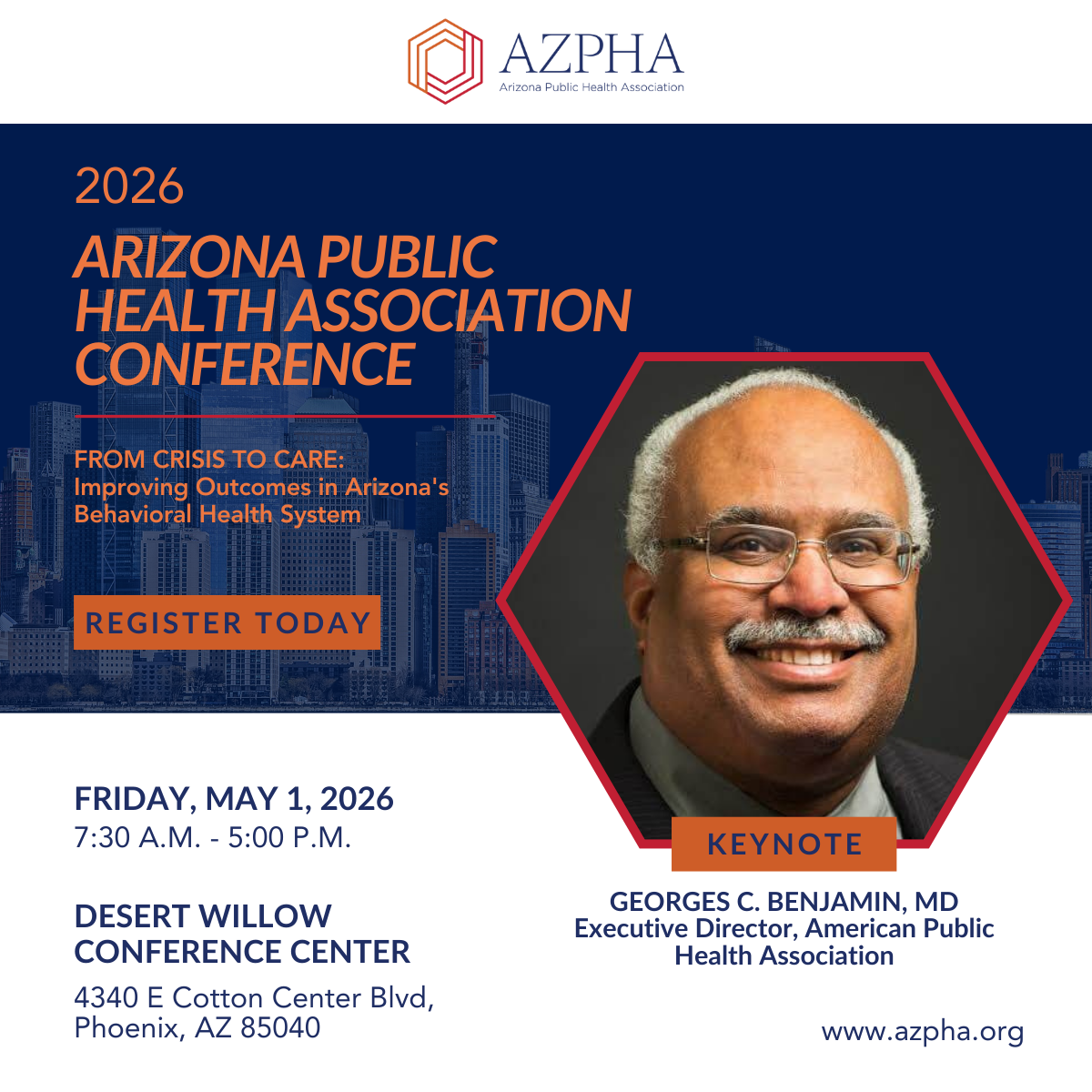
AZPHA Conference Agenda | Register Today

We’ve just posted our close to final agenda for the Arizona Public Health Association’s 98th Annual Conference, and this year’s program focuses on one of the most important public health challenges facing Arizona: strengthening our behavioral health system.

Join us Friday, May 1 at the Desert Willow Conference Center in Phoenix for From Crisis to Care: Improving Outcomes in Arizona’s Behavioral Health System.

View Our Agenda

The day will explore practical strategies to improve outcomes across Arizona—from crisis response systems and Medicaid policy to maternal mental health, housing supports, integrated care, and new analytic tools.

Keynote

We’re honored to open the conference with Georges Benjamin, MD, Executive Director, American Public Health Association, one of the nation’s most influential physician leaders and a steadfast advocate for evidence-based public health policy.

Speakers (in order of presentation)

Georges Benjamin, MD
American Public Health Association
Taylor Vaughn, MPH
Arizona State University
William Riley, PhD
Arizona State University
George Runger, PhD
Arizona State University
Adonis Deniz Jr.
Mercy Care
Noemi Zaragoza
Mercy Care
Tenasha Hildebrand
Mercy Care
Crystal Fox
Arizona Mad Moms
Rachel Streiff
Arizona Mad Moms
Kimberly Craig
Center for Health and Recovery
Michele Russell
La Frontera
Maria Navarrete, MSW
Chicanos por la Causa
Heather Brady, LPC
University of Arizona
Shannon Alexander, AdvCD (DONA)
University of Arizona
Violet Perez-Siwik, MD
University of Arizona
Jonathan Brinks
University of Arizona
Chant Sullivan
University of Arizona
Yevheniia Varyvoda, PhD
University of Arizona
Roshini Moodley Naidoo, MBChB, MPH, MBA
Arizona State University
Marisa Domino
Arizona State University
Matthew Martin
Arizona State University
Alex Demyan
Contexture
Jess Howard, LMSW
Solari Crisis and Human Services
Ty Rosensteel
Solari
Jessica Varney, MPH
Terros Health
Vanna Campion, MD
Terros Health
Kate Dobler
AHCCCS
Alisa Randall
AHCCCS
Barbara Cuadras
AHCCCS
Charles Sullivan
ABC Housing Corporation
Dede Yazzie Devine, MBA
Lived Experience Advocate
Catherine Dobler,       AHCCCS Carmen Heredia, MSW  Sonora Strategy Partners 

Throughout the day, speakers will examine how Arizona can move toward stronger prevention, treatment, and recovery systems for folks with behavioral health needs in Arizona.

The AzPHA conference is also one of the best opportunities each year to connect with Arizona’s public health community, exchange ideas and build partnerships that improve health across our state.

Register or Become a Sponsor

If you’re planning to attend, it’s a good idea to register early. And if your organization wants to connect with Arizona’s public health community, please consider joining us as a sponsor.

Register

View Our Agenda

Running the US Public Health Service Isn’t an Influencer Gig

The President’s nominee for U.S. Surgeon General, Casey Means, is facing a difficult confirmation process in the U.S. Senate. The concerns raised during her hearings are serious and are more than about politics.

It’s about whether she’s qualified and prepared to lead the 6,000 professionals who do the important work of the US Public Health Service.

The Surgeon General’s primary responsibility is to lead and manage the USPHS workforce and ensuring that their work fits with the most pressing public health and medical threats.

Every Surgeon General until now has been a physician who completed a medical residency and became board certified in a specialty. That background matters because medical training teaches physicians how to evaluate evidence, apply the scientific method, and make evidence-based decisions based on rigorous data.

Means doesn’t meet those basic expectations. She didn’t complete a residency and isn’t board certified in anything. Instead, she’s built her career as a wellness influencer, promoting health products and lifestyle advice through social media platforms – often with little or no evidence that what she’s selling is useful or even works.

What the Surgeon General Actually Does

The Surgeon General is one of the most visible public health figures in the country. The post can have a high public profile (depending on the SG’s personality), but the job isn’t primarily about developing public policy.

The Surgeon General’s central responsibility is different: leading the U.S. Public Health Service Commissioned Corps, a workforce of 6,000 public health professionals.

The Commissioned Corps is a uniformed, noncombatant service of about 6,000 health professionals. Officers include physicians, nurses, pharmacists, dentists, veterinarians, scientists, engineers, environmental health specialists, and public health administrators. These officers serve across the federal government. Roughly:

  • About one-third work in the Indian Health Service providing clinical care in tribal and rural communities.
  • Hundreds serve in the Federal Bureau of Prisons, delivering health care to incarcerated individuals.
  • Others work at agencies such as the CDC, NIH, FDA and VA.
  • Officers also support agencies outside traditional health programs, helping bring medical expertise into federal operations.

Their work includes:

  • Preventing and responding to disease outbreaks
  • Providing clinical care in underserved communities
  • Conducting research and regulatory work
  • Preparing for and responding to disasters and public health emergencies

For example, Commissioned Corps officers deployed during the 2014 Ebola crisis, working alongside CDC teams to contain the outbreak. They’re also regularly deployed during hurricanes, wildfires, and other national emergencies.

The Corps also includes the Ready Reserve, a surge workforce of trained health professionals who can deploy within days to support emergency responses.

In short, the Commissioned Corps is a mobile national public health workforce that helps protect the country during both routine operations and emergencies.

Leadership Requires Scientific Judgment

Managing a workforce of 6,000 highly trained health professionals needs strong leadership and administrative experience. It also requires something equally important: a clear understanding of evidence-based decision making.

The Surgeon General needs to ensure that officers are deployed effectively and focused on the nation’s most important health priorities. That requires someone who understands how to interpret scientific evidence and apply it in real-world public health settings.

A Job That Requires Preparation

The Office of the Surgeon General dates back more than two centuries, beginning with the Marine Hospital Service created in 1798 to care for sick seamen and prevent the spread of disease through U.S. ports. Over time, that system evolved into today’s U.S. Public Health Service and its Commissioned Corps.

Today the Surgeon General is responsible for helping lead that workforce and ensuring it is ready to respond to the nation’s (and sometimes global) health threats.

That role requires credibility, scientific judgment, and experience leading complex organizations.

The US has been fortunate that past Surgeons General brought those qualities to the job.

The Senate now has the responsibility to decide whether they think Means is qualified. We urge the Senate to decline to confirm Means and ask the administration to send them a qualified candidate.

Current Status: The nomination is still pending. She has had a senate committee hearing but is still awaiting a committee vote and then a full Senate vote.

We Need Your Voice to Map Maricopa County’s Future Public Health Priorities

The Maricopa County Community Health Needs Assessment (CHNA) is a comprehensive data-collection effort to identify community health strengths and challenges, and opportunities to improve public health.

Every three years, Maricopa County Department of Public Health, in collaboration with community organizations, local governments, and healthcare institutions, conducts a CHNA Survey to develop a deeper understanding of issues related to quality of life, availability of essential services, physical and mental health, and more.

The information gathered from the survey is then sent throughout the county to support planning and guide efforts to make Maricopa County a healthier place for all.

We would love your help sharing this survey with others, such as colleagues, employees, family, friends, and neighbors! The more people we hear from, the better picture we get of our community’s health. More information about the survey can be found here

Back at the Capitol: What’s Dead, What’s Moving, and the Most Radioactive Bill of the Session

We’re now well into the second half of Arizona’s 2026 legislative session. Many bills that affect public health have either stalled out or are crossing over to the other chamber. That means we have a much clearer picture of what’s still alive, what’s dead, and what still deserves serious attention.

The Arizona Public Health Association has been tracking dozens of bills this session that affect health care, prevention, behavioral health, Medicaid, public health authority, and the broader conditions that shape health in Arizona.

Here’s the latest snapshot.

See Our Bill Tracking Spreadsheet

The Good News: Several Bad Bills Are Dead

A number of proposals that would have undermined public health or created unnecessary problems for the health system appear to be finished for the year. Among the bills that have stalled:

  • SB1019 – Would have banned community water fluoridation statewide.
  • SB1016 – Prevented employers from questioning religious exemptions for medical products.
  • SB1194 and HB2005 – Prevented clinicians from declining patients who refuse vaccination.
  • HB2007 – Allowed ivermectin to be sold over the counter without a prescription.
  • HB2107 – Attempted to micromanage SNAP purchases.
  • HB2154 – Prohibited public entities from contracting with organizations connected to abortion services.
  • SB1236 – Added new bureaucratic hurdles to AHCCCS eligibility verification.
  • HB2797 – Added significant administrative red tape to SNAP eligibility.

Unfortunately, a few bills we supported also didn’t make it across the finish line this year, including:

  • HB2542 – Would have allowed AHCCCS dental benefits to be used for preventive care.
  • HB2617 – Required insurance coverage for PSA screening for high-risk men.
  • SB1082 – Basic hygiene requirements for petting zoos.
  • SB1716 – A practical fix to prevent dangerous interruptions in clozapine access for people with serious mental illness.

Still, the list of harmful bills that are now dead is longer than the list of good bills that stalled—which is at least a small win.

Good Bills Still Moving

Several bills that AZPHA supports are still advancing and could improve parts of Arizona’s health system.

  • HB2176 – Health facility licensing reform that prevents “license swapping,” improves complaint investigations, and creates a clearer informal dispute resolution process.
  • HB2195 – Strengthens oversight of skilled nursing facilities and speeds up the deficiency notice process.
  • HB2177 – Restores AHCCCS waiver authority to provide services to tribal members that were discontinued in 2010.
  • HB2178 – Requires state agency chief medical officers to hold an active Arizona medical license.
  • HB2673 – Requires mental health screening and treatment assessments in county jails.
  • HB2923 – Improves judicial review procedures for court-ordered behavioral health treatment.
  • SB1112 and SB1113 – Improve procedures related to behavioral health court-ordered evaluations.
  • SB1165 – Requires insurance plans to cover medically necessary breast exams without cost sharing.
  • SB1247 – Allows individuals to live with a family member receiving services in assisted living if the facility agrees.
  • SB1169 – Expands funding authority for graduate medical education residency slots.
  • SB1813 – Eliminates the outdated 55-bed cap on Maricopa County civil admissions to the Arizona State Hospital and requires admission decisions to be based on clinical need rather than geography.

Most of these bills still need to clear committees and floor votes in the opposite chamber, but they remain very much alive.

Bills That Still Raise Serious Concerns

Several proposals moving through the Legislature could undermine public health protections or weaken important prevention and safety-net programs.

  • HB2248 – A sweeping anti-vaccine bill that prevents many businesses and institutions from setting vaccination requirements.
  • HB2086 – Restricts the ability of governments and businesses to require masks or vaccinations in certain situations.
  • HB2331 – A “reliable energy standard” designed to discourage wind and solar energy development.
  • HB2267 – Labels certain solar projects as public nuisances, making them nearly impossible to site.
  • HB2364 – Criminalizes mailing abortion-inducing medications.
  • HB2448 – Restricts Arizona’s ability to seek federal waivers related to SNAP work requirements.
  • SB1368 – Attempts to restrict what SNAP participants can purchase if a federal waiver is granted.
  • SB1212 – Interferes with vaccine incentive structures used by insurers.

These bills remain active and could still reach the governor’s desk if they continue moving through the process.

☢️ Radioactive Bill of the Session: HCR2056

Every legislative session has one proposal that stands out for its potential to cause widespread damage to public health policy.

This year that distinction goes to HCR2056.

The measure would amend the Arizona Constitution to create a sweeping “right to refuse medical mandates.” On the surface that may sound simple, but the actual language is extremely broad.

If approved by voters, the amendment would prohibit governments—and potentially many institutions—from requiring vaccines or other medical interventions as a condition of employment, education, access to services, or public participation.

In practice, that will eliminate vaccination requirements for schools, weaken outbreak response authority, and significantly limit the ability of public health officials to protect communities during infectious disease emergencies.

HCR2056 has already passed the House and is now moving through the Senate. If it clears the Legislature, it would go directly to the statewide ballot.

From a public health perspective, it is easily the most radioactive bill of the session. It has passed the House and has been assigned to the Senate Government Committee where it will surely pass. Our next hope will be to stop it on the Senate floor. If it gets through that it’ll go straight to the Fall ballot.

Judge Pumps the Brakes on Kennedy’s Anti Vaccine Policies

Issues a Preliminary Injunction – Kennedy’s Decisions Likely Violate the Federal Advisory Committee Act

A federal judge this week pumped the brakes on some of Kennedy’s actions over the last year that have undermined national vaccine policy.

In American Academy of Pediatrics v. Kennedy, a federal court issued a preliminary injunction blocking Kennedy’s overhaul of the nation’s vaccine advisory process and reversing all of his vaccine schedule changes since last June. The American Public Health Association is also a key plaintiff in the case.

The case centers on the CDC’s ACIP and Kennedy’s summary policy changes in which he bypassed ACIP altogether.

The judge issued the preliminary injunction halting Kennedy’s changes because he thinks the plaintiffs have a good chance of winning their lawsuit which argues the processes Kennedy has been using doesn’t follow required federal administrative law under the Federal Advisory Committee Act.

FACA requires that federal advisory panels be:

  • Fairly balanced in expertise and viewpoints
  • Scientifically qualified
  • Selected through a transparent process
  • Free from undue influence

In 2025, Kennedy removed the entire ACIP committee and replaced it using a slipshod and opaque process with people with little or no experience – many of whom are influencers with strident anti-vaccine opinions.

The few ACIP meetings that did take place over the last year used selective evidence, sidelined CDC scientists, didn’t follow standard evidence review procedures and made spurious claims and decisions.

Then, in January 2026, Kennedy went even further, completely bypassing ACIP, making summary changes to the child and adult vaccine schedules all on his own.

He moved the influenza, rotavirus, hepatitis A, hepatitis B, some meningococcal vaccines, and RSV protection from routine recommendation to “shared clinical decision-making”.

Those vaccines were still covered by insurance and VFC even though they were moved to the different category. But moving them out of routine recommendation matters.

Routine recommendations normalize vaccination, set the standard of care, drive provider behavior, and support strong uptake. Shared clinical decision-making status undermines those principles.

What the Court Found

The court focused on Kennedy’s flawed decision-making processes, not the scientific merit of his decisions.  The preliminary injunction means the judge believes the plaintiffs are likely to win. The ruling points to three core problems:

  • Bypassing ACIP: Federal law ties vaccine access and coverage to ACIP recommendations. Kennedy can’t rewrite the schedule alone, yet that’s what he did with 6 vaccines.
  • Violating FACA: The court found strong evidence that ACIP was not properly constituted after Kennedy dismissed the former committee members. The new members were installed without standard vetting, and some had publicly documented anti-vaccine advocacy positions. Taken together, the committee appeared designed to deliver a predetermined outcome, the judge wrote.
  • Arbitrary decision-making: Major policy changes are supposed to have a ‘reasoned explanation’. Kennedy didn’t do that… he just said the reason is that Denmark does it this way so we should too.

Under FACA, if an agency head uses a flawed advisory process (or doesn’t use a required advisory process.. or both) the resulting policy can be struck down as arbitrary and capricious. And that’s what Kennedy did. He used a flawed process.

What Happens Now

All vaccine policy changes Kennedy made since summer 2025 are now on hold. The system reverts to the prior schedule, including restoring routine recommendations for:

  • Influenza
  • Rotavirus
  • Hepatitis A
  • Hepatitis B
  • Meningococcal vaccines
  • RSV protection for infants

Further, the judge in the PI said ACIP, as currently structured, can’t operate as an official advisory committee moving forward because of the flawed process used by Kennedy to change the makeup of the committee. Upcoming meetings (which had been scheduled for this week) are canceled.

Open questions now are whether Kennedy will rebuild ACIP properly in advance of the actual lawsuit hearings or double down with the current members and appeal the PI. Probably the latter.

Regardless, access to vaccines stays intact for now and all 17 vaccines are back to being routinely recommended.

The past year has definitely taken a toll, but it’s refreshing to see that checks and balances – at least within the judicial branch of government – are still in place as guardrails.

Over the past year, those guardrails were pushed aside. This week, the court temporarily put them back.

Bill Spotlight – SB1212: Micromanaging Insurance Contracts & Undermining Childhood Vaccination

The Arizona Senate passed Senate Bill 1212 this week on a party-line vote. If it becomes law, it could make it harder for doctors to protect kids and communities from vaccine-preventable diseases.

SB 1212 would ban health insurers from paying doctors differently based on vaccination rates among their patients. In other words, insurance companies wouldn’t be allowed to include vaccination goals as a quality incentive in their quality-based payment programs.

Many insurers use these quality programs today. Doctors can receive small bonuses if they meet benchmarks for preventive care like cancer screenings, blood pressure control, and childhood vaccinations.

Vaccination rates are often included because vaccines are one of the most effective tools in public health. When vaccination rates are high, communities are protected from outbreaks of diseases like measles, whooping cough, and meningitis.

If vaccination goals disappear from quality programs, clinics may have fewer resources to support immunization efforts—things like reminder systems, outreach to families, and patient education. Over time, that could mean fewer kids getting the shots that protect them.

SB 1212 is likely to get through the House on a party line vote (it already passed the Senate) where it would likely meet Hobbs’ veto pen… so we’re in little danger of this becoming law – but it is a good example of how the legislature often goes through exercises in futility to make a point and to please their precinct committees.

Bill Spotlight: SB1813 – Ending the 55-Bed Cap for Maricopa County Residents at the Arizona State Hospital

SB1813 Hearing Monday in the House Health Committee

Arizona’s behavioral health system includes an unusual rule that most people have never heard about: only 55 residents of Maricopa County can be admitted to the civil side of the Arizona State Hospital at any one time.

The limit dates back to 1995 and came out of the Arnold v. Sarn litigation that reshaped Arizona’s behavioral health system through the 1995 Stipulation Agreement. At the time, the goal was to reduce reliance on institutional care and move the system toward community-based services.

The 55-bed treatment cap isn’t written in Arizona statute. It exists only because of stipulation agreements stemming from the Arnold v. Sarn case that were later incorporated into the 2014 settlement that finally closed the litigation.

Today, however, the cap has become a major bottleneck in Arizona’s behavioral health system and no longer serves a useful purpose.

It’s important to understand what the cap does and does not apply to.

The limit doesn’t apply to patients sent to the Arizona State Hospital through the criminal courts (the forensic side of the hospital). It applies only to civil patients—people with severe mental illness who meet Arizona’s legal standard for court-ordered treatment because they are a danger to themselves, a danger to others, persistently or acutely disabled, and require the type of care that only a psychiatric hospital can provide.

How the Civil Unit Admission Process Works

Typically, a person experiencing a severe mental health crisis is evaluated in a hospital emergency department or crisis facility. If clinicians believe the person meets Arizona’s legal standard for involuntary treatment, the county attorney files a civil commitment petition.

A judge can then order treatment after hearing the evidence—even if the patient doesn’t want the help.

At that point, the system first tries to provide care in the least restrictive setting, usually a community behavioral health facility funded through AHCCCS or while the person lives with family or a behavioral health group home.

Only when those options can’t meet the person’s needs (and when the patient needs the intensive psychiatric services that only a state hospital can provide) does the system pursue admission to the Arizona State Hospital.

That’s where a bottleneck develops.

Because of the 55-bed cap created by the 1995 Arnold v. Sarn Stipulation Agreement and carried forward in the 2014 Settlement Agreement, Maricopa County residents end up waiting for admission even after a court decides they need the level of care provided at ASH. Actually – most of them can’t get in at all and get stuck in places that can’t meet their needs.

Again… nothing in state law requires the 55-person cap. Yet admission can still be blocked simply because the patient lives in Maricopa County.

Why the Cap Creates Systemwide Problems

The consequences ripple across the entire behavioral health system.

Patients can become stuck in emergency departments, crisis units, or community facilities that are not designed for long-term, high-acuity psychiatric care.

That delays treatment for people who are often in the most severe phase of their illness and forces them to receive care in settings that are not best for what they need.

Removing the cap would also allow ASH to re-commission unused space in the Ironwood and maybe even Palo Verde buildings once staff are hired and trained, creating more treatment capacity…  potentially adding more than twenty badly needed treatment slots.

A Partial Solution

SB1813 (which will be heard in the House Health Committee on Monday) addresses the source of the bottleneck.

Why lawmakers may lift the 55-bed cap for Maricopa County residents at the Arizona State Hospital

If SB1813 passes, the 55-bed cap would be eliminated directly in state law. No agreement between the original parties is needed to remove the current 55 treatment capacity cap. Why? Because the Legislature has the authority to make that change when there is a compelling community need and when the fix is narrowly tailored.

Once SB1813 is enacted, ADHS & AHCCCS could return to court with an amendment to the Settlement Agreement consistent with the new state law. Courts routinely approve such changes when circumstances have evolved… especially when statutes have changed.

A Personal Note

When the 2014 settlement agreement was finalized, I was Director of the Arizona Department of Health Services and signed the agreement on behalf of the state.

At the time, I disagreed with the plaintiffs’ insistence on keeping the 55-bed cap for Maricopa County residents, but I signed the settlement anyway.

The broader agreement set up objective performance measures and finally resolved a lawsuit that had lasted more than three decades.

In that context, the compromise made sense.

Today, however, the cap has become an unnecessary bottleneck in the civil commitment system and is increasingly unfair to Maricopa County residents.

Policies that no longer serve their purpose should be revisited—and this is one of them.
The Bottom Line
  • Arizona’s behavioral health system should admit patients to the Arizona State Hospital based on clinical need and medical judgment, not what county they live in.
  • SB1813 moves us toward that goal by ending an outdated policy that is a system bottleneck & barrier to care.
  • The 55-bed cap may have made sense decades ago in the context of a specific lawsuit and a different behavioral health system. Today, it’s simply getting in the way of the system working better.
  • The Arnold v. Sarn Settlement Agreement wouldn’t be at risk if SB1813 passes because courts routinely approve settlement agreement changes when circumstances change… especially when the legislature amends state law.
  • Even if SB1813 passes & ASH increases capacity by staffing up the vacant Ironwood floors, there will still be grossly inadequate high-end treatment capacity in Arizona – but at least things would be marginally better.

______________________________________

Our message to the House Health Committee:

Hi…

I’m writing to urge you to support SB1813 when it comes before your health committee next week.

SB1813 addresses a long-standing bottleneck in Arizona’s behavioral health system: the 55-bed cap for Maricopa County residents admitted to the civil units of the Arizona State Hospital. This limit is not in statute. It stems from a decades-old provision in the Arnold v. Sarn settlement agreement and no longer reflects the needs of Arizona’s largest county or today’s behavioral health system.

The result is simple and troubling: admission to ASH is constrained not by clinical need, but by a patient’s county of residence. SB1813 corrects that problem by requiring that admission decisions be based on clinical criteria rather than geography.

Some opponents have suggested that passing SB1813 would “reopen the Arnold case.” That claim is inaccurate and often motivated by a core opposition to psychiatric treatment in secure environments. The Legislature has clear authority to address pressing community needs through statute—especially when the solution is narrowly tailored, as it is here. SB1813 simply establishes in state law that access to treatment at ASH should be determined by medical need.

If SB1813 becomes law, the ADHS/AHCCCS could then return to court to seek a modification of the settlement agreement so that it aligns with the new statute. Courts routinely approve such updates when circumstances change or when legislatures revise the governing law.

In short, SB1813 doesn’t undermine the goals of the original settlement. Instead, it updates an outdated operational constraint that is now harming patients and creating unnecessary pressure throughout Arizona’s behavioral health system.

For individuals with the most severe mental illnesses who require secure hospital treatment, the current 55-person limit is simply no longer workable for Maricopa County. Clinical need—not geography—should guide access to care.

I respectfully urge you to vote YES on SB1813 when it is heard in committee.

Here’s my blog post with more information about the bill, why it’s needed, and why the Arnold scare tactics are inaccurate: Bill Spotlight: SB1813 – Ending the 55-Bed Cap for Maricopa County Residents at the Arizona State Hospital – AZ Public Health Association

Thanks for your consideration…

will