Congress Passes Budget with Huge Deficit Spending & Large Cuts to Social and Health Services

By now of course all of you know that Congress passed HR1 – the large tax break bill for wealthy people along with some cuts to social and healthcare spending – along with very large deficit spending.

In general, the reductions to revenue (tax cuts for wealthy people and people who put in overtime and collect tips) happen right away while the cuts to social services like Medicaid and SNAP don’t happen for a few years – in most cases not until after the 2026 mid-term elections.

Here’s what the bill does in a nutshell/The Senate passed bill includes:

Medicaid Work Requirements

Require childless adults and parents of children older than 13 to work, volunteer or attend school for 80 hours a month as a condition of enrollment, unless they qualify for an exception –$317 bil.

AZ will already be implementing this as a result of a bill Ducey signed in 2015. AZ will need to expand the required populations up to 64 from 56.

The main way people get knocked off Medicaid with this approach is due to failure or inability to report the work/school attendance rather than not qualifying. How good a job the state does making it easy for people to report compliance is a HUGE part of this.

Provider Taxes that Pay State Match

Freeze current state taxes on most providers in states that have not expanded Medicaid and slowly lower the allowed rates in expansion states from 6% to 3.5% 

AZ pays the state part of the match with a provider (hospital) tax for 550,000 AHCCCS enrollees. AZ will be able to collect less from that assessment starting in 2028 making the legislature find a different funding source to keep them enrolled. Will they do that? I think not.

Hospitals will need to work under the assumption that 550,000 Medicaid members will be disenrolled in 2029 because the legislature is unlikely to pick up the tab for the reduction in the hospital assessment – making them way less likely to expand (especially in rural AZ)

Note: these impacts are worse in rural AZ because while about 17% of urban Arizonans are on Medicaid – 38% of rural people are on AHCCCS.

The reduction schedule begins in FY 2028 and gradually reduces the current 6 % cap by 0.5 percentage point per year, reaching 3.5 % in FY 2032.

So, the schedule is:

  • FY 2028  5.5%
  • FY 2029  5.0%
  • FY 2030  4.5%
  • FY 2031  4.0%
  • FY 2032 (and beyond)  3.5%

–$183 bil.

Limit Provider Directed Payments

Prevent expansion states from using special funding to pay Medicaid providers higher prices than Medicare would pay. Limit non-expansion states to slightly higher prices. –$149 bil.

This will mean the Healthy AZ payments will need to go down and doctors and other providers will leave the Medicaid network because of bad reimbursement. That will hurt rural AZ hospitals the most.

More Medicaid Eligibility Checks

Require states to check eligibility of people in the Medicaid expansion every six months instead of once a year –$58 bil.

AZ Medicaid members will need to get redetermined every 6 months vs once per year – that doubles the chances for people to get knocked off because they didn’t reply to the RFI on time etc.

Rural Health Fund

The bill has a ‘rural health fund’ with $50B in it to help states support rural health care providers

Important Note: the final bill did not change the percentage rate at which the federal government pays for Medicaid in states (aka the FMAP rate). 

Requires SNAP State Matching Funds

SNAP cost-shift to States with a payment error rate of 6% or higher. Requires states (except for Alaska) to pay a share of benefits currently funded in full by the federal government. Increases the share of state costs to administer the SNAP program from 50% to 75%

Clean Energy Incentives Eliminated

Ends Residential clean energy credit

Terminates the tax credit for rooftop solar, geothermal heat pumps and other home devices by Dec. 31, 2025 (-77B)

Way fewer people will install rooftop solar.

Ends Clean vehicle credit

Terminate the $7,500 consumer rebate for electric vehicles by Sept. 30, 2025 (-78B)

Fewer people will buy EV – and it’s not just the tax credit ending it’s the enormous tariffs being charged on Chinese EV’s (which are the best and most affordable). tariff is 100%

Ends Qualified commercial clean vehicles credit

Terminate the credit for companies that buy electric cars or trucks, including businesses that lease the vehicles to consumers, by Sept. 30, 2025 (-105B)

Business will stop or really slow down buying EV’s

Ends Clean energy electricity investment credit

Quickly ending tax credits for investments in zero emissions electricity sources. Wind and solar projects to claim the credit as long as they begin construction by July 2026 or come online before the end of 2027.

Nuclear projects would have more time. It is unclear how the changes will affect the provision’s savings. (-178B). 

This will make electricity more costly as a main incentive to expand with good solar ends because the tax credits are ending. 

_________________ 

I’m at a loss for words on a final editorial comment on all this. It’s just sad and discouraging that millions of people in this country are good with all this stuff including the 300% increase in spending for ICE agents who abduct, incarcerate, and deport asylem seekers (and other migrants) and the 265% increase in funding for new immigration detention centers.

What’s in the Senate Version of Trump’s Big Policy Bill? – The New York Times

Free Webinar: 2025 Arizona Legislative Session Wrap – A Public Health Perspective

July 8, 2025 12:00 PM

Join Vitalyst and Will Humble, Executive Director of the Arizona Public Health Association, for an overview of this year’s legislative session. We will discuss the wins and the challenges for community health and Arizona as a state.

Arizona’s 2025 Legislative Session:
What Passed, What Didn’t, and What It Means for Public Health

The 2025 Arizona Legislative Session has wrapped, and it brought wins for public health, protections from harmful policies (with Hobbs’ vetoes), and some investments in behavioral health, access to childcare and other one-time public health investments.

View Our PowerPoint Summarizing the 2025 Legislative Session

As always there were also missed opportunities to address pressing public health problems like firearm violence – but all in all I’d say it’s a net win for public health. We’ll dive into the details at this free webinar.

Register Here!


Arizona’s 2025 Legislative Session: What Passed, What Didn’t, and What It Means for Public Health

The 2025 Arizona Legislative Session has wrapped, and it brought wins for public health, protections from harmful policies (with Hobbs’ vetoes), and some investments in behavioral health, access to childcare and other one-time public health investments.

View Our PowerPoint Summarizing the 2025 Legislative Session

As always there were also missed opportunities to address pressing public health problems like firearm violence – but all in all I’d say it’s a net win for public health. Let’s dive into some of the details:

GOOD BILLS SIGNED INTO LAW
 Strengthening Health Facility Oversight

SB1308 Public health licensing; sober living: Establishes better standards for sober living homes.

SB1219 Public health licensing: Requires ADHS to provide a priority matrix for complaints filed against health care institutions on its public website.

Healthcare Consumer Protections

HB2175 claims; prior auth; company conduct: Requires health insurers to individually review denials & prior authorizations.

SB1291 health insurers; provider credentialing; claims: Requires health insurers to finish provider credentialing within 60 days after they get a complete credentialing.

Behavioral Health

SB1604 licensed secure health facility; defendants: Makes clear that Title 13 (criminal) & Title 36 patients (civil commitment) Court Ordered Treatment folks can’t be stationed at the same secure behavioral health residential facility (SBHRF).

HB 2291: Ending Red Cap Rule on Opioids: Removes the outdated red-cap requirement for opioid prescriptions, reducing risk of theft and diversion.

HB 2179: Restricting Marijuana Ads Near Youth: Prevents marijuana ads from targeting youth or appearing near schools and youth events.

Tobacco, Heat Safety, Access to Care & Nutrition

SB1247 Tobacco use; minimum age: Moves the legal age to buy tobacco products (including vapes) from 18 to 21 (consistent with federal law).

HB 1182: Protecting Outdoor Workers from Extreme Heat: Allows cities to let construction start earlier (5 a.m. weekdays, 7 a.m. Saturdays from May to October), helping to reduce heat-related illnesses.

SB 1727: Boosting Access to Medical School for Arizonans: Requires Arizona’s public medical schools to interview all qualified in-state applicants during the first admissions round.

HB 2164: Cutting Ultra processed Foods from Schools: Bans ultra processed food sales during school hours at campuses taking part in the federal free/reduced lunch program starting in 2026–27.

BAD BILL SIGNED INTO LAW

HB 2679: Non-Bypassable Utility Fees: Allows monopoly utilities like APS to issue bonds and charge unavoidable fees making ratepayers pay for the bond debt.  This undermines consumer protection and could lock in coal-era infrastructure.

VETOES THAT PROTECTED PUBLIC HEALTH

Governor Hobbs used her veto power to block many bills that would have harmed access to care, threatened privacy, or undermined vaccine protections:

  • HB 2063: Would have required schools to notify parents about vaccine exemptions.
  • HB 2257: Would have blocked foster placements based on vaccination policies.
  • HB 2126: Would have granted parents automatic access to minors’ health records—eroding patient confidentiality.
  • SB 1071: Sought to make it harder for families to qualify for SNAP and TANF.
  • SB 1268: Would have required hospitals to inquire about patients’ immigration status.
  • SB 1020: Would have allowed guns on public college and university campuses.
  • SB1019: Would have forbidden the use of photo enforcement systems for both speeding and running red lights.
MISSED OPPORTUNITIES

Several promising public health initiatives did not pass including SB 1612, which would have made state government procurements more transparent, state agencies more accountable and would have finally required AHCCCS to actually follow the state procurement code (they have been exempt since 1982).

FINAL BUDGET OUTCOME

The FY 2026 budget was signed on June 27. Here’s what it delivers in terms of new one-time funding:

  • $45M for childcare aid
  • $5M for ibogaine clinical research grants
  • $5M for capital expenses for secure residential behavioral health facilities
  • $4M for graduate medical education
  • $2M for the Produce Incentive Program
  • $1.5M for nursing education at community colleges
  • $750K for a dementia awareness campaign
  • $500K for AEDs for public high school athletics
  • $160K for isolation valves, $695K for anti-ligature renovations, $83K for perimeter detection systems, $3.3M for this year’s funding shortfall for Arizona State Hospital operations.

There was good news about the development of secure residential behavioral health facilities. After several years of constant work, AHCCCS was finally appropriated $5M for secure behavioral health residential facilities.

One warning is that someone added passive aggressive session law to the feed bill and some of that language looks like it’s designed to tee up excuses for AHCCCS not to issue the RFP for the facilities, but we’ll see.

The Senate budget also requires AHCCCS to offer one-year AHCCCS complete care contract extensions to all managed care entities and RBHAs through September 30, 2028.


📬 Not a member yet? Join here: Individual Membership – AZ Public Health Association
🌐 More resources: www.azpha.org
📣 Follow us on Twitter/X: @willhumble_az 

2025 AzPHA Public Health Awards

We’re proud to announce that our 2025 award program will be held:


Thursday, October 23, 2025
5:30 – 8:30pm
435 Collective

435 S 3rd Ave, Phoenix, AZ 85003

Each year AzPHA recognizes public health professionals, health professionals and community members across Arizona who are performing extraordinary services to our community at our annual awards event. Many of our awards go back decades.

Register Today: Only $45

Includes complimentary beer, wine, soft drinks & taco bar!

Now Accepting Nominations

for:

  • Policy Maker of the Year 
  • Senator Andy Nichols Honor Award 
  • Pete Wertheim Public Health Leadership Award 
  • Public Health Research Award 
  • Alida Montiel Indigenous Health & Advocacy Award 
  • Rising Public Health Champion 

Nominate Here: Deadline September 1, 2025

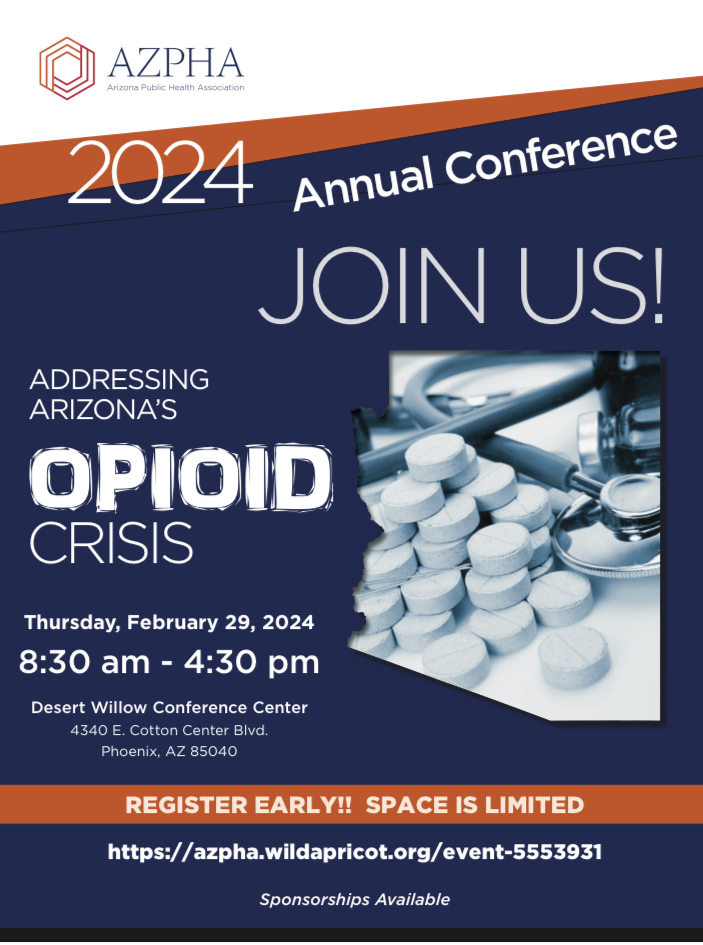
A Historic $7.4 Billion Opioid Settlement: What It Means for Arizona’s Public Health

Last week all 55 U.S. states and territories including Attorney General Kris Mayes signed on to a landmark $7.4 billion settlement with Purdue Pharma and the Sackler family. The agreement marks the largest to date with individuals held responsible for the opioid epidemic.

It removes Sackler control over Purdue and bans them from selling opioids in the U.S. – something that was very important to the plaintiffs.

Arizona is poised to receive up to $108 million over the next 15 years for opioid interventions like 1) Addiction treatment & recovery services; 2) Prevention & public awareness; and 3) Infrastructure and workforce development.

For example, Maricopa County has already channeled opioid settlement money into staffing, tools, and community grants to serve local organizations.

More than half of the money is slated for payment during the first three years including a first infusion of $1.5 billion from the Sacklers and $900 million from Purdue.  This front-loaded structure means Arizona (and other states) can quickly ramp up interventions while keeping the momentum going over time.

What’s next for Arizona?

  • Local agreements: County and city governments across Arizona will be invited to formally take part once the settlement receives final approval from the bankruptcy court
  • Strategic investment planning: Agencies like Maricopa County Public Health and Pima County are already mapping out targeted use of these funds—from peer counseling to naloxone distribution and school prevention efforts.
  • Tracking outcomes: Jurisdictions will have to report annually on their impact and expenditures.

State Budget Finished: Modest Wins for Public Health

The Senate passed a $17.6B state budget after midnight last Thursday which includes some of Hobbs’ priorities and some priorities on both Senate Dems and Republicans.

The House then threw a temper tantrum protesting their lack of involvement with the negotiations (even they themselves decided not to take part.

After passing a budget on Thursday am that was sure to be vetoed (and it was), the House then made a few tweaks to the previously passed Senate budget late Thursday night. That amended bill passed and was sent back to the Senate this morning. Because it’s been tweaked from the version – the Senate still needs to vote on it one last time before it gets sent to the governor.

Here’s a link to the main (amended) appropriations bill and the health budget reconciliation bill that the Senate will not take up one last time before sending the package to the Governor.

The Senate had originally included speech therapy and cochlear implants as a covered service for adults but that was stripped by the House last night.  Funds for traditional healing practices for tribal members survived the House amendments.

The House and Senate eventually agreed on the following increases in one-time funding:

  • $45M for childcare aid
  • $5M for ibogaine clinical research grants
  • $5M for capital expenses for secure residential behavioral health facilities
  • $4M for graduate medical education
  • $2M for the Produce Incentive Program
  • $1.5M for nursing education at community colleges
  • $750K for a dementia awareness campaign
  • $500K for AEDs for public high school athletics
  • $160K for isolation valves, $695K for anti-ligature renovations, $83K for perimeter detection systems, $3.3M for this year’s funding shortfall for Arizona State Hospital operations.

There was good news about the development of secure residential behavioral health facilities. After several years of constant work, AHCCCS was finally appropriated $5M for secure behavioral health residential facilities. One warning is that someone added passive aggressive session law to the feed bill and some of that language looks like it’s designed to tee up excuses for AHCCCS not to issue the RFP for the facilities, but we’ll see.

The Senate budget also requires AHCCCS to offer one-year AHCCCS complete care contract extensions to all managed care entities and RBHAs through September 30, 2028.

APS Rate Hikes & the Corporation Commission’s Industry Capture are Undermining Health

Electricity is already the 2nd second-highest expense for many households, trailing only rent and surpassing even food. Constant rate hikes from our monopoly utilities like APS is making electricity more and more expensive and is seriously damaging the social determinants of health in Arizona.

Last week APS filed yet another rate increase request along with a proposal to make their return on equity even higher for their stock shareholders – proposing to raise residential rates by 14% and boosting their Return on Equity (ROE) entitlement to an eye-popping 10.7%.

Just last year APS asked for (and of course got) an 8% rate increase. True to form, the ACC also rubber-stamped their ROE entitlement to 9.55% the previous year’s 8.7%.

Their current unreasonably high return on equity level of 9.55% is already one of the highest in the country for a ‘regulated’ monopoly.

 APS’ argument that these rate increases are needed for infrastructure development are disingenuous. The ONLY reason to raise the ROE entitlement is to be able to make even more profit for their wealthy Pinnacle West/APS stock and bond investors.

Attorney General Mayes to Vigorously Oppose APS Rate Hike, Seek to Intervene to Protect Consumers | Arizona Attorney General

Meanwhile, APS’s parent company, Pinnacle West and their stock shareholders are on easy street – with $609M in profits in 2024, up from $502M in 2023.

Shareholders are celebrating the fact they know the Corporation Commission is captured by APS and will almost certainly give APS everything their hearts desire.

Make no mistake, this new rate hike and especially the increase in the return on equity are about Pinnacle West shareholder expectations and APS/Pinnacle West CEO Jeffrey B. Guldner’s compensation.

Electricity & the Social Determinants of Health

Public health isn’t just about access to care doctors and hospitals like many people think. It’s shaped by a range of social determinants like housing, food security, financial stability, and access to utilities.

When electricity costs continue to go up because a monopoly like APS can do whatever they like as they’re being overseen by a captured Commission the social determinants of health crumble.

High utility bills push people to the brink especially in the summer. Many families are forced to choose to keep the A/C on or pay rent. Miss a payment, and eviction or disconnection could follow… especially since our landlord and tenant act makes eviction super easy.

Updating Arizona’s Landlord-Tenant Act: A Crucial Step to Prevent Evictions and Save Lives – AZ Public Health Association

When electricity bills eat up more of a family’s limited income than food it causes emotional stress too. Parents worry about their kids’ safety and whether they’ll make it through another month. Chronic stress is a known driver of heart disease, depression, and poor developmental outcomes in children.

APS doesn’t have any competition. It’s a monopoly that’s supposed to be regulated by the Arizona Corporation Commission. Yet the ACC keeps greenlighting higher rates and richer shareholder returns, like the 9.55% return on equity it approved of last year.

That’s money being drained from Arizona households into the hands of Pinnacle West investors.

When the ACC rubber-stamps rate hikes and continually allows the company to collect more return on equity and higher rates they’re undermining the very conditions families need to survive. In a state where electricity can cost more than food, where there’s little affordable housing and where evictions are super streamlined – that’s unacceptable.

It’s time to stop putting stock investor profits over people. That means electing people to the AZ Corporation Commission who care about you more than monopoly utilities. Until we do, APS will continue to take us to the cleaners.

Vote carefully.

Kennedy Ends US Participation the Global Vaccine Alliance: Is that Really a Bad Thing?

Kennedy announced this week that U.S. is pulling all funding from Gavi, the global vaccine alliance, dealing a big blow to health systems and vaccine access in lower-income countries.

This is by no means a surprise as Kennedy is a well-known decades-long opponent of vaccines.

Gavi, the Vaccine Alliance is a world‐class public‑private partnership created in 2000 to expand vaccine access in poorer countries who would otherwise be unable to afford to fund vaccines for their people.

To date, it’s helped immunize over 1 billion kids, preventing more than 19 million future deaths.

In 2023 alone, Gavi-backed immunization efforts averted about 1.3M deaths and delivered lifesaving vaccines like pneumococcus, rotavirus, Hib, and HPV across 57 developing countries.

Vaccines are among the most cost-effective interventions out there with ROIs of 27:1 for many vaccines and all with an ROI greater than 4:1.

Overall, Gavi’s programs have generated roughly $220 billion in economic benefits since 2000.

The U.S. Government and Gavi, the Vaccine Alliance | KFF

Up until this week, the US has been a primary funder of Gavi initiatives, contributing 12-15% of the GAVI budget. Below are the other countries in the top tier of donors

  • UK: $2B
  • Bill & Melinda Gates Foundation: $1.5B
  • United States – $1.3B (now $0)
  • Norway – $830M
  • Germany – $773M

Of note – the US held one of the 18 representative seats on GAVI’s governing board. After Kennedy’s announcement this week that will no longer be the case. More on that in a bit.

If other donors don’t step up to keep funding vaccines and or entire vaccine campaigns will need to be scaled back or paused. Immunization coverage could drop, leading to worsened outbreaks of measles, pneumonia, rotavirus, and future blasts of vaccine-preventable diseases.

This move, along with the US abandonment of WHO participation and dues paying (Kennedy ended that a few months ago) and Rubio’s elimination of the US Agency for International Development isn’t just bad for global health – it’s a squandering of decades worth of US global soft power.

Editorial Note: My first reaction when I heard Kennedy was pulling the US out of GAVI was – of course he did. Kennedy is against vaccines and now controls the purse strings of 35% of the federal government including the entire health portfolio.

My second reaction was sadness for the loss of vaccine that will be administered in developing countries.

My third reaction however, was – well maybe this isn’t such a bad thing after all. The US only contributes about 12% of GAVI’s budget. Does GAVI really want to have a troublemaker anti-vax zealot from the US on the governing board peppering them with garbage ‘science’ and hijacking meetings for the next 3.5 years?

Is it worth 12% of the budget to not have a knucklehead on the Board? Yeah

There are many wealthy nations not yet contributing substantially to GAVI including Japan, China, Saudi Arabia, Qatar, UAE, etc. who may be willing to make up the difference and not put a wacko on the governing body.

Indeed, Healthwatch reported yesterday that despite the US abandonment of Gavi, they still exceeded their $9 billion pledging goal – with a record number of donors committing to the tune of $11.9B for the coming five years (2026-30). These are pledges – not actual dollars so don’t count the chickens yet.

Perhaps it’s best for the US to not be involved in endeavors like this for the next 3.5 years as with the current HHS leadership we’re more likely to cause harm than good.

About the GAVI Alliance

My Pet Peeve of the Session – HB2704: A $1.3 Billion Gift to Baseball Billionaire Kendrick

Arizona’s State Senate approved HB 2704 last Thursday night, putting taxpayers on the hook for over $1.3 billion, including sales and income taxes, for Chase Field stadium improvements that the Diamondbacks were originally contractually bound to pay for under their 2018 deal with Maricopa County (but failed to do). Monday the House did the same – completing the legislative branch’s role in the giveaway of public funds to Kendrick. Hobbs praised the scheme when it passed the House suggesting she’s ready to approve the heist.

Despite late-night amendments promising transparency, governance tweaks, and a legislative “intent” that the team contribute $250 million, but none of these provisions are enforceable.

Nearly all sales taxes from stadium events and income taxes from players and staff will automatically be funneled into the stadium fund. Though the bill technically caps the public contribution at $500 million, it automatically escalates 3% each year meaning the total is well over $1.3B over 20 years.

What’s more, because Kendrick doesn’t disclose revenues from concerts or playoff games, there’s no way to verify how rapidly the fund is filling or if the money is being spent appropriately.

Also, economic studies consistently show that public funding for sports stadiums don’t generate real economic value they simply shift entertainment dollars from local businesses to subsidize billionaire profits.

The Impact of Professional Sports Franchises and Venues on Local Economies: A Comprehensive Survey by John Charles Bradbury, Dennis Coates, Brad R. Humphreys :: SSRN

Is this public gift to the Diamondbacks really worth robbing taxpayers of over a billion dollars without transparency, enforcement, or public benefit?

No

Federal Judge Orders NIH to Reinstate Kennedy’s Research Grant Cuts

In a partial win for researchers and public health advocates, a federal judge in Boston ruled this week that Kennedy’s decision to cancel hundreds of National Institutes of Health grants was illegal—and ordered that the funding be immediately restored.

The grants, totaling roughly $3.8B, had funded research in areas such as racial disparities in disease, vaccine hesitancy, maternal mortality, and the effects of climate change on human health.

Judge Young called the cancellations discriminatory, saying from the bench: “I’ve never seen government racial discrimination like this.”

The court found that NIH and Kennedy were “arbitrary and capricious” when they revoked 367 competitive research awards. Most of these grants had already been peer-reviewed and approved for multi-year funding but were suddenly pulled without clear justification.

This decision orders NIH to immediately reinstate the canceled grants.

Given his aversion to public health and medical research, Kennedy is expected to challenge the decision, likely seeking an emergency stay of the ruling while it moves through the First Circuit Court of Appeals.

Again – the judicial branch of government comes to the rescue (for now).