
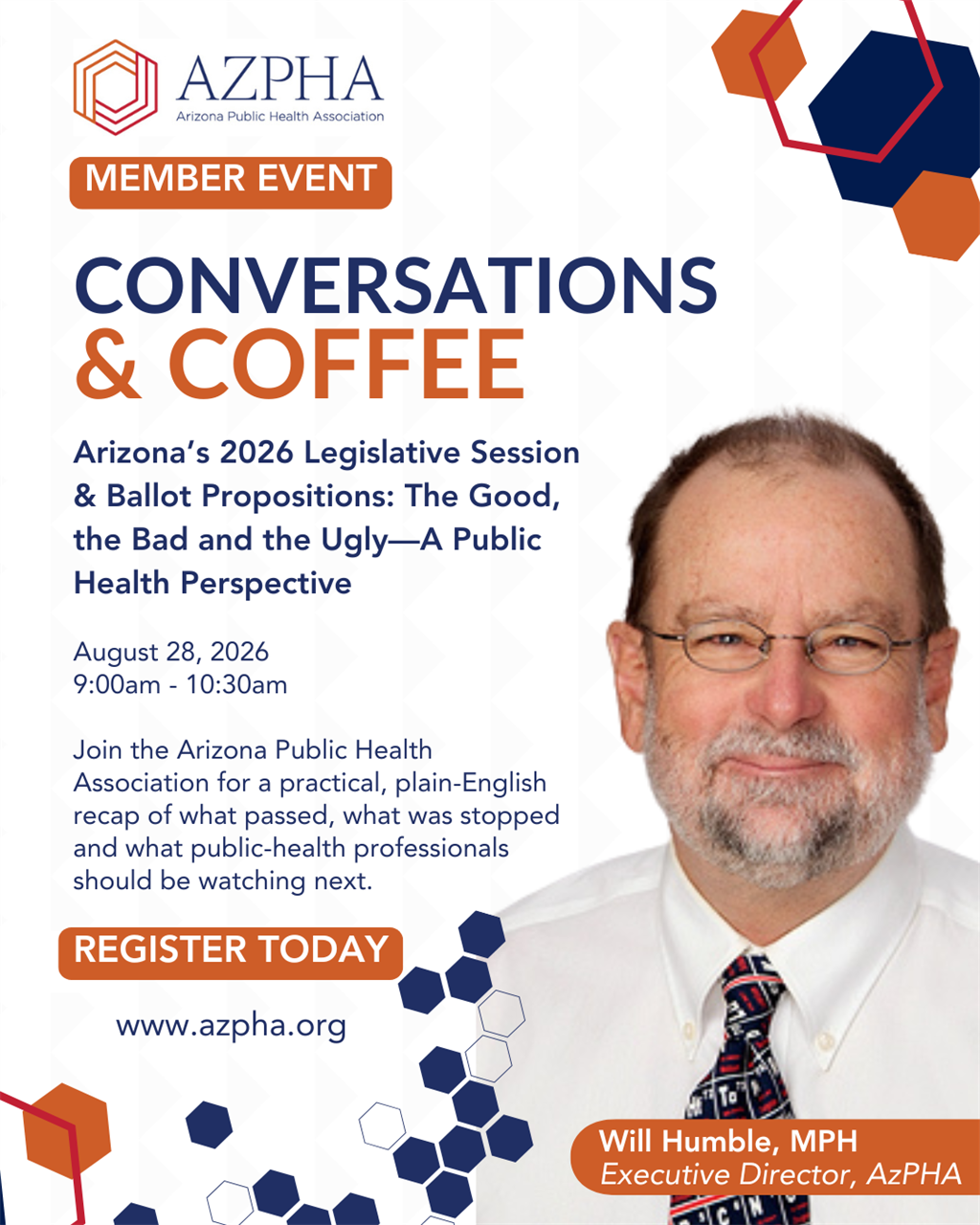
Arizona’s 2026 Legislative Session: A PublicHealth Perspective Friday, August 28, 2026

View the Webinar

AI Webinar Summary

Will led a comprehensive review of the 2026 legislative session from a public health perspective, covering both passed bills and vetoed measures that would have harmed public health.

The session included several significant public health wins, including improved licensing and oversight of skilled nursing and assisted living facilities through bills 2176, 1162, and 2195, as well as new requirements for county jails to screen for mental health needs at intake through bill 2673.

The governor successfully vetoed numerous bills that would have negatively impacted public health, including measures that would have prohibited vaccine incentives for providers, restricted business vaccine requirements, and required hospitals to ask about immigration status.

The budget included important funding wins of $21 million for eligibility staffing at Access and DES to prepare for HR1 implementation, along with $13 million to modernize the Healthy Arizona Plus computer system.

Will also reviewed upcoming ballot propositions, noting that only nine measures would appear on the ballot after several were removed by courts, and discussed AZPHA’s positions against Propositions 144 (securing elections) and 319 (banning photo enforcement cameras).

2026 Legislative Session Public Health

Will presented a summary of the 2026 legislative session from a public health perspective, highlighting both positive developments and areas of concern. Key public health wins included new licensing structures for skilled nursing and assisted living facilities, improved notice requirements and informal dispute resolution processes, better collaboration between AHCCCS and ADHS, and enhanced access to personnel records. Will also discussed a compromise bill allowing cameras in assisted living facilities with resident and family consent, noting that while watered down from previous versions, it represented progress in addressing family concerns about facility oversight.

Long-Term Care Monitoring Requirements

Will explained that a new bill requiring long-term care facilities to disclose whether they allow video monitoring in residents’ rooms will take effect in a few weeks, though he noted this is only a partial step forward and AARP has been pushing for more comprehensive monitoring requirements for years.

The discussion then shifted to a new bill (2673) requiring county jails to screen for mental health needs at intake, though Will expressed concern about the weak enforcement provisions in the bill. The conversation ended with Will mentioning that Maricopa County jail has experienced deaths from drug overdoses and suicide, though the specific numbers were not provided.

Mental Health Court Bills Discussion

Will discussed two bills related to mental health court-ordered treatment and judicial review, explaining that House Bill 2923 aims to streamline the process for families seeking court-ordered treatment while balancing treatment needs with civil liberties. Will noted that current processes are cumbersome and may require additional legal action to address compliance issues in Maricopa County.

Sharon Barnes from Arizona Mad Bombs clarified that Senate Bill 1113 allows for process serving of individuals in hospitals and facilities without involving police, which helps avoid trauma from law enforcement interactions and reduces costs.

Police Presence and Housing Reforms

Sharon and Will discussed the challenges of police presence in facilities serving populations with trauma from past law enforcement interactions. Will agreed to update a slide with more depth on this topic based on Sharon’s input.

Will also explained a small victory in public health housing, highlighting changes to Arizona’s Residential Landlord and Tenant Act that make it easier for tenants to document payment of eviction judgments and potentially seal records, though he noted this is just a step toward needed reforms to balance landlord-tenant rights.

Legislative Updates and Veto Status

Will presented updates on recently passed and vetoed bills, including a new requirement for state agency chief medical officers to maintain active MD or DO licenses, and a victory for breast cancer screening cost-sharing prohibition in commercial health plans.

He emphasized the importance of stakeholders providing feedback to the governor’s office regarding why certain bills should be vetoed, as this helps justify the vetoes of problematic legislation. Will also highlighted that the governor successfully vetoed a bill that would have prohibited health plans from offering financial incentives to providers for high vaccine participation rates.

Budget and Vetoed Bills Update

Will discussed several vetoed bills, including one that would have stopped businesses from requiring masks or vaccinations, which the governor vetoed. He highlighted key budget wins, including $21 million allocated for eligibility staffing at Access and DES to handle new Medicaid requirements from HR1, and $13 million for modernizing the Healthy Arizona Plus computer system.

Will also reviewed upcoming ballot propositions, noting that only nine measures would appear on the ballot after some were removed by courts, and explained that AZPHA opposed Prop 144 (which would restrict mail-in voting) and Prop 319 (which would ban photo enforcement cameras).


What Does It Take to Run the FDA: Is Overton Up to the Task?

The president has nominated Dr. Heidi Overton to be the next Commissioner of the FDA. She’ll be up for Senate confirmation at some point in the next few months presumably. Is she up to the task?

A good place to start is: What is the job, and how prepared to do a good job is she?

FDA is basically a regulatory agency. It oversees most foods moving in interstate commerce (including imports); prescription and over-the-counter drugs; vaccines; medical devices; tobacco products; cosmetics; and animal drugs and feed.

And it’s huge. FDA’s budget is $7B ($3.4B in appropriations and $3.6B in industry user fees. They have (or I should say had before DOGE) 18,200 FTEs, but after Kennedy implemented DOGE cuts, they only have 16,000 employees now.

So, the commissioner oversees roughly 16,000 employees, laboratories, inspectors and regulatory operations around food, drugs and animal products around the country and overseas.

FDA can’t wing the way it regulates foods and drugs. Their authority comes from statutes enacted by Congress (mostly the Federal Food, Drug, and Cosmetic Act and its amendments). Over decades FDA has adopted detailed regulations to guide their regulatory actions in Title 21 of the Code of Federal Regulations.

When FDA makes regulatory decisions or changes regulations, they’re supposed to follow federal administrative procedures (including notice-and-comment rulemaking) and they have to stay within their statutory and administrative boundaries. They have discretion, but they also have strict boundaries.

When people are adversely impacted by FDA decisions think FDA got it wrong, they’re not shy about suing FDA. Judges examine whether the agency stayed within its statutory authority, followed required procedures, applied their regulations properly and adequately explained its decision.

FDA decisions therefore have to survive not only scientific scrutiny but often judicial review because they’re a regulatory agency.

So… the FDA commissioner needs more than scientific credentials. The job requires leadership, administrative experience, discipline, and regulatory competence.

Oddly enough, Congress says nothing about the qualifications the FDA commissioner is supposed to have. 21 U.S.C. §393 says the commissioner is nominated by the president and confirmed by the Senate. There’s no required degree, scientific background, regulatory experience or management experience. That’s inadequate.

Arizona actually does somewhat better. ARS §36-102 requires the ADHS director to have administrative experience with progressively increasing responsibilities; an educational background preparing the director for the position’s administrative responsibilities; and health-related experience ensuring familiarity with health problems.

Those qualifications aren’t perfect, but at least they recognize the need for subject-matter knowledge and administrative experience.

Congress does spell out the FDA commissioner’s duties. The law says the commissioner provides “overall direction,” establishes and implements policies for FDA management and operations, and coordinates and oversees its administrative entities.

So how does Overton stack up?

Her medical and scientific background is good. She earned an M.D. from the University of New Mexico, trained in surgery at Johns Hopkins, earned a Ph.D. in Clinical Investigation from the Johns Hopkins Bloomberg School of Public Health and is board-certified in Public Health and General Preventive Medicine. Her peer-reviewed research includes work on opioid prescribing and improving physician practice using data.

She also has some policy experience. She served as a White House Fellow, became Chief Policy Officer at the America First Policy Institute and now serves as Deputy Director of the White House Domestic Policy Council.

She also served as a voting member of the University of New Mexico Board of Regents. The American College of Preventive Medicine notes that her specialty includes training in epidemiology, biostatistics and health-systems management.

The weak part of her résumé is large-scale operational management and a lack of regulatory experience. I can’t find any evidence that she has run a major agency, managed large numbers of employees or ran a complex regulatory organization.

There’s also a separate question about scientific independence. In a 2023 interview, Overton called for “conservative-based” scientific journals and alternative research infrastructure. She has also advocated restrictions on mifepristone from an explicitly anti-abortion policy perspective.

Overton appears to be scientifically qualified and has some policy experience. But (and this is really important for a huge regulatory agency) she really doesn’t have any executive and no regulatory experience.

There’s also a risk that her political viewpoints could override whatever past professional commitments she’s had to evidence-based decision making.

And for a regulatory agency as big and as important as the FDA… that’s a big question-mark. If she is rogue in the end, at least we still have checks and balances in the constitution and a fairly independent federal judiciary as a backstop.

Editorial Note: One reason I’m comforted a bit by the prospect of the public health damage an administrator Overton could do is the Supreme Court’s 2024 decision in Loper Bright Enterprises v. Raimondo, which overturned the 40-year-old Chevron deference doctrine.

Under Chevron, when a statute passed by Congress was in question, courts generally deferred to a federal agency’s reasonable interpretation of the law.

The Loper Bright case changed that. The Supreme Court held that under the Administrative Procedure Act, judges are supposed to independently assess what federal statutes mean rather than deferring to an agency’s interpretation.

I wasn’t enthusiastic about that ruling when it came out because it shifted authority away from subject-matter experts in federal agencies and toward judges.

But… there’s another side to it. If an ideologically driven FDA commissioner pursues an ideological agenda and makes inappropriate regulatory decisions federal courts now have way more authority to overturn federal agency decisions

Yet Another Giant APS Electricity Rate Hike & Return on Equity Boost? Really? 

Arizona Public Service (APS), the state’s largest (monopoly) electric utility, is asking the Arizona Corporation Commission (the five-member body that oversees monopoly utility rates) for a whopping 14% rate increase this year.

If you’re one of APS’s more than 1.4 million customers, you deserve to know a few things about their request that aren’t getting enough attention.

APS is a monopoly utility. If you live in its service territory, you don’t have any choice of which utility to get your power from—it’s the only one allowed to operate there.

The company knows this about its customers, which makes it especially important for the elected members of the Commission to scrutinize APS’ rate increase requests to make sure they’re really necessary. In recent years, they haven’t been doing that.

Let’s dig into some details. The Commission already rubber stamped an 8% rate increase that took effect in 2024. Now APS already wants another 14% rate increase?

And it’s not just rate increases that the Corporation Commission has been generous to APS with.

APS is already allowed a generous 9.55% return on equity — the return regulators allow the company to earn for its shareholders on the equity in its utility system.

Now APS wants the Commission to bump that up to 10.7%, on top of the 14% rate increase!

There’s compelling evidence that nothing close to a 14% increase is necessary to provide reliable service. Pinnacle West, APS’ parent company, had more than $616 million in net income in 2025.

CEO Ted Geisler received about $8.1 million in compensation that year. Former CEO Jeff Guldner received about $2.8 million. All that ultimately comes out of customers’ pockets.

Thankfully, Attorney General Kris Mayes has our back. She filed expert testimony showing that APS could maintain reliable service and a strong credit rating with an increase of about 3%—a far cry from the 14% we’re now told is needed.

The timing matters too. The Corporation Commission expects to decide this case by the end of December—after the November election but before newly elected Commissioners take office. In other words, the current Commission will decide whether APS gets its latest increase.

APS wants more than just higher rates and a higher return for shareholders. They’ve also been walking back their earlier clean-energy commitments.

In 2020, APS committed to providing 100% clean, carbon-free electricity by 2050.

It also set interim goals for 2030 and said it would end coal-fired generation by 2031. That would have set APS on a path to providing cleaner, more affordable energy for decades to come.

APS has since walked back those commitments and joined other Arizona utilities in backing a major new methane gas pipeline project to bring gas from West Texas to Arizona. When utilities make long-term investments in fossil fuel pipelines, supply contracts and power plants, they lock customers into those costs—and the resulting air pollution—for years to come.

The Corporation Commission is expected to vote on the request after the November 3 general election. Take time before then to tell the commissioners you’re not a piggy bank for companies that are already comfortably profitable.

You can find their contact information at www.azcc.gov.

And remember to research your vote for the Corporation Commission carefully this fall.

Your family budget is on the ballot!

See also in the Yuma Sun at: Guest Column: Yet another giant APS electricity rate hike? Really? | Humble Opinion | yumasun.com