Professional Development Opportunity – A Chance to Connect, Learn & Help Shape What Comes Next

Taking care of the public’s health depends on having a workforce that’s supported and able to thrive. But how often do health professionals get the chance to step back, compare experiences with colleagues, and talk about what would make their work healthier and more sustainable?

The Wellbeing Collaborative of Arizona is hosting a series of virtual Health Workforce Wellbeing Listening Sessions that offer just that opportunity. These guided conversations invite participants to share experiences, challenges, insights, and ideas about wellbeing in health organizations.

The sessions offer an opportunity for professional development through peer learning, reflection, and conversation. Participants will join small discussion groups with people from similar professional backgrounds, including public health professionals, nurses, and physicians.

Four sessions are available, each from noon to 12:50 p.m.:

  • Tuesday, October 20: General wellbeing topics and questions.
  • Thursday, November 5: General wellbeing topics and questions.
  • Tuesday, November 10: AI, Work & Wellbeing.
  • Wednesday, November 18: Exploring What’s Possible, Turning Insights into Action.

You can register for more than one session. The sessions will not be audio- or video-recorded. Insights will be de-identified and reported in aggregate, with no individual comments attributed to participants.

We encourage AzPHA members to bring their experiences and ideas to the conversation. It’s a chance to learn from colleagues while helping shape practical approaches to supporting Arizona’s health workforce.

Register here for the Health Workforce Wellbeing Listening Sessions

Good AHCCCS News RE Reproductive Health, Disability Services & Tribal Dental Care

Considering all my bummer recent posts about Medicaid eligibility restrictions and AHCCCS’ ability to administer those changes recently, I looked around this week for some good AHCCCS news. I found some.

Last week AHCCCS finalized changes to their administrative rules that’ll be good. The changes include:

  • Birth control: AHCCCS members can now get a one-year supply of oral contraceptives in a single pharmacy fill, rather than having to return repeatedly for refills.
  • Cochlear implants: The rules added cochlear implants to the list of authorized services for adults, expanding access to technology that can help people with significant hearing loss. Sadly, bone anchored hearing aids still aren’t covered.
  • Speech therapy: Outpatient speech therapy is now authorized when medically necessary, helping people with communication and swallowing problems (which can be dangerous).
  • Tribal dental care: The new rules recognize expanded adult dental coverage through IHS and tribal facilities.

You can review the final AHCCCS rulemaking here.

The contraceptive change is especially practical. Requiring women to return to the pharmacy every month or every few months creates unnecessary barriers, particularly for people with transportation problems, unpredictable work schedules or limited pharmacy access.

A year’s supply reduces those obstacles and can help prevent unintended pregnancies.

The disability-related changes are important too. Cochlear implants can substantially improve people’s ability to function independently, take part in their communities and support their health.

And better access to dental care through tribal healthcare facilities addresses a longstanding gap in adult Medicaid benefits.

Note: The 12-month contraceptive benefit was an initiative by the governor using her executive authority. The cochlear implant and speech therapy changes implement legislation passed in 2025. The tribal dental provisions reflect earlier statutory and federal policy decisions.

The US Needs More Doctors… but is it Ethical to Poach them from Developing Nations?

About 25% of U.S. physicians got their medical education abroad… and they’re providing an important public health service especially in rural and underserved areas.

Doctors educated abroad are more likely than U.S.-educated physicians to practice in communities with primary care shortages. Physicians working here through the H-1B visa program are also more likely to serve high-poverty communities.

But the Trump administration’s immigration policies are making these doctors harder and more expensive to recruit. The $100K fee on H-1B petitions imposed by Rubio and Mullen, now facing legal challenges, adds to those recruitment barriers.

In addition, Rubio has imposed travel restrictions affecting 39 countries and is even scrutinizing visa applicants’ Instagram & Facebook to stop certain visa applicants.

But there’s another public health question that I’ve been wrestling with: Is it ethical for us to solve our physician shortage by poaching doctors from countries that have even greater physician shortages?

Whose Shortage Are We Solving?

From a strictly US point of view, recruiting another physician can mean better care for patients and more efficient operation of medical facilities.

But public health ethics asks us to consider who benefits and who bears the cost.

When a physician leaves a country with scarce medical resources, the community they leave loses access to care. If public funds financed that doctor’s education, the country also loses the benefits of an investment in medical training.

Indeed, the WHO warns that poorly managed health worker migration is weakening health systems in the global south and widening inequities in countries already facing shortages.

In other words, our gain often comes at someone else’s expense.

Doctors Have Rights, Too

That doesn’t mean physicians should have to stay where they were born or trained. They have legitimate reasons to look for better pay, safer working conditions, professional opportunities or a more secure future for their families.

Nor does every foreign-trained physician’s arrival mean there’s a loss to an underserved community. Countries differ in their training capacity, employment opportunities and ability to keep clinicians (and some foreign medical graduates are legal US residents who studied overseas).

There’s an ethical distinction between a doctor independently seeking a job and a hospital system actively poaching from a country with an already inadequate workforce.

What Would a More Ethical Approach Look Like?

My view is that we should take greater responsibility for producing and keeping the healthcare workforce we need by expanding medical education and most especially residency opportunities, as well as supporting rural practice.

When we take the path of least resistance and actively recruit from developing nations, we’re not being ethical in my view. We’re being selfish.

I’m not 100% sure what the answers are. My purpose here is to highlight that it’s important for us to look at the full picture when it comes to recruiting physicians trained overseas. I don’t have a problem with recruiting from Australia, Canada, Western Europe etc.

But it strikes me as wrong when we actively recruit from places like India, Pakistan, Jordan, Lebanon and Nepal (the top 5 from developing countries).

On the other hand – making that distinction also looks like racial discrimination – which also bothers me.

Like I said – I don’t have the answer – but I also know it’s not a simple question. Like a lot of things in life – it’s a shade of gray.

Arizona’s Newest Copper Mine: Who’s Looking Out for Public Health & the Environment?

Copper is increasingly important as we try to electrify & transition away from fossil fuels. EV’s, solar panels, batteries and transmission lines use lots of copper so we’re going to need more of it to mitigate climate change.

That growing demand is driving up copper prices and whetting the appetite for mining companies eager to meet the increasing demand for Cu and to benefit from the rising price per kilo in copper-rich Arizona.

The latest effort is a mine called Florence Copper.  It’s a new mine that uses acid injection into the ground to get the copper rather than the open pit mine you might be most familiar with. They expect to produce approximately 38,500 metric tons of copper annually.

Florence Copper opens new mining operation in Arizona

At today’s copper price of $14 per kilo, that’s $570M worth of copper per year. Copper is likely to keep going up because of global electrification efforts (although that will also depend on how many new mines are developed globally).

Note: There are some weird things going on right now in the global copper market because of tariffs: Tariff threat built a US copper mountain, but the effects are fading.

Instead of excavating rock like in typical open pit mining Florence Copper uses in-situ copper recovery. They inject sulfuric acid solution underground into copper-bearing rocks. The acid reacts with copper oxide, dissolving the copper into an aqueous copper sulfate solution. Then they pump that to the surface for processing.

CuO + H₂SO₄ → CuSO₄(aq) + H₂O

The copper solution is processed using solvent extraction and electrowinning (electricity) to make the copper metal. The remaining solution is reinjected to dissolve more copper.

The company says they take out more acid solution than they inject and that makes a ‘cone of depression’ in the groundwater which keeps the acid from spreading underground in the groundwater (according to geologists and hydrologists).

But… injecting acid underground obviously raises an environmental health question: How (and who) makes sure the acid doesn’t contaminate groundwater?

Who Decides Whether Acid Injection Is Allowed?

Until recently, the EPA regulated these kinds of acid injection wells. Last October EPA transferred that regulatory authority to ADEQ. EPA approved Arizona’s regulatory program Az long as ADEQ follows the memorandum of agreement defining responsibilities.

Now it’s ADEQ who issues permits, conducts inspections and enforces injection requirements. EPA keeps federal oversight authority.

EPA originally approved Florence Copper’s commercial injection permit in 2023 (they began production in February of this year). ADEQ assumed responsibility and reissued the permit in January 2026.

What Arizona Laws Govern These Decisions?

ADEQ staff and (now confirmed) Director Karen Peters make the decisions about how they regulate this via state statutes & their administrative rules:

  • A.R.S. § 49-257.01: Establishes Arizona’s underground injection permitting program and prohibits injection that endangers underground drinking-water sources.
  • Arizona Administrative Code, Title 18, Chapter 9, Article 6: Sets technical requirements for injection wells, permits, monitoring and enforcement.
  • A.R.S. § 49-241: Aquifer Protection Permit requirements for covered facilities and discharges.
  • Arizona Administrative Code, Title 18, Chapter 9, Articles 1 and 2: Fleshes out aquifer protection permit (APP) requirements, including groundwater monitoring and permit conditions.

Who Makes Sure the Company Complies?

ADEQ is supposed to review compliance information and conduct inspections and can use enforcement authority when violations occur. They continue throughout operations and post-closure monitoring.

The company oversees following their permit requirements. ADEQ is responsible for enforcing them. The Governor is ultimately responsible for the actions of the ADEQ Director… and EPA is responsible for making sure ADEQ is doing a good job.

How effective the regulations are at protecting groundwater of course depends on how good a job ADEQ does. That depends on having enough qualified staff and good, ethical, and uncaptured agency leadership.

It also depends on whether the governor allows the agency to do their job or micromanages it, directing them to pull back on compliance and enforcement work as has happened in the past. And that – of course – directly relates to who ends up winning the Governor’s race this year.

Editorial Note: The real effectiveness of this regulatory system rests on whether ADEQ has the resources, expertise, staffing and leadership to make sure the company follows them during operations and after it closes.

As we saw during the Ducey Administration, Governors can intentionally starve agencies for needed operating revenue and place arbitrary ‘head count’ caps on them to make them intentionally weak and ineffective – a passive way of kowtowing to industry.

That’s why it’s important for people to vote for elected officials, including governors, who care about how well their agencies work.

The Midterms: From Election Integrity to Collective Power


Monday, Oct. 26 | 12-1 p.m. PT / 2-3 p.m. CT / 3-4 p.m. ET

Register now
The Nov. 3 midterm elections present immediate opportunity for the public health community to put its collective power into practice. But protecting election integrity takes more than knowing what’s on our ballots and making sure we’re registered to vote. We need to ensure that our communities can vote freely and fairly, that their votes are counted and that election results are upheld.

Recent efforts to restrict voting access have raised concerns about election integrity. Efforts to undermine elections are a well-documented threat to democracy, and they can include disrupting voting, creating chaos and sowing doubt, or trying to block certification when results don’t go a certain way.

Public health has a role to play before, during and after the election. We can make these tactics backfire through encouraging broad voter participation, proving and enforcing results and preparing ourselves for attempts to subvert the process.

Join Health in Partnership, the American Public Health Association, Protect Democracy, Health Begins, the National Public Health Coalition, Health Equity Community Collaborative and other partners for this free, one-hour webinar to learn what to expect, what’s at stake and how we can tak

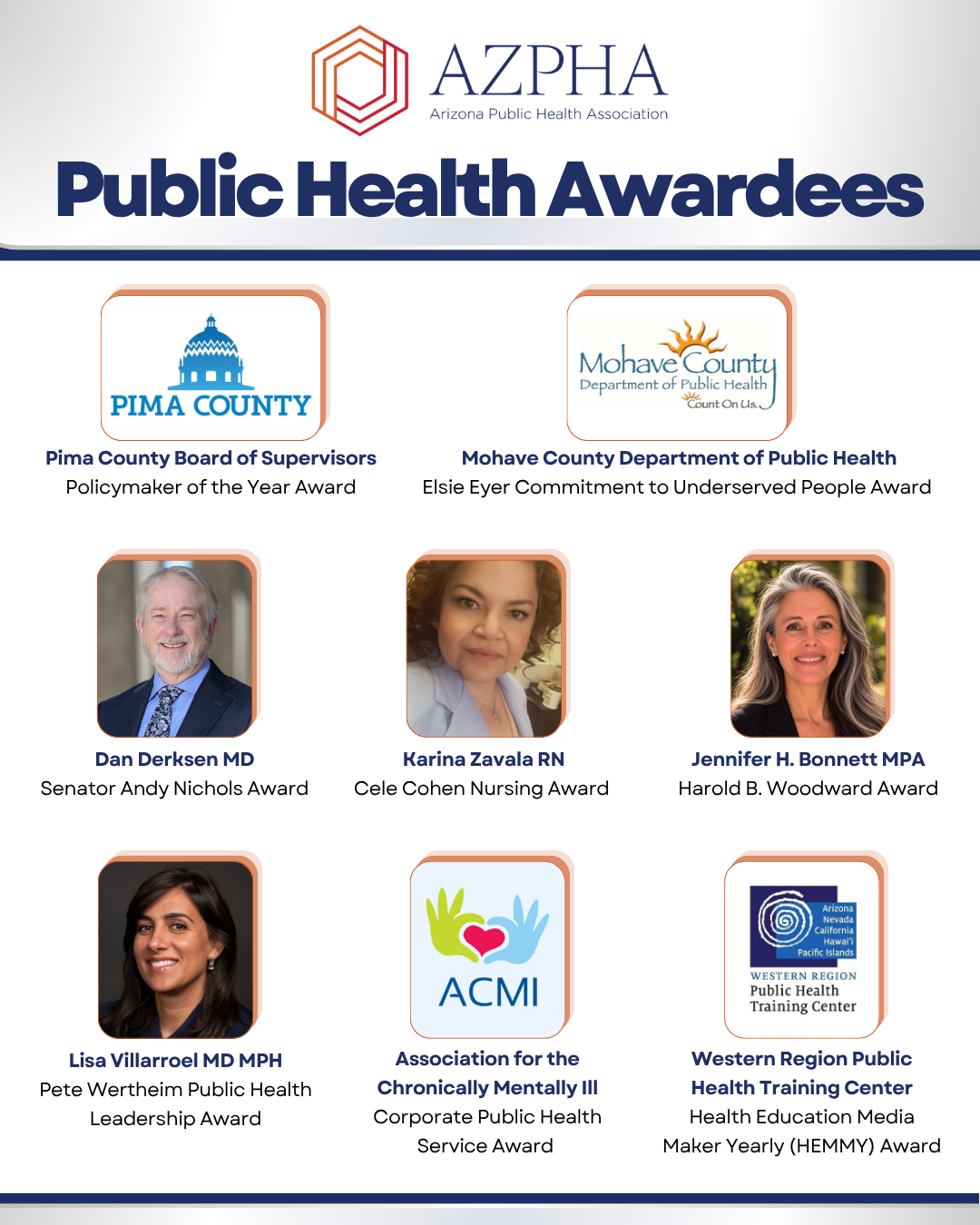
Registration Closing Soon: 2026 AzPHA Public Health Awards

We’re proud to announce that our 2026 award program will be held:

Thursday, October 29, 2026

5:30 – 8:30pm

Social Hall Tempe

715 S McClintock Dr, Tempe, AZ 85288

Each year AzPHA recognizes public health professionals, health professionals and community members across Arizona who are performing extraordinary services to our community at our annual awards event. Many of our awards go back decades.

Register Today: Only $45

Includes complimentary beer/wine, soft drinks & appetizers!

Thank You to Our Sponsors

Event Venue Sponsor

Appetizer Sponsor

Holly Gieszl and Dr. Scott Gieszl

AzPHA Partner Sponsors


Join us in celebrating our 2026 Awardees!

Stories for Health: An Evening of Learning & Connection for AzPHA Members

Health policy becomes more meaningful when we hear from the people it affects. For public health professionals, those stories can help us ask better questions, communicate more clearly and strengthen our advocacy.

AzPHA members have an opportunity to bring those perspectives together at Arizona Talks: Stories for Health on Monday, October 26, 2026, from 6–8 p.m. at Grand Canyon University, 3300 West Camelback Road, Phoenix.

Hosted by Arizona Talks with Blue Cross Blue Shield of Arizona and Grand Canyon University, the evening will combine personal experiences with a discussion of Arizona’s health care system and opportunities to improve outcomes.

It’s a chance to deepen your understanding of health policy, hear community perspectives and connect with people working across health care and advocacy. Bring your questions and your own experience.

I’ll be taking part alongside Heather Carter, Shannon Clancy, Lorenzo Sierra, Matt Jewett, Brenda Cardenas and Dan Derksen.

Doors open at 6 p.m., with time to connect before the program begins at 6:30 p.m. Personal stories will be followed by a health policy panel at 6:50 p.m. and audience questions at 7:30 p.m. The evening concludes at 8 p.m.

How to register: Visit the Stories for Health event and registration page. In the Event Registration section, enter your first name, last name and email address, select your ticket quantity, then choose Continue to Payment to complete registration.

The listed general admission price is $10. Arizona Talks members attend free, and students can use AZSTUDENT in the promo-code field and click Apply. 

Professional Development Opportunity Stories for Health: An Evening of Learning & Connection for AzPHA Members

Health policy becomes more meaningful when we hear from the people it affects. For public health professionals, those stories can help us ask better questions, communicate more clearly and strengthen our advocacy.

AzPHA members have an opportunity to bring those perspectives together at Arizona Talks: Stories for Health on Monday, October 26, 2026, from 6–8 p.m. at Grand Canyon University, 3300 West Camelback Road, Phoenix.

Hosted by Arizona Talks with Blue Cross Blue Shield of Arizona and Grand Canyon University, the evening will combine personal experiences with a discussion of Arizona’s health care system and opportunities to improve outcomes.

It’s a chance to deepen your understanding of health policy, hear community perspectives and connect with people working across health care and advocacy. Bring your questions and your own experience.

I’ll be taking part alongside Heather Carter, Shannon Clancy, Lorenzo Sierra, Matt Jewett, Brenda Cardenas and Dan Derksen.

Doors open at 6 p.m., with time to connect before the program begins at 6:30 p.m. Personal stories will be followed by a health policy panel at 6:50 p.m. and audience questions at 7:30 p.m. The evening concludes at 8 p.m.

How to register: Visit the Stories for Health event and registration page. In the Event Registration section, enter your first name, last name and email address, select your ticket quantity, then choose Continue to Payment to complete registration.

The listed general admission price is $10. Arizona Talks members attend free, and students can use AZSTUDENT in the promo-code field and click Apply. 

New York’s Measles Emergency Order: What Does the Emergency Declaration Actually Do?

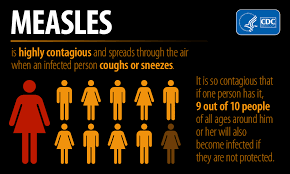
New York Governor Hochul declared a statewide measles disaster emergency on October 5 after NY state documented at least 108 cases of measles this year (it’s probably a lot more than that though).

Most recent cases have been in under-immunized rural upstate NY. Her declaration runs through November 4 unless extended.

But what does declaring an emergency actually do?

EO No. 65: Declaring a Disaster Emergency in the State of New York Due to an Ongoing Measles Outbreak essentially temporarily expands the scope of practice for a host of health professionals so they can vaccinate people more quickly.

It also lets state agencies buy supplies and services faster (easing their procurement policies). Her goal seems like an attempt to get ‘all-hands-on-deck’ by helping county health departments reach unvaccinated and under-vaccinated people much faster.

New York’s Executive Order 65 makes several specific changes:

  • Pharmacists can vaccinate younger kids. They can administer the measles, mumps and rubella vaccine to kids age 2 and older under standing orders (relieving pediatric office bottlenecking).
  • Paramedics can give MMR vaccines at community clinics and other non-emergency locations.
  • Midwives can vaccinate a broader population, beyond their usual patients (under specified supervision and conditions).
  • Registered nurses can order measles testing. Standing orders expand RN’s scope so they can collect throat, nasal, urine and blood specimens without getting a separate order for each patient.
  • State agencies can use faster emergency procurement and contracting to obtain supplies, equipment and services that support the response.

These changes give counties more people to staff vaccination clinics and help families find vaccination closer to home. They also remove regulatory barriers that otherwise slow down testing.

Faster testing will give county health departments earlier warning about where measles is spreading so they can find exposed people, check immunity and vaccinate while there’s still time to prevent illness.

NY county health departments were already investigating cases, tracing contacts and offering vaccines before the declaration. But under the new Order they can expand the workforce and speeds up their response

They can also use pharmacists, paramedics and midwives as a temporary surge workforce to vaccinate (and a surge workforce using RN’s to collect specimens etc.)

People born before 1957 generally had measles as children and are presumed immune.

Adults vaccinated before the two-dose recommendation began in 1989 (people currently between 37 and 66 years old now) may have received only one dose. One is still sufficient for most adults, but a second is recommended for healthcare workers, international travelers and college students.

People younger than 37 likely to have received the two-dose childhood series and don’t need a booster.

Editorial Note: In my view, New York’s approach is precisely how public health emergency authorities should be used: temporarily remove barriers, expand the workforce and give county health departments more tools to protect people.

Arizona experienced a misuse of public health emergency authority during the pandemic. Governor Ducey and health director Christ initially blocked local mask requirements and used their emergency authority to prohibit state and local governments from requiring proof of COVID-19 vaccination for entry or services.

Their executive orders called vaccination records “vaccine passports” giving an ordinary public health tool a politically loaded label. In my view, those restrictions and many others in which Ducey and Christ preempted local government, schools, and even businesses from taking reasonable response measures.

That undermined the response by taking protective options away from local officials and ended up harming, not helping the response. They grossly misused Arizona’s public health emergency authority.

SW Gas Wants You to Pay Higher Rates: But Growth Should Pay Its Own Way

We’ve been making the case that data centers should pay the full cost of the power infrastructure they require, rather than shifting those expenses onto regular residential customers like what is happening now.

Analysis: APS customers paid $587 million for data center sector growth. APS denies claim. 12News

Southwest Gas’s latest rate request raises a related question: Should existing customers pay to extend gas infrastructure to serve new development?

Our answer is the same: Growth should pay its own way.

Southwest Gas is asking the Arizona Corporation Commission for approximately $101 million in additional annual revenue. The company estimates its proposal would increase the average residential customer’s bill by a whopping 10.69%, following its most recent Arizona rate adjustment in March 2025.

Why This Is a Public Health Issue

Affordable energy helps families maintain safe homes, prepare meals, and meet basic needs. When utility bills rise, less money remains for food, housing, prescriptions, and healthcare.

Families may delay medical appointments, put off filling prescriptions, or cut back on nutritious food. Financial strain also creates stress and can threaten housing stability.

These pressures fall hardest on people with low incomes, older adults on fixed incomes, and people with disabilities or chronic illnesses. The Commission should consider the combined burden of gas, electricity, water, and other essential expenses—not just each proposed increase separately.

Who Benefits? Who Pays?

Safe and reliable utility service requires investment. But spending money doesn’t automatically establish that existing customers should pay.

The Commission should distinguish necessary maintenance and safety improvements from infrastructure built to serve new development. Developers should cover the full incremental cost of extending gas service to their projects.

The same principle applies to data centers. If a giant new customer requires more generating capacity, substations, or transmission lines, that customer should pay the costs it creates. Residential customers shouldn’t subsidize infrastructure built primarily to help someone else.

Whether we’re talking about gas pipelines or electricity generation, regulators need to ask: Who needs this investment, who benefits, and who should pay?

Preserve Public Oversight

Southwest Gas also proposes an annual rate-adjustment mechanism to recover changes in its cost of service. We’re concerned that these “formula rates” would weaken the scrutiny and meaningful public participation a full rate case provides.

Customers deserve opportunities to question spending and explain how increases affect their lives. Their household budgets deserve as much attention as the utility’s financial needs.

AzPHA is urging the Commission to deny this request, reject formula rates, and require developers to pay their own infrastructure costs.

You can send a public comment to the Arizona Corporation Commission. Reference Southwest Gas Docket G-01551A-26-0018.

See the letter that we sent to the Corporation Commission docket for this case: SW-Gas-Rate-Case-Comments-October-2026.pdf